

By SUZANNE DOWNING
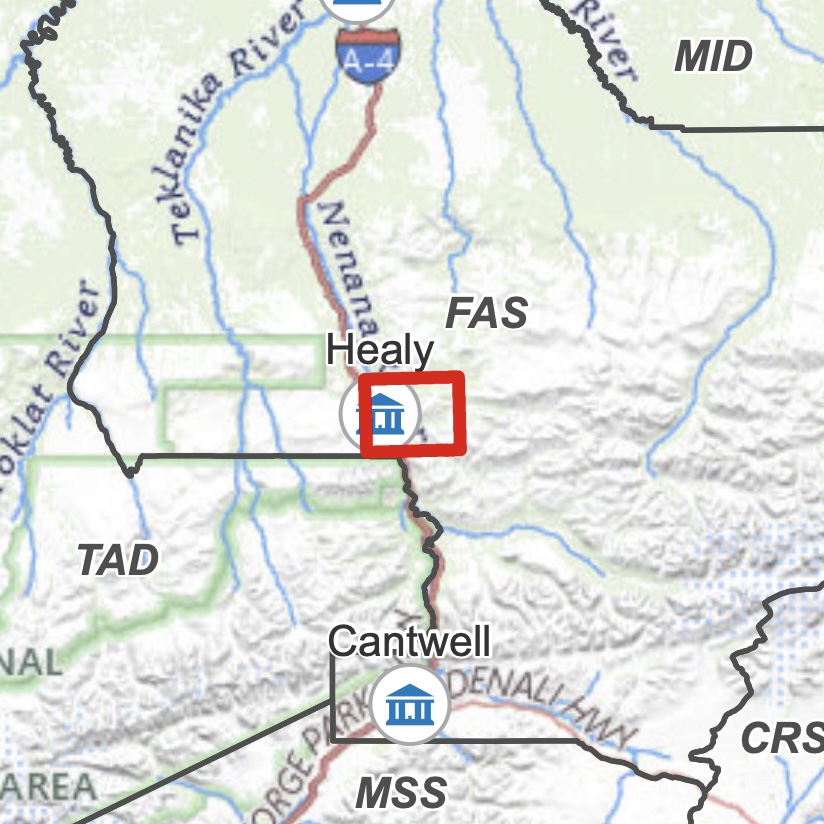
A small wildfire burning near Healy on Wednesday evening served as a reminder of one of Interior Alaska’s most unusual and persistent natural hazards: underground coal seam fires.
The Gagnon Coal Seam Fire (#206) was reported at approximately 7:30 pm on Wednesday east of the Usibelli Coal Mine along Healy Spur Road. According to the Alaska Division of Forestry & Fire Protection, the fire was estimated at only about three acres and was burning primarily in grass, with roughly half of its perimeter actively involved when firefighters arrived.
Crews from the Alaska Division of Forestry & Fire Protection, Tri-Valley Volunteer Fire Department, and Anderson Fire Department responded with a five-person Initial Attack squad, a helicopter, and an engine. Light rain aided suppression efforts, and officials reported no threat to structures and no evacuations.
Forestry officials issued what they described as a final update shortly after the response, indicating the fire was quickly brought under control.
While small, the fire draws attention to a phenomenon familiar to residents of the Healy area but largely unknown elsewhere: coal seam fires.
Unlike typical wildfires that consume grass, brush, or timber, a coal seam fire burns within a layer of coal beneath the ground. Once ignited, these fires can smolder for years, decades, or even centuries because the fuel source is effectively built into the earth itself.
The Healy region sits atop extensive coal deposits, including those mined by Usibelli Coal Mine.
Coal seam fires can start in several ways. Some are triggered by lightning strikes or wildfires reaching exposed coal. Others result from human activity. In some cases, the coal ignites through a process known as spontaneous combustion, in which slow oxidation generates heat until the material eventually catches fire.
Once burning, oxygen enters through cracks and fissures in the ground, allowing the fire to continue underground while producing heat, smoke, and gases that may emerge through vents at the surface.
The Healy area experiences coal seam fires with enough regularity that firefighters often view them as a sign that wildfire season has arrived.
Over the years, numerous coal seam fires have been recorded around Healy, including the Louise Creek fires in 2013 and 2018, French Gulch, and the Popovich Creek Fire, which burned more than 1,000 acres in 2024. In some seasons, multiple coal seam fires burn simultaneously in the area, occasionally merging with larger surface wildfires.
Surface signs can include smoke venting from the ground, unusually warm soil, scorched vegetation, and isolated patches of flame. In some locations, the ground may become unstable as the coal burns away beneath the surface, creating voids that can eventually collapse.
Coal seam fires are not unique to Alaska. Perhaps the most famous example in the United States is the fire beneath Centralia, Pennsylvania, which began in 1962 and still burns today. The underground fire eventually forced most residents to abandon the town.
Around the world, coal seam fires have been documented in Australia, China, India, Russia, and throughout coal-producing regions of the American West. Some are believed to have burned continuously for thousands of years.
Extinguishing them can be extraordinarily difficult. Traditional wildfire suppression techniques often prove ineffective because the fire may continue smoldering far below the surface. In some cases, crews excavate burning coal, inject inert gases or foam into underground voids, or construct barriers to isolate the fire. Many are simply monitored because the cost and complexity of complete extinguishment can be prohibitive.
Although the Gagnon Coal Seam Fire was small and quickly controlled, it serves as another reminder that in Alaska’s coal country, fire season sometimes starts underground long before flames become visible on the surface.