


By THE ALASKA STORY
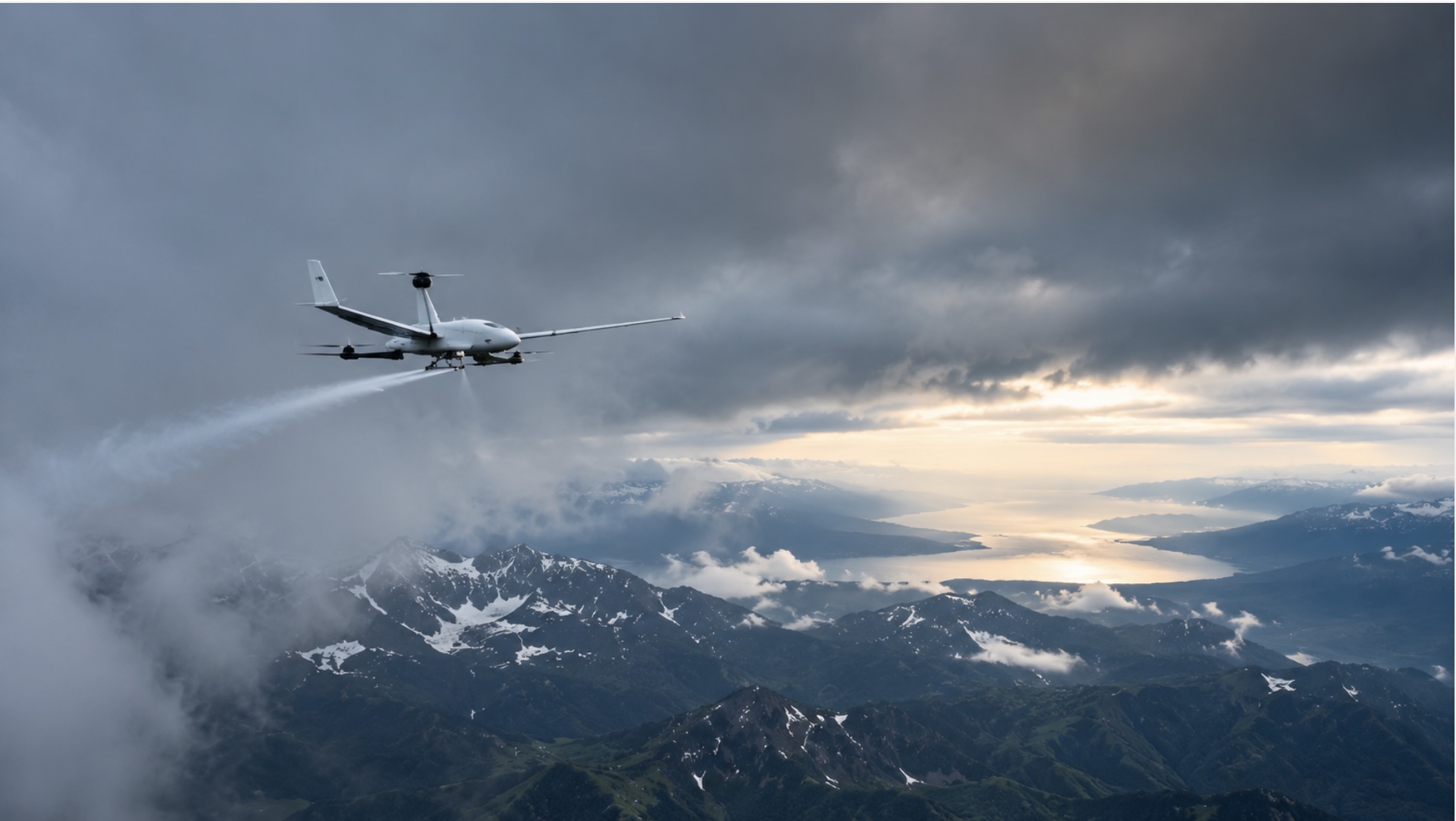
Aug. 25, 2026 – A California weather-technology company says seven cloud-seeding missions flown over the Kenai Peninsula last weekend produced an estimated 19 million gallons of additional precipitation in roughly three hours.
Rainmaker Technology Corporation, an El Segundo-based company founded by Augustus Doricko, released a detailed report Monday describing drone operations conducted Aug. 22–23. The company characterized the Alaska flights as research and development intended to test and validate its drone-based cloud-seeding system.
According to the company’s self-published validation report, two “Elijah” drones identified as EL-151 and EL-153 flew seven coordinated missions as a low-pressure system strengthened over the Gulf of Alaska.
The drones released 19 silver iodide flares containing a combined 374 grams — less than one pound — of material. Silver iodide, commonly abbreviated AgI, has a crystalline structure similar to ice and is used to encourage the formation of ice crystals inside clouds containing supercooled water.
Rainmaker said the flights were conducted at elevations ranging from approximately 11,700 feet to 14,000 feet above sea level. Temperatures at the release altitudes ranged from approximately minus 5 degrees Celsius to minus 15 degrees Celsius, which the company said was suitable for activating the silver iodide.
Surface temperatures were warm enough that precipitation fell as rain in the valleys and snow over higher terrain.
Rainmaker said it identified seven separate “seeding signatures” using data from the PAHG NEXRAD radar serving the Anchorage and Kenai Peninsula region. Each radar signature appeared after one of the seven missions and moved downwind in a manner that the company said was consistent with the growth and descent of seeded ice particles.
The signatures appeared between approximately 17 and 40 minutes after the flares were released and, in some cases, remained visible on radar for more than an hour.
Using a 27-model quantitative precipitation estimate, Rainmaker calculated that its operations generated a mean of 57.6 acre-feet of additional precipitation, equivalent to about 18.8 million gallons. Its middle range of estimates was approximately 45.7 to 64.8 acre-feet, while the broader range extended from about 41.7 to 89.4 acre-feet.
The area receiving at least a trace of precipitation attributed to the seeding covered approximately 96 square miles, according to the company. Rainmaker estimated that the center of the affected area received more than one millimeter of additional precipitation.
Those figures are Rainmaker’s estimates, not measurements independently verified by an Alaska or federal agency.
The company acknowledged that some natural precipitation was already falling during the experiment and that atmospheric conditions were favorable but not ideal. The clouds contained both natural ice and intermittent pockets of supercooled liquid water, making it more difficult to separate naturally occurring precipitation from precipitation caused by seeding.
To account for the background precipitation, Rainmaker subtracted a baseline radar-reflectivity value before calculating the estimated additional water. The company also acknowledged uncertainty involving radar calibration, the placement of the manually drawn boundaries around the signatures and what happened to the precipitation as it fell below the radar’s lowest beam.
Rainmaker’s analysis is modeled on research from the 2017 Seeded and Natural Orographic Wintertime Clouds: The Idaho Experiment, known as SNOWIE. That National Science Foundation-supported project used aircraft, radar and ground instruments to identify and quantify snowfall attributable to cloud seeding.
A peer-reviewed study published in 2020 concluded that researchers had isolated radar-observable snowfall generated by cloud seeding during three Idaho events. That research was considered an important advance because earlier cloud-seeding studies often depended largely on statistical comparisons between seeded and unseeded storms.
Rainmaker applied a similar radar-based approach in Alaska, but its Kenai findings have not yet undergone peer review or independent third-party validation.
Cloud seeding does not create storms or manufacture clouds from clear skies. It attempts to extract additional precipitation from clouds that already contain the necessary moisture and temperature conditions. The results depend heavily upon the type of cloud, its temperature, the amount of supercooled water available and local wind patterns.
The technology has been used for decades in western states seeking to increase mountain snowpack and water supplies. Scientific studies generally indicate that glaciogenic cloud seeding can enhance precipitation when conditions are suitable, although calculating an exact increase from an individual operation remains difficult because no two natural storms are identical.
Rainmaker says it has been conducting flight testing and validation work in the Kenai Peninsula area since June. The company describes the Alaska operation as research rather than a commercial precipitation-enhancement program and says it operates with the applicable federal authorizations and aviation waivers.
Federal law requires weather-modification activities to be reported to the National Oceanic and Atmospheric Administration, although NOAA says it does not conduct, fund or oversee cloud-seeding programs. Aviation approval and other requirements may also apply when drones are operated at high altitudes or beyond the pilot’s direct line of sight.
Rainmaker said the Alaska flights represent a proof of concept and that it intends to continue refining its cloud-seeding platform during the coming winter.
The claim that the drones added approximately 19 million gallons of water over the Kenai Peninsula rests on Rainmaker’s own flight records and interpretation of publicly available radar data. The underlying cloud-seeding process is scientifically established, but the precise amount of precipitation attributed to this particular Alaska operation has not been independently confirmed.


21 thoughts on “California company says cloud-seeding drones produced 19 million gallons of precipitation over Kenai Peninsula”
Now that doesn’t seem sensible. A California company producing rain in Alaska? That’s about as silly as importing LNG into Alaska. Isn’t the challenge to produce rain in California?
A guess: They’re possibly testing it here because complying with the regulatory red-tape in Cali is probably too burdensome to justify for merely testing unproven cloudseeding tech.
Seriously? Our weather forecast has been fairly accurate, 10 days out, all summer.
But I’d like an address to send a bill for the lack of summer tanning time, the extra growth of lawn which required more attention mowing and the psychological suffering I experienced for all the time I sat through grandchildren’s baseball and softball games in the damn rain, depriving me of the sunshine for which I deserve reparations.
We can’t build a two-track to Cold Bay, but California Chemtrail Company can spray toxic silver iodide over our salmon streams during spawning season. Likely, with minimal permitting, oversight and EIS .
Meanwhile, it’s more difficult to obtain an Anchorage Storm Water Treatment plan, so I can park a couple trucks than said company producing 19 billion gallons of extra storm water.
I would like to know who gave permission to spray silver iodide into our atmosphere, and why are we just now finding out about it… Plus.. Who is actually funding this, and…why ?
People and animals live here.
stop experimenting over our heads.
Don’t come back during winter, we don’t need more snow.
who the heck allowed a California company to do such experiments without our consent! WTF is this garbage nonsense!?!?
No thanks! Keep your CA rain out of Alaska!!! Why is this ok?!?!?
If they plan on continuing with this through the winter, how will that much water affect our snow? I think our state needs to step up and let us know that this is happening here. They had to have given permission for this. Personally I don’t care to be outside while it’s going on and how will whatever is in it affect our berries that we are about to pick? This is wrong imo
Why would they want to “screw” our weather.. This year, we were just beginning to enjoy our DRYER weather..The last 2 years, I felt like we’re swimming.. I wished they’d just leave our weather alone..so we can enjoy it more especially in the summer.. Besides all this spraying of chemicals ruins our fishing..
Who gave them permission to? Which part of government over sees this.
“The drones released 19 silver iodide flares containing a combined 374 grams — less than one pound — of material.”
“The area receiving at least a trace of precipitation attributed to the seeding covered approximately 96 square miles”
Perspective is a powerful tool, less than a pound over almost 100 square miles.
Kinda crazy if less than a pound could cause even a 10th of the 19 million gallons claimed, hard to believe really.
Good Morning Susanne
WOW.!!!! WOW
THKS !!!
Goodday
Rusky Rednecks
Nobody is making rain out of thin air. That is not how this works and it never has been.
The moisture has to already be up there, and the conditions have to be right. Temperature, cloud type, wind, all of it. If the cloud is not carrying water, no amount of silver iodide does a thing. What seeding does is give that water something to freeze onto so it falls out here instead of a few miles downwind. It is more about location than creation.
This is old science. A GE researcher named Vincent Schaefer dropped dry ice into a cold cloud in 1946 and made it snow. Bernard Vonnegut found silver iodide worked the same way that year. By 1963 airports were using it to clear cold fog off the runways, first at Salt Lake City and Medford, Oregon. Better than eighty percent success. The Air Force ran it at Elmendorf through the late sixties and seventies. That was fog, not rain, so it is not the same job as the Kenai flights. Same chemical, different use. But it means Alaska has been living with this stuff for sixty years.
We do versions of this already. Ski areas make snow. Farmers move water through ditches. We route runoff through storm drains. Nobody panicked. And we still do not control wind or sun, which drive far more of our weather than a couple of drones over the Kenai ever will.
Worth remembering what this actually was. Eighty years in, nobody was testing whether seeding works. They were testing whether their drones could deliver it. That is a delivery experiment, not a weather experiment.
I am not saying I am for this. I am saying the fear is running out ahead of the facts, and that is not how we get to a good answer. The effect here was small. We still need to know who authorized it and under what law. Both of those are true at the same time.
Typically, conservatives that comment here would never follow your solid advice: “ I am saying the fear is running out ahead of the facts, and that is not how we get to a good answer.”
Call the Governor’s office and demand answers. Do not let up. And spare me the “fear is getting to you” garbage. I’m not a lab rat.
What are you concerned about?
Just what we needed! NOT!
Learn more about the lies and deception at Geoengiineeringwatch dot org
No. No and No. Stop it! Completely insane.
Question: did seeding the clouds deplete them of moisture that otherwise would have been dispersed in another part of Alaska. What if those clouds were headed to an area with super dry conditions (like Tok), loaded with moisture but were depleted in a different part of Alaska? Did the cloud seeding prevent nature from assisting in putting out a wildfire? Have you noticed certain areas in the lower 48 are having more & more wild fire problems? Is this cloud seeding preventing nature from giving moisture to drought land? Can this company & other companies performing this operation culpable for damages?
JUST A QUESTION?
Rain making, weather modification and chemtrails – more “conspiracies” that are being validated daily. The CIA funded fact checker, SNOPES, loved to ridicule as false all of these technologies!