



By THE ALASKA STORY
Glenfarne is taking another major step toward turning the long-discussed Alaska LNG Project into an active construction effort.
The Houston-based energy developer, through its subsidiary Glenfarne Alaska LNG, LLC, has filed with the US Federal Energy Regulatory Commission seeking authorization to begin “early works” on the project’s natural gas pipeline component.
The filing, reported first Feb. 9 by LNG Prime, signals that Glenfarne is preparing to move Phase One of the project into on-the-ground execution as soon as this spring.
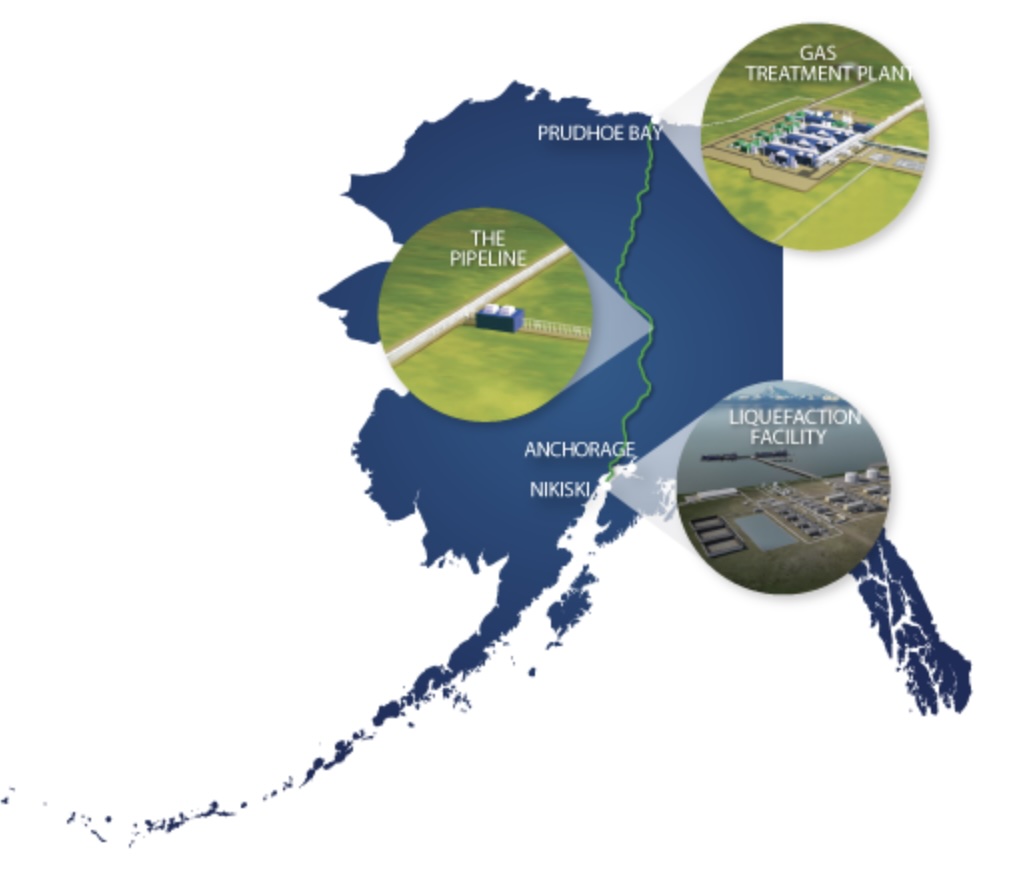
The Alaska LNG Project is designed as an integrated system to transport natural gas from Alaska’s North Slope to Southcentral Alaska and eventually to global export markets.
Glenfarne is the majority owner and lead developer through 8 Star Alaska, LLC, a partnership in which the State of Alaska retains a minority interest through the Alaska Gasline Development Corporation.
The project already holds key federal authorizations, including an original FERC approval granted in 2020. Additional permitting work has continued through late 2025 under the federal FAST-41 infrastructure permitting process.
Now, Glenfarne is seeking permission to begin early construction preparation along the pipeline corridor.
The early works request applies specifically to Phase One of Alaska LNG, which focuses first on delivering affordable natural gas for Alaskans before advancing to full liquefied natural gas export development.
Phase One centers on a large-diameter pipeline, roughly 739 miles long in this stage of planning, running from the North Slope to Southcentral Alaska, terminating near Nikiski. Phase Two would later add the liquefaction facility needed for LNG exports.
Glenfarne has structured the project into two financially separate phases in an effort to accelerate progress and ensure Alaska domestic supply comes first.
According to reports, Glenfarne’s filing includes a 119-page implementation plan outlining the types of preparatory work it hopes to begin once authorized.
The early construction activities would include:
-
Approximately 20 construction camps
-
Around 46 pipe storage sites
-
Roughly 100 construction pads and staging areas
-
Initial site access and logistical preparation
The company’s goal is to position the project for rapid mobilization once full construction approval is in place.
The proposed schedule described in the filing targets a fast-moving start:
-
Early works beginning as soon as mid-April 2026
-
Full mobilization expected in June 2026
-
Major pipe installation targeted for November 2026
-
Mechanical completion projected for 2028
-
First in-state gas deliveries anticipated in 2029
While those dates remain dependent on regulatory approvals and financing milestones, they represent one of the most detailed construction timelines yet attached to the project.
The FERC filing follows Glenfarne’s Jan. 23 announcement of several major Phase One developments, including conditional construction awards to pipeline firms such as MasTec, Quanta Services, Michels Pipeline, and VINCI Construction.
The company has also moved forward with line pipe supply agreements, including with POSCO International, and selected Worley Limited for engineering, procurement, and construction management services.
In addition, Glenfarne has reported in-state gas supply and offtake arrangements, along with preliminary LNG export interest abroad.
Reports indicate the project has secured heads of agreement for roughly 11 million tons per annum in potential LNG sales to buyers in Japan, South Korea, Taiwan, and Thailand, commitments that would become more relevant under Phase Two.
No final decision from FERC has yet been announced regarding the early works request, as current coverage focuses on the application itself. Still, the filing represents one of the clearest signs yet that Alaska LNG’s pipeline component is moving from planning into the earliest stages of execution.



10 thoughts on “Breaking: Glenfarne seeks approval from FERC for early start on Alaska LNG”
TBH, I am still waiting to see if this project becomes real. We have had decades of studies and MOUs and named “partners” and press releases and blah-blah-blah. Wake me when someone delivers materials for cash or turns some dirt. Fifty years of hype is enough.
Words are cheap. Steel is expensive.
Sure seems like they are getting closer to the expensive part…
I hope it happens, but as a realist/engineer/energy investor I doubt they will find the money. This is the least economic LNG project on the planet. And paying off a big bore pipeline without an LNG plant attached at the south end will result in astronomical energy rates for Alaskans.
And the Glenfarne hype is all just a little cloying, as is the Alaskan dream of a return to the pipeline boom days.
And the anti-civilization, anti-human naysaying of radical leftist extremists is as predictable as the sunrise.
Go into ferc.gov and file your comments. You would be surprised what ism in there. FERC evaluates on the comments that are tagged with the request. Have fun! Glenfarn is a loser company. Crime Boss Dunleavy goes for losers. Glenfarn starts at the rear of a project and tries to move forward. They have problems in management.
Is there a total cost of the pipeline project and who will be writing the checks?? Just a few details.
I have not seen any recent discussion of who is going to build the gas conditioning plant on the NS that will be required to send gas down the pipe?
This is the latest encouraging step. Having Exxon and Hilcorp publicly on board is a much larger step. However, the deadline of the November mid-term election becomes nearer every day. Construction must be well under way by then should either part of Congress flop over to the other party.
Even though there have been at least 3 gas line groundbreakings over the decades, all of them associated with election years, having two of the 3 owners of North Slope natural gas commit to sell gas into this project sets this latest effort apart from the six or seven previous efforts (for which the state has spent between $3 billion and $5 billion in 2026 dollars). If this one fails it will likely end the concept for 50 or more years so long as Alaska remains part of the US. Failure this time would ensure that government and health care continue to grow in our economy as the population ages, and young people who want to work somewhere not in government or health care will continue to leave. The good news is we will likely know which it’s going to be no later than November.
May we cut to the chase …how much will home-heating bills increase, if a supply conflict arises, which buyers get priority, will product be sold to Communist China, ?
.
What assures that pipeline-control gear will be CISA vetted?
(https://www.cisa.gov/)
.
What assures that Alaskans and the Permanent Fund won’t be on the hook for contractor fraud?
(https://ptop.substack.com/p/guide-to-uncovering-contractor-fraud?)