


By THE ALASKA STORY
June 26, 2026 – Alaskans who enjoy watching the night sky may want to mark June 27 on the calendar, when a mountain-sized asteroid will make its closest approach to Earth in more than 400 years.
The good news: There is no danger.
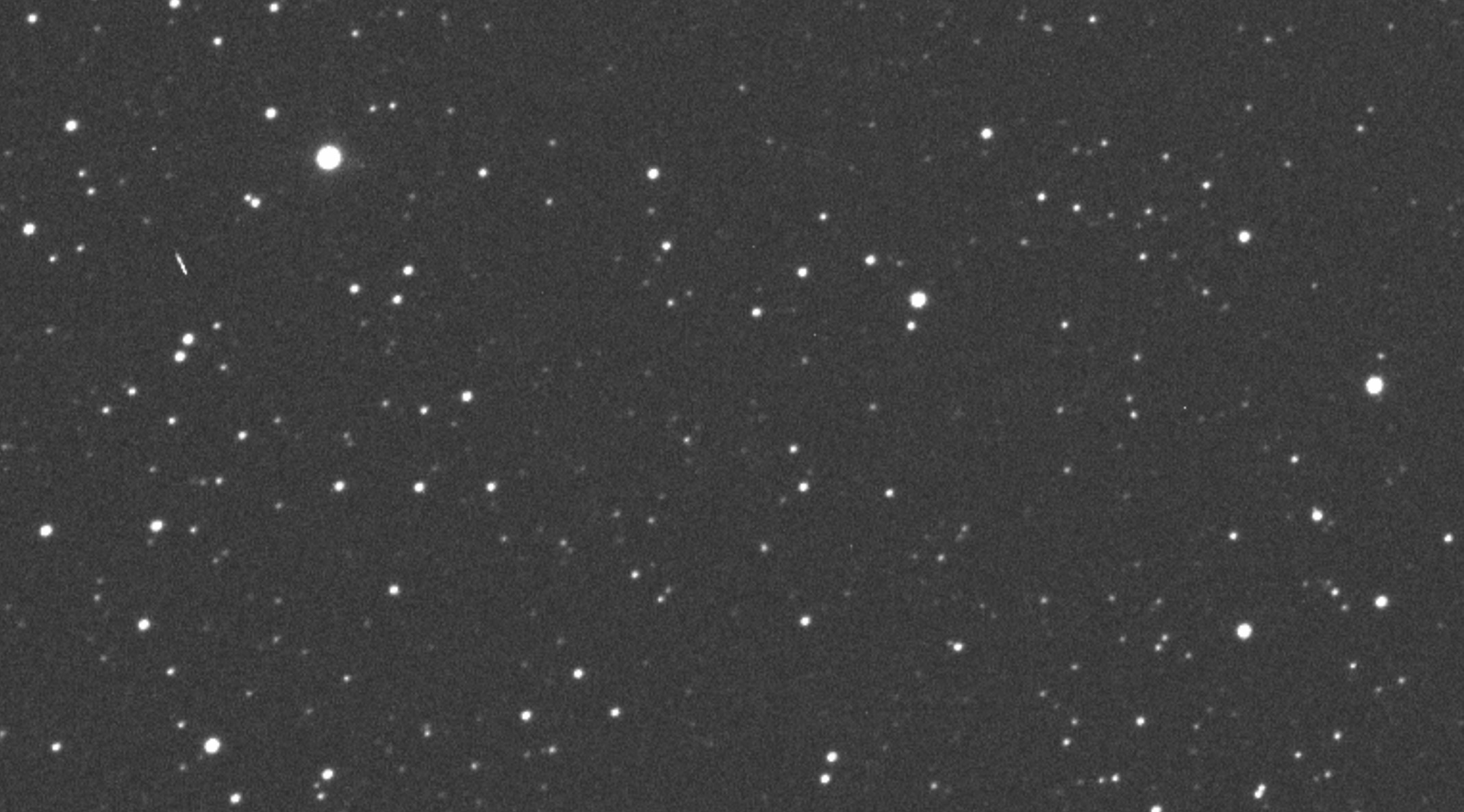
The object, known as asteroid 152637 (1997 NC1), is estimated to measure roughly 0.6 miles (about one kilometer) across and will pass Earth at a distance of approximately 1.6 million miles, about 6.6 times farther away than the moon. Astronomers have tracked its orbit for nearly three decades and say there is zero chance of an impact.
While skywatchers in many parts of the world may be able to spot the asteroid with a moderate-sized telescope, Alaska’s nearly endless daylight around the summer solstice will make the viewing far more difficult. Those in Australia and New Zealand will have a better view.
The asteroid reaches its closest approach just days after the summer solstice. Even in Southcentral Alaska, true darkness never arrives this time of year, making it challenging to see an object that shines at only about 10th magnitude, roughly 100 times dimmer than what the human eye can detect without optical aid.
Those determined to try should look during the darkest hours around local midnight on June 26 through June 28. A telescope with at least a 6-inch aperture is recommended, along with a clear southern horizon. The asteroid will appear as a faint, star-like point of light slowly moving against the background stars over several minutes.
The viewing challenge doesn’t end with Alaska’s bright skies. A nearly full moon will add even more glare, reducing contrast for telescope observers.
Asteroid 1997 NC1 was discovered in 1997 by NASA’s Near-Earth Asteroid Tracking (NEAT) program atop Haleakala, Hawaii. It is classified as a “Potentially Hazardous Asteroid,” a technical designation given to large objects whose orbits bring them relatively close to Earth. The label does not mean it poses an actual threat. In this case, astronomers know its orbit well enough to predict its path with confidence.
For perspective, the asteroid is estimated to be roughly 50 to 60 times wider than the Chelyabinsk meteor that exploded over Russia in 2013. That unexpected airburst created a powerful shock wave that shattered windows across six cities and injured about 1,500 people, mostly from flying glass. The Chelyabinsk object approached from the direction of the sun and went undetected before entering Earth’s atmosphere.
By contrast, asteroid 1997 NC1 has been monitored for years, and scientists know exactly where it will be.
Professional astronomers plan to use radar observations during the flyby to learn more about its size, shape, and rotation. For those whose skies are too bright, including most of Alaska this time of year, organizations such as the Virtual Telescope Project are expected to stream the event live online.
The next time asteroid 1997 NC1 comes this close to Earth won’t be until the year 2133.



2 thoughts on “Big asteroid to make closest pass in centuries, but don’t expect to see it from Alaska’s bright summer skies”
Revelations does point out asteroids ☄️ will be more frequent becoming more common as this life gets closer to the end of this age. The increasing frequent occurrences just another reminder to look up and remember our priority is to occupy but not waste time desperately try to fix this world holding on to something that is not our’s to hold on to.
At 2033, boomers, GenX, Millenniaks/GenY, GenZ, and GenAlpha will be passed on or died/while GenBeta those who were born after 2019 will be at their 90th and 100thbirthdays