By BARBARA HANEY, PhD
Nov. 24, 2026 – Last week I wrote that Alaska votes as three different states: one on election day, one at early-vote sites, and one by mail, which decides close races. This is about how the parties went after the mail-in state, and what the Division of Elections’ own records show about who did it well.
Every absentee application in Alaska is logged in a public register: the date it arrived, the voter’s party, the date the ballot was mailed and the date it came back. Read day by day, the 2026 register shows the parties’ mail programs landing like weather fronts.
There were three waves. Republicans went first. From July 23 to August 1, Republican applications climbed while Democratic ones stayed flat; on July 24 and 25, Republicans outnumbered Democrats nine to one. Democrats came second, from Labor Day through September. It is the only stretch of the cycle in which Democratic applications outnumbered Republican ones, and for a party with half as many registered voters, it was plainly deliberate. Republicans came back in October with the largest wave of all: 5,475 Republican applicants, arriving in three weekly drops.
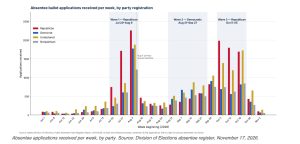
By volume, the Republicans won. The register says volume is not what mattered. What mattered was the calendar. The Division mails general-election ballots in bulk. Everyone who applied by September had a ballot mailed around October 9. The October applicants waited until a median of October 20. By election day, 84 percent of the September Republican applicants had returned their ballots. Only 65 percent of the October Republicans had.
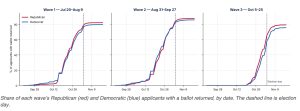
The September wave shows something else. A week after the October 9 mailing, 18.8 percent of the Democrats who applied in September had already sent their ballots back, against 14.7 percent of Republicans. That early lead is what a ballot-chase program looks like: calls and texts in the first days after a ballot lands. Republicans caught up by Halloween and finished ahead, 87.5 percent to 85.8. In the July wave, Republicans returned faster from the start. Republican voters are not less reliable. When they get their ballots in time, they send them back at least as often as anyone.
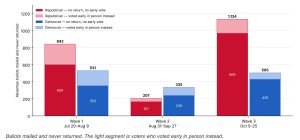
Then there are the ballots that never came back. 10,370 Alaskans were mailed a ballot and never returned it. Matching them against the Division’s early-vote registers shows that 1,881 voted early in person instead. The July applicants were the likeliest to switch, three in ten. The October applicants were the least likely, about one in eight. Of the 1,134 October Republicans who never returned a ballot, 165 voted early. About 970 are unaccounted for.
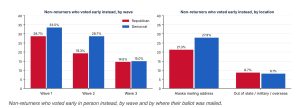
Where a voter lives decides most of it. Non-returners with an Alaska mailing address voted early 22 percent of the time. Those mailing outside Alaska, or flagged military or overseas, did so 7.5 percent of the time. A ballot mailed October 20 to Arizona or an APO address has little time to make the round trip, and a voter in Arizona cannot walk into a Fairbanks early-vote site. For many of those ballots a non-return probably meant no vote at all. Democratic non-returners also switched to early voting more often than Republicans in every wave, which is what a campaign telling its voters “if you haven’t mailed it, go vote early” would produce.
What did the calendar cost? Had the October Republicans returned their ballots at the September rate, about 450 more would have been cast. About 1,000 more would have been in hand by election day, while a campaign still had time to chase the rest. No single race can be shown to have turned on that. In a state where House District 30 was decided by two votes and House District 29 by seven, it is not a rounding error.
None of this is irregular. The counts reconcile: in every House district, the number of absentee ballots counted is at or below the number the register shows received. The lesson is practical, and it applies to any campaign of any party. Mail early enough that a September application rides the first ballot mailing.
Chase the week the ballots land. Tell voters who haven’t returned their ballots to vote early. Reach the out-of-state voters first, because they need the most time.
One question is still open: how many of the remaining 8,489 non-returners voted on election day. The Division’s voter history file for this election will answer it, and the Division should publish it promptly.
Alaska’s close races are increasingly won in October, in mailboxes. The calendar is public. So is the register. Whoever reads it first has the advantage.
Barbara Haney, PhD, is an economist who lives in North Pole.


Home » Barbara Haney: Alaska’s mail vote was won on the calendar
Barbara Haney: Alaska’s mail vote was won on the calendar
By BARBARA HANEY, PhD
Nov. 24, 2026 – Last week I wrote that Alaska votes as three different states: one on election day, one at early-vote sites, and one by mail, which decides close races. This is about how the parties went after the mail-in state, and what the Division of Elections’ own records show about who did it well.
Barbara Haney: Alaskans vote as if we are three different states
Every absentee application in Alaska is logged in a public register: the date it arrived, the voter’s party, the date the ballot was mailed and the date it came back. Read day by day, the 2026 register shows the parties’ mail programs landing like weather fronts.
There were three waves. Republicans went first. From July 23 to August 1, Republican applications climbed while Democratic ones stayed flat; on July 24 and 25, Republicans outnumbered Democrats nine to one. Democrats came second, from Labor Day through September. It is the only stretch of the cycle in which Democratic applications outnumbered Republican ones, and for a party with half as many registered voters, it was plainly deliberate. Republicans came back in October with the largest wave of all: 5,475 Republican applicants, arriving in three weekly drops.
By volume, the Republicans won. The register says volume is not what mattered. What mattered was the calendar. The Division mails general-election ballots in bulk. Everyone who applied by September had a ballot mailed around October 9. The October applicants waited until a median of October 20. By election day, 84 percent of the September Republican applicants had returned their ballots. Only 65 percent of the October Republicans had.
The September wave shows something else. A week after the October 9 mailing, 18.8 percent of the Democrats who applied in September had already sent their ballots back, against 14.7 percent of Republicans. That early lead is what a ballot-chase program looks like: calls and texts in the first days after a ballot lands. Republicans caught up by Halloween and finished ahead, 87.5 percent to 85.8. In the July wave, Republicans returned faster from the start. Republican voters are not less reliable. When they get their ballots in time, they send them back at least as often as anyone.
Then there are the ballots that never came back. 10,370 Alaskans were mailed a ballot and never returned it. Matching them against the Division’s early-vote registers shows that 1,881 voted early in person instead. The July applicants were the likeliest to switch, three in ten. The October applicants were the least likely, about one in eight. Of the 1,134 October Republicans who never returned a ballot, 165 voted early. About 970 are unaccounted for.
Where a voter lives decides most of it. Non-returners with an Alaska mailing address voted early 22 percent of the time. Those mailing outside Alaska, or flagged military or overseas, did so 7.5 percent of the time. A ballot mailed October 20 to Arizona or an APO address has little time to make the round trip, and a voter in Arizona cannot walk into a Fairbanks early-vote site. For many of those ballots a non-return probably meant no vote at all. Democratic non-returners also switched to early voting more often than Republicans in every wave, which is what a campaign telling its voters “if you haven’t mailed it, go vote early” would produce.
What did the calendar cost? Had the October Republicans returned their ballots at the September rate, about 450 more would have been cast. About 1,000 more would have been in hand by election day, while a campaign still had time to chase the rest. No single race can be shown to have turned on that. In a state where House District 30 was decided by two votes and House District 29 by seven, it is not a rounding error.
None of this is irregular. The counts reconcile: in every House district, the number of absentee ballots counted is at or below the number the register shows received. The lesson is practical, and it applies to any campaign of any party. Mail early enough that a September application rides the first ballot mailing.
Chase the week the ballots land. Tell voters who haven’t returned their ballots to vote early. Reach the out-of-state voters first, because they need the most time.
One question is still open: how many of the remaining 8,489 non-returners voted on election day. The Division’s voter history file for this election will answer it, and the Division should publish it promptly.
Alaska’s close races are increasingly won in October, in mailboxes. The calendar is public. So is the register. Whoever reads it first has the advantage.
Barbara Haney, PhD, is an economist who lives in North Pole.
Latest Post
Sen. Dan Sullivan concedes to Mary Peltola after Alaska certifies election
By SUZANNE DOWNING Nov. 24, 2026 – US Sen. Dan Sullivan conceded Alaska’s Senate race
It’s been 29 days since ‘Decoy Dan’ was spotted. It’s been 55 years since D.B. Cooper vanished
By SUZANNE DOWNING Nov. 24, 2026 – Some 29 days have passed since Alaska’s “Decoy
Margaret Nelson: Alaska veteran loan costs may increase under new federal measure
By MARGARET NELSON Nov. 24, 2026 – Alaska veterans seeking affordable housing will face another
Comments