


By SUZANNE DOWNING
April 16, 2026 – A discovery in Anchorage in October helped unravel a major international wildlife trafficking operation involving tens of thousands of illegal shark fins, federal officials announced this week.
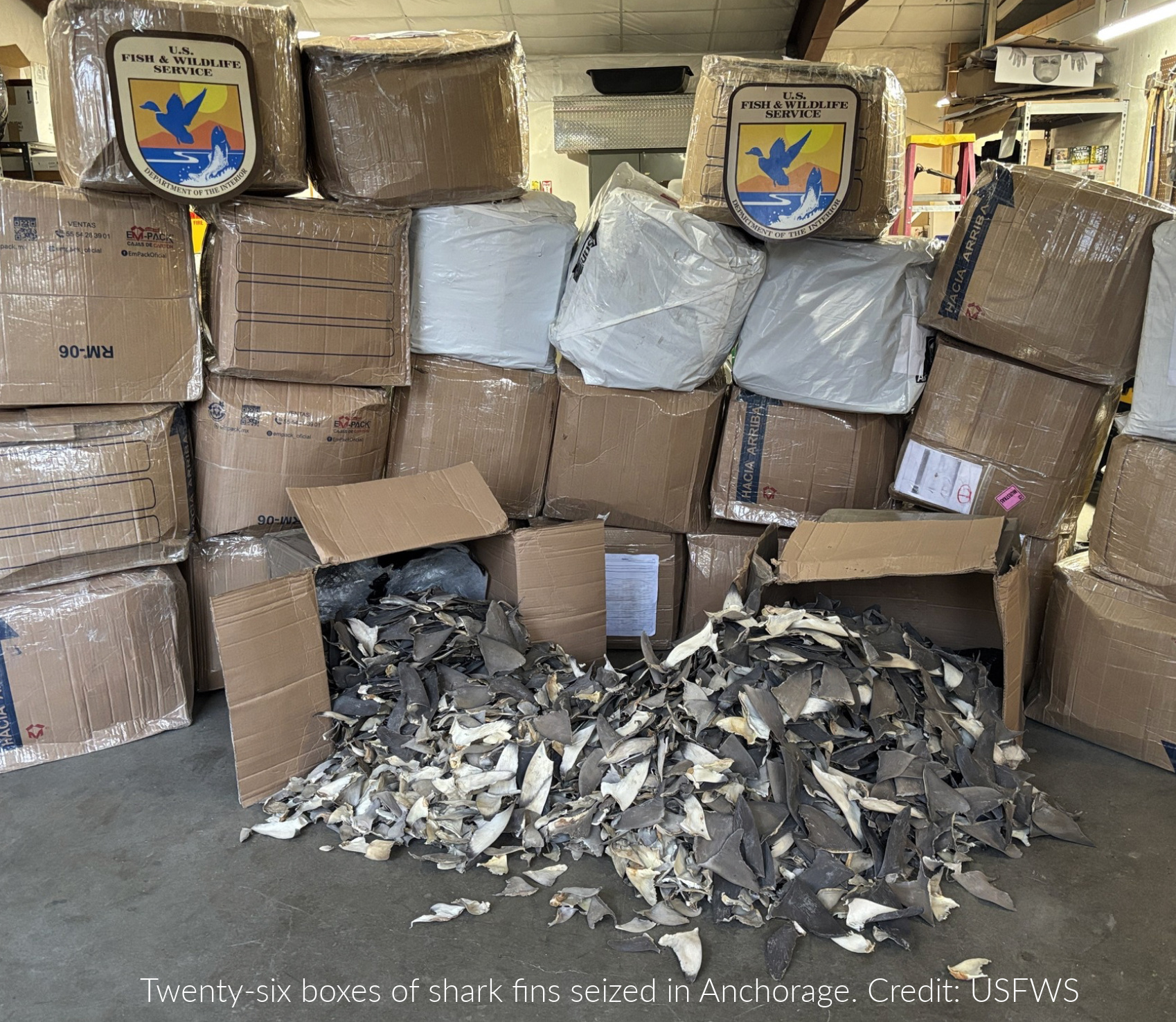
According to the US Fish and Wildlife Service, inspectors first uncovered a suspicious shipment in Anchorage in October 2025. What initially appeared to be a routine inspection of car parts quickly escalated into a multi-port investigation that ultimately led to the seizure of roughly 50,000 dried shark fins.
In total, authorities intercepted about 1,600 pounds of shark fins across 20 shipments, with an estimated black-market value exceeding $1 million.
The Anchorage find triggered a broader enforcement effort that stretched across multiple US shipping hubs, including Louisville, Kentucky, and Cincinnati, Ohio. The shipments were moving from Mexico to Hong Kong and were deliberately mislabeled as car parts in an apparent attempt to evade detection.
Federal officials say the shipments were linked to a larger trafficking network operating across international borders.
The seizures were carried out as part of Operation Thunder, a global crackdown targeting illegal wildlife trade. The effort involves coordinated enforcement among multiple countries aimed at disrupting trafficking networks that profit from endangered and protected species.
Most of the fins seized were identified as coming from silky sharks and bigeye thresher sharks, species protected under Convention on International Trade in Endangered Species of Wild Fauna and Flora. International trade in these species is tightly regulated due to concerns about declining populations.
All of the shipments were confiscated for violations of federal wildlife laws, and authorities have shared information with international partners for potential enforcement actions abroad.
Why shark fins command such high prices
Shark fins are among the most valuable wildlife products in the world, largely driven by demand for shark fin soup, a traditional delicacy in parts of Asia and with Asian immigrants in America that is often served at weddings and banquets as a status symbol.
The fins themselves have little flavor, but they provide a unique gelatinous texture that is prized in the dish. That cultural demand, combined with limited supply from increasingly regulated fisheries, has created a lucrative black market.
Individual fins can sell for hundreds of dollars per pound, with rare or large fins commanding even higher prices. The profitability has fueled global trafficking networks that often engage in “finning,” a practice in which sharks are caught, their fins removed, and the bodies discarded at sea.
Conservation groups warn that such practices have contributed to steep declines in shark populations worldwide, particularly for slow-growing species like silky and thresher sharks.
The Anchorage seizure revealed Alaska’s role as a key checkpoint in international cargo routes, and how a single inspection can expose a much larger criminal pipeline.



2 thoughts on “Anchorage discovery leads to major shark fin trafficking bust spanning US ports”
Ha-Ha-Ha … there’s more perpetrator ‘chins’ than a Chyneeze phone book!!!
Is there anyone and/or any Guv’ment Agency see a pattern here?
If not, let me know and I’ll gladly connect the dots for you!
I don’t care about shark fin trafficking. I care about the cost of groceries, gasoline, utilities and most of all taxes.