


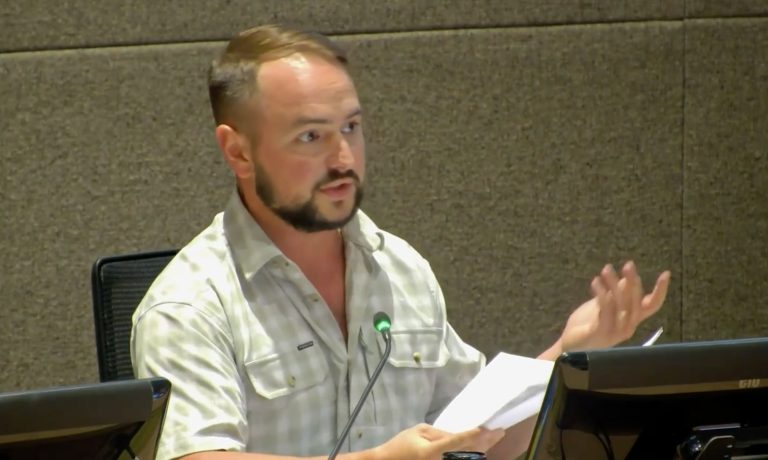
Photo-video screenshot: Joshua McHoes, communication director for the Alaska Libertarian Party, testifies in front of the Anchorage Assembly regarding the proposed tax breaks for first-time homebuyers in Anchorage, on Sept. 15, 2026.
By SUZANNE DOWNING
Sept. 16, 2026 — The Anchorage Assembly on Tuesday voted to indefinitely postpone a 10-year property-tax exemption for qualifying first-time buyers of newly constructed homes, voting 11-1, effectively killing an incentive promoted by Mayor Suzanne LaFrance as one answer to the city’s housing shortage. Only the chair of the Assembly, Anna Brawley, voted no.
The Assembly separately postponed a companion tax break for qualifying residential units in new or rehabilitated mixed-use developments. That matter, unlike the first-time homebuyer tax break, will return to the Assembly in October.
The measures would not reduce the amount the municipality is permitted to collect under Anchorage’s tax cap. Instead, exempting selected properties removes them from the taxable base, shifting more of the cost of municipal government and the Anchorage School District onto existing homeowners, landlords, and businesses that don’t get such exemptions.
That concern dominated much of the public testimony on AO 2026-89, the first-time-homebuyer ordinance.
Supporters argued that Anchorage’s high construction costs, mortgage rates and property taxes have pushed new homes beyond the reach of younger buyers. Opponents said the Assembly was choosing winners and losers while presenting a redistribution of the tax burden as a tax cut.
The substitute version of AO 2026-89 applies to qualifying newly constructed homes purchased and occupied as a primary residence by a first-time homebuyer. The exemption would last 10 consecutive years and cover both the municipal and Anchorage School District portions of the property tax.
Applications would be accepted through Aug. 31, 2031. A qualifying home would need to receive its certificate of occupancy within five years of the ordinance’s approval. Short-term rentals would not qualify.
The substitute ordinance raised the maximum purchase price to 120% of Anchorage’s most recent average assessed value for a single-family home. Based on the administration’s approximately $497,000 figure, a home selling for as much as roughly $596,400 could qualify.
The exemption itself, however, would be capped at the average assessed value. Any value above that amount, along with the land, would remain taxable.
Bill Taylor, a longtime Anchorage owner of Colony Builders, urged the Assembly to approve the ordinance, calling it one step toward easing the housing shortage.
Taylor said first-time buyers have largely disappeared from his market as costs have increased. He estimated that the tax exemption could represent roughly 15% of a qualifying buyer’s monthly mortgage-related payment.
“This is one brick in that wall, and it will help,” Taylor told the Assembly.
Skyler Quinn, president of the Anchorage Home Builders Association, also supported the substitute ordinance. He said buyers generally focus less on the listed price of a house than on whether they can manage the total monthly payment, including principal, interest and taxes.
Reducing that monthly cost could increase demand for smaller, entry-level homes and encourage builders to produce more of them, Quinn said.
Several Anchorage taxpayers objected that the incentive would simply transfer the bill to them.
One homeowner said her family already pays approximately $8,000 a year in property taxes on a house built in 1952 and is preparing for potentially steep increases in energy costs.
“It is not responsible for this body or this administration to volunteer my family to pay for first-time homeowners for a decade,” she said.
A representative of the Alaska Libertarian Party made a similar argument, saying the ordinance “does not lower taxes — it moves them.”
“When the Assembly removes property from the taxable base, the rate rises on everything that remains,” Joshua McHoes said. “Property owners pay more. Renters pay more.”
Another resident questioned whether a house approaching $600,000 could reasonably be described as a starter home.
Using the administration’s goal of producing 10,000 new homes, he said that if only 1,000 homes qualified at close to the maximum price, hundreds of millions of dollars in residential value could be kept off the tax rolls for a decade.
He also contrasted the treatment of buyers purchasing new houses with first-time buyers purchasing older and usually smaller Anchorage homes. Buyers of existing homes would receive no exemption and could face higher taxes as exempt properties are removed from the tax base.
Anchorage Assembly to hear proposal giving 10-year property-tax break to select first-time homebuyers
The administration’s original economic analysis described the measure as having little immediate effect on current tax revenue because the qualifying houses have not yet been constructed and therefore are not presently taxed.
But the same analysis acknowledged that property-tax exemptions can shift the cost of government to the remaining tax base through higher mill rates. The tax benefit would also delay the point at which the new construction becomes fully taxable.
AO 2026-93, considered immediately afterward, would offer a separate 10-year exemption for the residential portion of qualifying new or rehabilitated mixed-use, multi-unit developments. The proposal is designed to encourage projects combining owner-occupied residential units with commercial space.
Under that proposal, a project would generally have to create at least four new residential units. The commercial portion and land would remain taxable.
Both ordinances are part of the LaFrance administration’s campaign to encourage construction of 10,000 homes over 10 years.
Whether the incentives produce construction that otherwise would not occur, or merely reward buyers and builders for projects that would have proceeded anyway, will determine whether the policies expand Anchorage’s tax base in the long term or simply divide the existing tax bill among fewer taxpayers in the near term.
The municipality’s YouTube recording cuts off before the Assembly’s debate and votes and the sound is missing from the recording.
Anchorage police admit drone deployment was omitted from required public report



3 thoughts on “Anchorage Assembly says no-go on 10-year tax breaks for first-time homebuyers”
This proves once again that Brawley is an idiot.
She is. And the people in her district voted to keep her in office. The ones who bothered to vote. Plenty of idiocy to go around.
Brilliant, give 1st-time homebuyers a tax break; meaning their share will be paid by the rest of the taxpayers. We must continue to divide the citizenry into countless factions to oppose each other. If we are all polarized against each other it will make our republic stronger. Wait…..