


By SUZANNE DOWNING
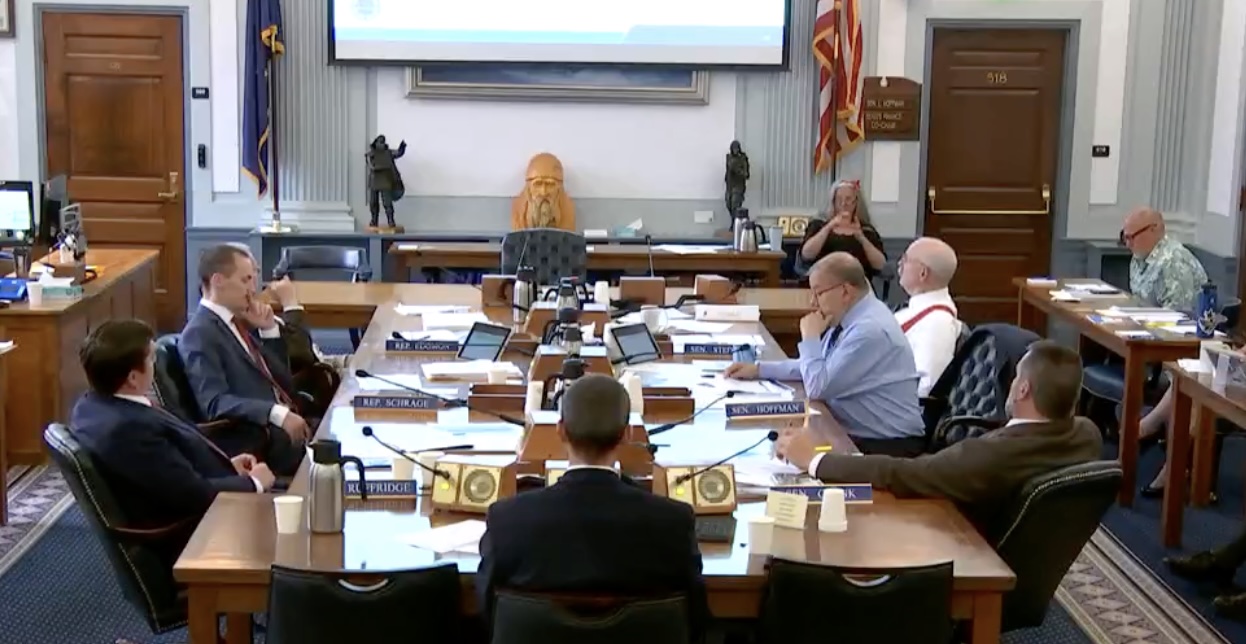
Nov. 7, 2026 – Alaska’s legislative power shift is taking shape before the final ballots are counted: The Democrat-aligned House coalition is organizing and positioned to expand, the Senate coalition is organizing for another term, and conservative Republicans face the prospect of far-less influence in both chambers.
If Democrat Jonathan Kreiss-Tomkins maintains his lead in the governor’s race, the change would extend beyond legislative arithmetic. Democrat priorities that encountered vetoes from Republican Gov. Mike Dunleavy could find a more receptive governor.
The remaining races will determine the size of the majorities. But it’s all over but the shouting for who will be in charge: the leadership announcements already show which lawmakers will control the agenda.
Preliminary results reported after Election Day showed Democrats and no-party politicians leading in 23 of the House’s 40 districts, compared with 19 seats won by those candidates in 2024. The outgoing governing coalition organized with just 21 members, including two turncoat Republicans.
A coalition with 23 Democratic and independent members could organize without Republican assistance, assuming those members agree to join or are invited. Republican participation would enlarge its majority rather than supply the votes necessary to create one.
The coalition has selected Anchorage independent Calvin Schrage as its incoming speaker, Republican Chuck Kopp as majority leader and independent Rebecca Himschoot as Rules chair. Democrats Neal Foster, Sara Hannan and Ashley Carrick are its choices to lead House Finance. Those selections remain subject to formal House action when lawmakers convene.
The arrangement puts Republicans who join the coalition in a different bargaining position. A majority that can survive without them has less reason to accommodate their objections.
Two Anchorage districts illustrate the shift: In House District 18, former Democratic Rep. Cliff Groh held a commanding preliminary lead over Republican Dan Sager for the open seat vacated by Republican David Nelson. Groh previously represented the district before Nelson defeated him in 2024.
The district includes Government Hill and Joint Base Elmendorf-Richardson. Its military population makes turnout especially consequential: Lower military participation in midterms has contributed to its swings between the parties.
In House District 15, Democrat Denny Wells led Republican incumbent Mia Costello with approximately 52.4% of the preliminary vote, meaning no further ranking will take place.
Northern Fairbanks offers another potential gain. Democratic-backed independent Joy Beth Cottle led Republican Harmony Tomaszewski by just 43 votes in the early count for House District 34. That margin remains too narrow to treat as settled, but the Democrats are planning for the win.
Republican incumbents Julie Coulombe of Anchorage and Sarah Vance of Homer were ahead in their respective races, limiting the coalition’s immediate opportunities for further gains. Several crowded contests, including Rep. Jamie Allard’s Eagle River race, remain dependent on subsequent rankings and uncounted ballots.
The open House District 37, vacated by Rep. Bryce Edgmon, who ran for Senate, offers a possible Republican pickup. A Republican victory there would offset part of the coalition’s gains elsewhere.
Senate power balance
The Senate’s shift is more about leadership and membership than a wholesale change in governing control.
The existing 14-member coalition is being reorganized under Anchorage Republican Cathy Giessel, the coalition’s choice for Senate president. The initial organizing group has the minimum 11 members, with negotiations continuing over a potentially larger majority.
Two unresolved Senate races are District C, where Republican Louise Stutes led a three-way contest with roughly 48% of first-choice votes, and in western Alaska’s District S, outgoing House Speaker Bryce Edgmon led a four-way race but remained well below a majority.
Coalition organizers have already selected Stutes for majority leader and Edgmon for a Finance co-chairmanship, alongside Juneau Democrat Jesse Kiehl. Democrat Bill Wielechowski is their choice for Rules chair.
Conservative Republicans could win individual races in the Mat-Su but will still remain outside the governing majority.
Pensions and spending move closer to the governor’s desk
The largest policy consequence may be the removal of obstacles to legislation already supported by coalition lawmakers.
A proposal to restore defined-benefit pensions for public employees and teachers passed the Legislature this year but was vetoed by Dunleavy. A more receptive governor, Democrat Jonathan Kreiss-Tomkins, would improve its prospects, alongside renewed demands for education funding and other spending.
For taxpayers, the question is how those commitments would be financed over time.
A pension proposal, adding long-term obligations, would sharpen the debate over taxes, Permanent Fund earnings, smaller dividends, and other revenue measures.
Ranked-choice voting remains central to some of the unfinished races. In some Mat-Su contests, such as District 30-Big Lake, Democratic voters’ later preferences could help determine which Republican advances. In that seat, Rep. Kevin McCabe has about 38.5% of the first votes, with Doug Massie holding a slight lead of nearly 36% and Democrat Sandra Loomis holding about 25.5%. The second-choice votes of Loomis will probably go to Massie, which could flip the seat but not the party holding the seat. Preliminary ranking shows that trend and predicts a Massie win. Massie is more aligned with passing the costly defined benefits pension plan for government workers.
The Division of Elections schedules ranked-choice tabulation for Nov. 18, with certification planned for Nov. 25. Tabulation will resolve races where transfers are needed; certification is a separate step.


3 thoughts on “Analysis: Alaska’s Democrat-led coalitions gain ground as Republican leverage shrinks”
My favorite part of Autumn is watching the states turn blue. Especially Alaska.
Enjoy the victory America First gave you. We had to deal with the traitors first, and we have.
After we reorganise, we will come for you again. We’ve beaten you many times already, and we will do so again.
So tell me, how are you doing to deal with Schumer and Jefferies who take Big AIPAC money? They are far from alone.
The exclusion of Senator Burt Stedman from the majority and the end of his control of Senate Finance would be the greatest victory of this election cycle. He has killed so many ideas and made such a muddle of issues over the years that Alaskans see the Senate as a spineless “blob” where too few matters are debated and resolved with clarity. (Remember the dead gas line?) Senator Stedman has enabled the Left for many years with many bad results. Minority Republicans should not trust him; he will likely just be carrying water for the Left.