




By ALEXANDER DOLITSKY
As of early 2026, Greenland is at the center of an intense geopolitical standoff, driven by persistent US efforts to gain control of the territory. Citing critical mineral resources and the need to counter Canadian, Russian and Chinese influence in the Arctic, the second Trump administration has pressured Denmark to allow an American takeover, a move firmly rejected by both Danish and Greenlandic authorities.
Many Americans are still navigating their own thoughts on what the ideal US strategy for Greenland should look like, especially considering the complexities involved with our existing five major and permanently inhabited territories, including: Puerto Rico, Guam, US Virgin Islands, American Samoa, and the Commonwealth of the Northern Mariana Islands (Saipan Island, etc.).
These unincorporated five permanently inhabited US territories are under US jurisdiction but are not states; they exist in a state of political limbo. Residents in these areas are subject to US laws and federal taxation in some cases, yet they possess varying citizenship statuses—American Samoans are US nationals rather than citizens—and they cannot vote in presidential elections or elect voting representatives to Congress.
Residents of Puerto Rico, Guam, the Northern Mariana Islands, and the US Virgin Islands are citizens, while residents of American Samoa are US nationals. Regardless of nationality or place of origin, all US residents are ineligible to vote in federal elections, although some may participate in party primaries. All five territories are heavily subsidized, with a significant economic dependence on federal funding and social programs.
The potential US strategy for Greenland presents a complex mix of strategic opportunities and diplomatic liabilities. There is valid concern that incorporating a new territory (Greenland) could create a “welfare state/territory” like the fiscal dependency of the current five territories.
Presently, Denmark provides an annual block grant of approximately DKK 3.9 billion (roughly $550–$600 million USD) to Greenland, accounting for about 20% of the island’s GDP and over half of its public budget. This subsidy sustains key public services, including healthcare, education, and social programs, as part of the Kingdom of Denmark’s commitment to the territory. Ultimately, if Denmark doesn’t pay the bill, taxpayers will.
Nevertheless, with Greenland’s massive untapped mineral wealth, rare earth elements, and its strategic importance in the Arctic against the US rivals—Canada, Russia and China—its acquisition is regarded by some as a 21st-century “Alaska Purchase.” The U.S. is currently considering options ranging from a negotiated buyout of Greenland to creating a “Compact of Free Association” or establishing sovereign military zones. Of course, this is an uncharted political territory, with a “rocky road” in perspective.
Recent reports indicate that Russian President Vladimir Putin addressed the issue of the United States potentially acquiring Greenland in January and, prior to that, in March 2025. He stated that Russia has no interest in intervening in the disputes between the United States and Denmark regarding the status of Greenland. Speaking on Russian television (specifically in a meeting with his Security Council), Putin noted that Moscow does not view Greenland’s ownership as its concern.
Furthermore, President Putin pointedly described Denmark’s historical administration of Greenland as colonial and harsh, essentially dismissing Danish authority over the island and suggesting this history justifies US interests in acquiring it. He also compared the potential acquisition of Greenland to historical land deals, such as the US purchase of Alaska from Russia in 1867 for $7.2 million dollars, noting that today a fair price for Greenland could be around $1 billion.
In contrast to President Putin’s position on Greenland, West European elites are acting on emotions rather than logic by opposing US interests in Greenland, therefore, failing to recognize that Washington views the island as a critical asset for security and early warning systems—a strategic focus that has driven US interest in acquiring the territory since 1946 and again in 1955.
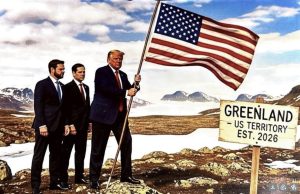
It should be noted that in early February of this year, President Trump shared an image on his social media platform, TruthSocial, that symbolically depicted Greenland as a US territory, featuring a US flag and a sign with the inscription in English: “Greenland, US territory, effective 2026.”
The author was born and raised in the former Soviet Union before settling in the U.S. in 1978. He moved to Juneau in 1986 where he taught Russian studies and Archaeology at the University of Alaska Southeast, and Social Studies Teacher at the Alyeska Central School of the Alaska Department of Education. From 1990 to 2022, he served as a director and president of the Alaska-Siberia Research Center, publishing in the fields of anthropology, history, archaeology and ethnography. Find him on Amazon.com.
Alexander Dolitsky: Brief history of America’s westward expansion and exploration of Greenland




4 thoughts on “Alexander Dolitsky: Greenland’s future in geopolitics, resources, and sovereignty”
Alex,
Its’ a key relevant geopolitical point by your adding Canada to the traditional US rivals list —Canada, Russia and China. The Trump Administration has gone out of its’ way to alienate Canada. Encouraging separatism in Alberta, haphazard economically destabilizing tariffs and blocking the opening of the critical Gordie Howe International Bridge in favor of maintaining the monopoly of the privately owned Ambassador Bridge. Which is owned by Matthew Moroun, a major Trump donor, who met with Commerce Secretary Lutnick (a former business partner and next door neighbor of the late Epstein) hours before Trump making threats to block the opening of the new one.
This is very relevant as Canada has been a vital ally for North American continental strategic missile defense. Our countries are economically, culturally and linguisticaly integrated. Notwithstanding the perennial
Quebecois separatist sentiments. Trump has forced Canada to commence mutually beneficial commercial ties with China. Incorporating Canada into the US and treating Canadians like Samoans without representation is a non starter. Annexing Canada with Congressional-Senate representation is a non starter as it would upset the carefully balanced power structure between the Democrat and Republican twins of our Uniparty.
This self inflicted destabilization of our continental security is already a potentially fatal policy.
Denmark has relinquished full colonial ownership of Kalaallit Nunaat by granting self governance sovereignty. Full independence is scheduled for such time as it is economically viable and its’ citizens have unanimously stated its’ not for sale. The Kalaallit have joint ownership of all land. Family homes are private, the land beneath them is also owned as a cohesive people.
Most resources remain under ice fields. The massive currently accessible mountain of rare earths in the south, Kuannersuit, already has a mining license. Which is in litigation due to a ban on extraction due to the high concentration of uranium in the ores. Offshore oil and gas exploitation are also banned. The idea that Washington would use public funds to buy Kalaallit Nunaat, and then manage the resources for the benefit of large donors in the states against the will of local people, in colonial fashion is not acceptable.
The concept of sovereign military zones by the US is also toxic. We see the long term negative issues this causes in Cyprus with the UK. All the land is sovereign by one unified people. There is no reason that the existing treaty to build bases and pay lease fees is insufficient for Washingtons’ security schemes.
Any bases on Kalaallit Nunaat would be isolated in the event we escalate the current economic and undeclared kinetic war we are already waging on Russia. Our navy although large, is obsolete. We have no ability to interdict hypersonic missiles fired from subsurface or surface Russian ships.
The irony is Russia has requested to join NATO several times and poses no threat if we simply ended the constant sanctions, ship seizures, terror operations and open war using proxies. With their fleet of nuclear powered ice breakers and rapidly expanding arctic coast infrastructure they would be a natural fit to work with. NW of Wainwright there are massive offshore oil and gas fields.
The picture in your post with our flag and sign saying Greenland 2026 US Territory is highly insulting. Both to the Kalaallit and as an American. It demonstrates the hubris and ignorance of our government and expresses the reasons why we are going to be hated instead of respected.
Thanks for the feedback, Tundra. To clarify, the Greenland image was published in direct reference to my article’s conclusion; last paragraph. It was meant to report a scenario, with absolutely no intent to insult or disrespect the local Native population.
Understand, I’ve seen that photo and one with a map of Kalaallit Nunaa, Canada and Venezuela covered in our flag. It isn’t your repost, its’ the hubris and vanity of an administration devoid of class or appropriateness that is disgusting. It underlines why Kalaallit Nunaa is not for sale!
I hope for a coordinated agreement with Greenland, the northern countries holdings like Canada, Iceland, Greenland, Norway, Sweden, Finland and Denmark with all NATO country memberships for the sake of securing their borders and protection with the United States. If the USA can accomplish that, it would be good and better than the “buying” scheme. i love that idea and all those cultures should have a say in the benefit of security, international relations and the means to mange their affairs without fear. The northern Arctic circle countries have strong and good history. I’m for this type of inclusion.