By SUZANNE DOWNING
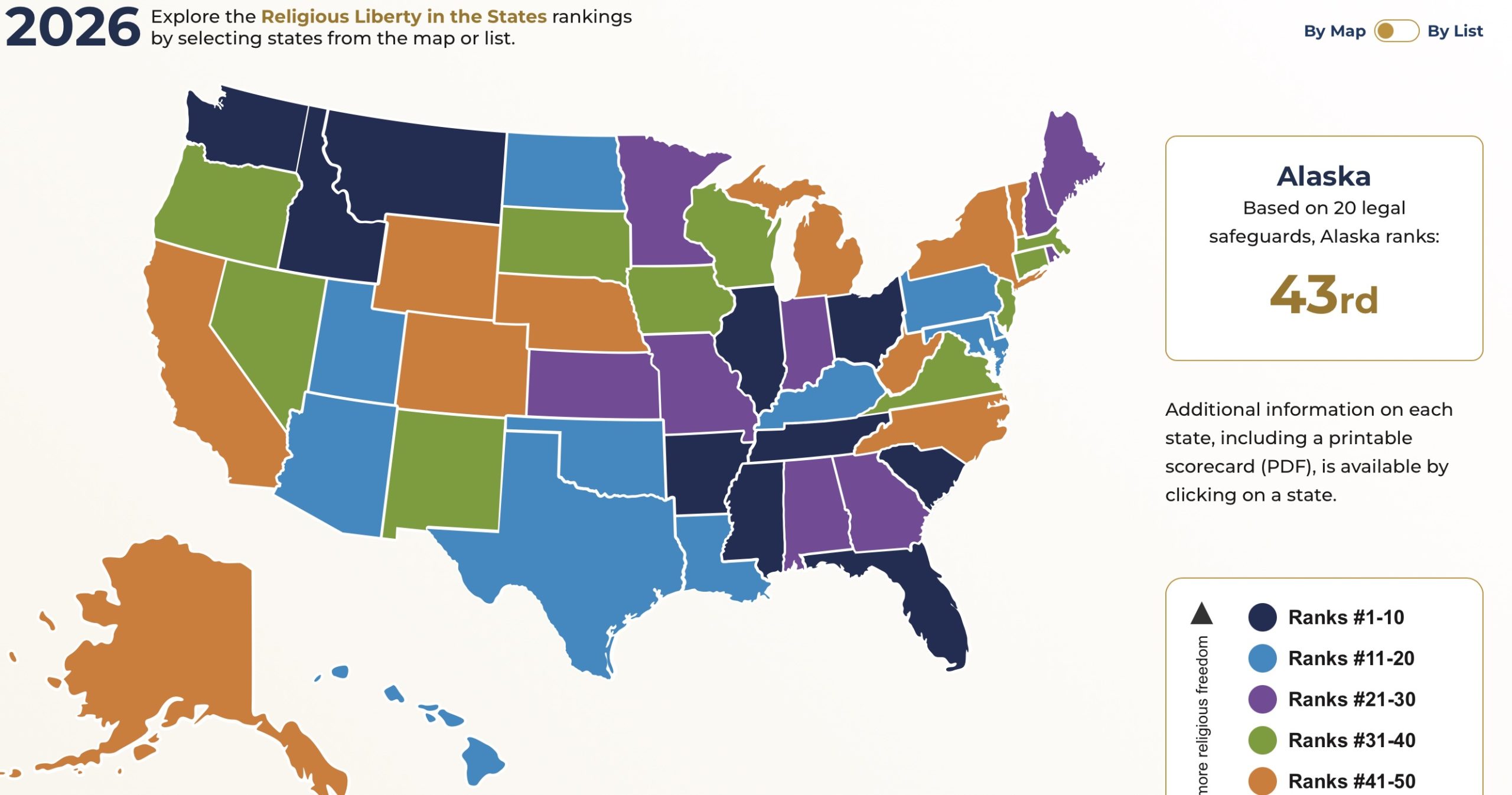
July 16, 2026 – Alaska nears the bottom, ranking 43rd in the nation for legal protections of religious liberty, according to the newly released 2026 Religious Liberty in the States report, placing it well behind many neighboring Western states and near the bottom of the national rankings.
The annual index, produced by the Center for Religion, Culture & Democracy at First Liberty Institute, evaluates each state based on 20 broad legal safeguards encompassing 50 specific statutory protections. Rather than measuring public opinion or religious participation, the report focuses on whether a state’s laws protect the free exercise of religion in areas such as education, employment, health care, parental rights, licensing, and conscience protections.
Arkansas claimed the top spot this year with an overall score of 89%, becoming the highest-ranked state in the fifth edition of the report. California ranked 46th, while Alaska finished only three places ahead at 43rd.
The report’s authors argue that one protection stands above all others: a state Religious Freedom Restoration Act, commonly known as a RFRA.
Congress enacted the federal Religious Freedom Restoration Act in 1993, but the U.S. Supreme Court’s 1997 decision in City of Boerne v. Flores ruled that the federal law could not be applied to state and local governments. Since then, states have been encouraged to adopt their own versions to restore those protections under state law.
According to the report, only 30 states have enacted their own RFRA statutes. Georgia and Wyoming were the latest to do so in 2025. Alaska is not among them.
The report tracks 20 major safeguards, including whether states have:
- A state Religious Freedom Restoration Act.
- Conscience protections for medical professionals.
- Religious accommodations for students and teachers.
- Protections for faith-based adoption and foster care agencies.
- Religious liberty protections for licensed professionals.
- Parental rights in education.
- Protection for religious organizations’ internal governance.
- Religious exemptions related to marriage and wedding services.
- Protections for houses of worship during emergencies.
- Safeguards for religious expression in schools and public life.
Arkansas rose to No. 1 after lawmakers approved several additional protections in recent years, including a 2025 law shielding individuals and religious organizations from being compelled to participate in wedding ceremonies that violate their religious beliefs. The report says only Arkansas and Mississippi currently provide that level of marketplace protection.
Only two states — Arkansas and Tennessee — earned the report’s “excellent” rating by adopting more than 80% of the legal protections measured.
At the other end of the spectrum, West Virginia, Michigan, Vermont and New York received the lowest scores, each protecting 30% or fewer of the safeguards evaluated.
Although Alaska finished well below the national median, the state did improve from previous editions of the index. In the 2024 report, Alaska ranked 49th under an earlier version of the methodology that measured 16 safeguards. The expanded 2026 index now evaluates 20 safeguards and 50 individual legal protections.
The report emphasizes that every state still has room for improvement, and its authors say states increasingly are borrowing successful policies from one another.
Whether Alaska lawmakers will pursue additional religious liberty legislation in future sessions remains to be seen, but under the report’s criteria, the absence of a state Religious Freedom Restoration Act continues to be one of the largest factors keeping the state near the bottom of the national rankings.