


By SUZANNE DOWNING
July 12, 2026 – A little-known feature of election law has become the focus of growing legal and political debate: In most states, certain US citizens who have never actually lived in the United States can still vote in American elections. Alaska is one of those.
The issue has prompted lawsuits in multiple states, renewed calls for Congress to establish a national standard, and questions about whether the current patchwork of state laws still makes sense.
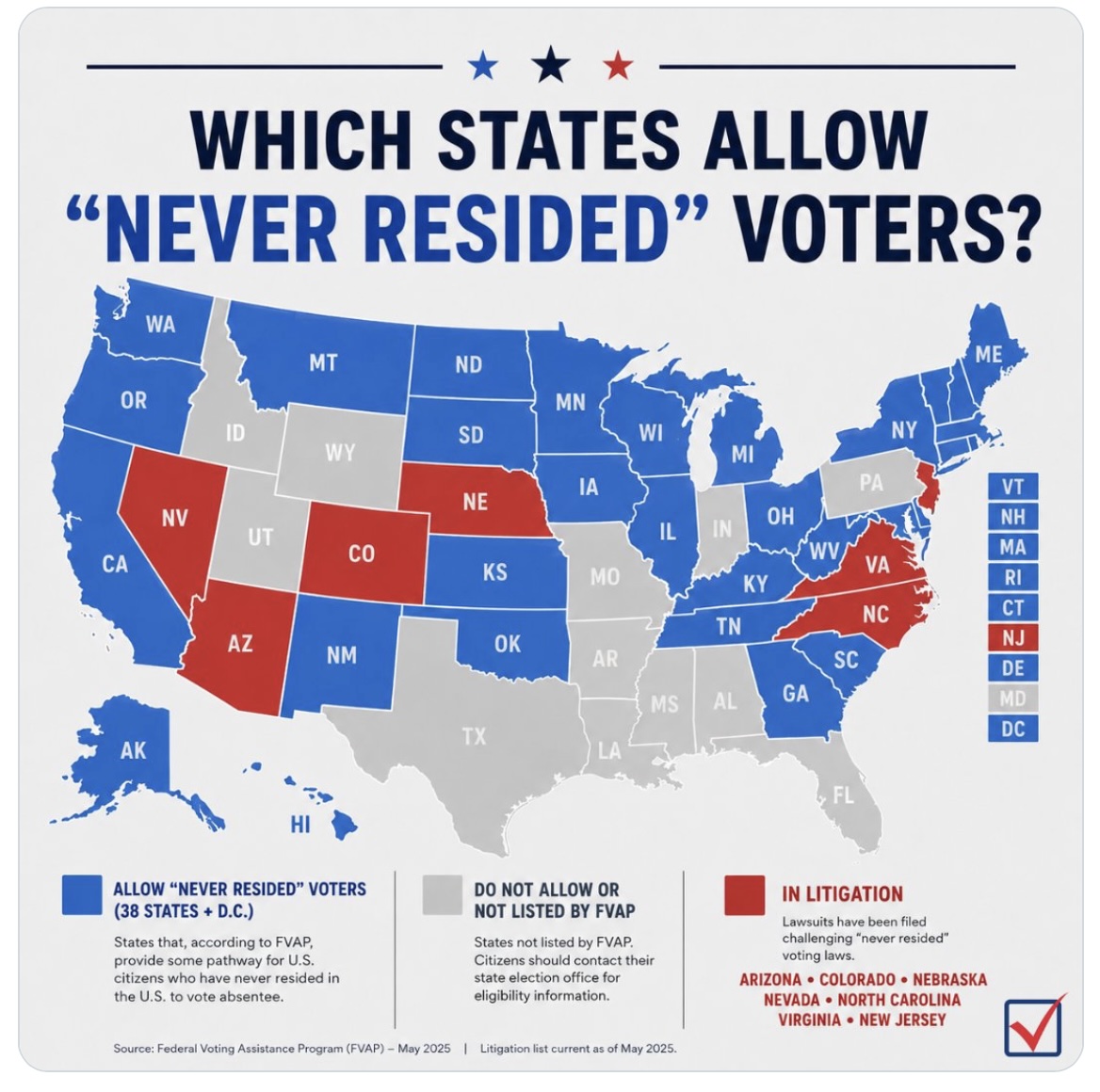
The map circulating online accurately reflects the Federal Voting Assistance Program’s guidance as it existed in mid-2025. According to the Department of Defense’s Federal Voting Assistance Program, 38 states and the District of Columbia provide some avenue for certain “never-resided” US citizens to vote absentee.
Those laws generally apply to people born overseas to American parents, but who have never established residence in the United States themselves. In most cases, they vote using a parent’s last US domicile.
Importantly, these laws do not apply to foreign nationals or non-citizens. Federal law prohibits non-citizens from voting in federal elections. The debate concerns US citizens born abroad.
Here’s how it applies to Alaska:
- A US citizen who was born abroad and has never resided in the United States can vote in Alaska if they have a parent or legal guardian who was last domiciled in Alaska.
- They are eligible only as a federal voter, meaning they can vote for federal offices only (US President/Vice President, US Senate, US House of Representatives).
- They cannot vote in Alaska state or local elections.
The parent/guardian must have had a genuine prior domicile (legal residence) in Alaska.
Here’s how it’s done:
- They use the Federal Post Card Application (FPCA) via FVAP.gov or Alaska’s Division of Elections site. This serves as both registration and absentee ballot request.
- They must re-request a ballot for each election cycle (typically annually for permanent overseas voters).
- Ballots are sent by mail; Alaska has specific deadlines (e.g., ballots must generally be received by certain dates.)
- Alaska offers provisions for military/overseas voters.
The obvious question is: Why Congress has never created a single nationwide rule?
The answer lies in the Constitution’s division of authority over elections.
Under Article I, state legislatures are primarily responsible for establishing election procedures, while Congress has authority to regulate certain aspects of federal elections. Historically, Congress has largely left voter qualification and residency rules to the states.
Congress did act in 1986 by passing the Uniformed and Overseas Citizens Absentee Voting Act, which guarantees absentee voting rights for military personnel and many Americans living overseas in federal elections. However, UOCAVA does not require states to allow voting by citizens who have never lived in the United States. Instead, Congress left that policy decision to each individual state.
The result is today’s patchwork, where some states allow these citizens to vote only in federal elections. Others permit participation in state elections as well. Several states prohibit the practice entirely.
That variation has fueled recent litigation, with Republican organizations, including the Republican National Committee, having challenged “never-resided” voting laws in several states, arguing they conflict with state constitutional residency requirements. The results have been mixed, with some courts upholding the laws while others have ruled against them or continue to hear challenges.
Congress has also begun considering whether federal law should be changed.
One proposal introduced in the current Congress — the PROVE Act — would amend UOCAVA by requiring non-military overseas voters to provide evidence of a qualifying residence connection before receiving absentee ballots. As of now, the bill has been introduced but has not become law.
Supporters of tighter residency rules argue that voting should be tied to an individual’s own connection to a state rather than a parent’s residence decades earlier. Some have proposed limiting absentee voting to people who have personally lived in a state or who otherwise establish their own residency.
Others have suggested broader changes, such as allowing overseas citizens to vote only where they previously lived or where they currently own property. Property ownership alone, however, generally does not establish voting residency under existing state laws, which typically rely on legal domicile rather than ownership of real estate.
Opponents of changing the current system argue that many affected voters are children of military personnel, diplomats, missionaries, and other Americans serving abroad who have genuine family ties to the United States. They contend eliminating these provisions would disenfranchise U.S. citizens through circumstances beyond their control.
The actual size of the “never-resided” voting population appears relatively small compared with the broader overseas voting population. Most overseas absentee voters are former US residents or members of military families covered under UOCAVA.
For now, Congress has chosen not to impose a nationwide standard, leaving each state to determine whether citizens born abroad who have never lived in the United States may vote using a parent’s last state of residence.
As lawsuits continue and new legislation is introduced, that longstanding balance between state authority and federal election law is likely to remain an active issue heading into future election cycles.


6 thoughts on “Did you know some people can vote in Alaska even if they’ve never set foot here?”
I wonder how many people vote that way.
Alaska has about 640 of these voter registrants. About 400 of them vote in recent elections. In Alaska they can only vote in the state wide contests and cannot vote on ballot initiatives.
Another reason to vote that Sen Mike Shower can be Alaska’s Lt Governor where it oversees the Div of Elections, and Alaskans will finally have a voice to the Governor for honest and fair elections as their Lt Governor who can tell the Governor what needs to be done to clean up the Div of Elections
Bernadette was smarter for partnering with Sen Shower known as Mr Elections
Because while the gubnatorial race is shaping up to be about a gas line this year is also all about Alaska’s Div of elections and voter rolls. Sen Shower is the ONLY candidate for Lt Governor who understands elections and the Div of Elections
Once again the communists look to the federal government for solutions. We are a sovereign nation that is a member of the republic of the United States. In other words Alaska is a member of the NATPO – North American Treaty Organization call the US. We write our own laws. We have our own government. We have our own courts. We can decide who can vote and who cannot vote. As long as an individual is a US citizen, required by the 14th Amendment, we can choose who can vote. We cvan fix this ‘in-house’ without begging the communists in DC to wipe our butts/
Thats as phony as the large number of illegal migrants who cross the US border just to give birth granting them citizenship for that reason only. Joe Biden’s gravy train packing votes for his comrades.
Election and grand-jury systems as FUBAR’d as ours, voter-roll integrity farmed out to ERIC, it’s not hard to see why “Legal Guardian” and “Domiciled” win, place, and show every time.
.
Recall the Great Alaska LeDoux Vote Experiment, how Gabby and friends brought a whole new meaning to “domiciled”.
.
Then there’s Alaska’s adult guardianship, court-appointsed guardians who make decisions for folks whose mental or physical issues make them unable to handle things like housing, medical care, or legal issues by themselves.
.
Guardians can even help incapacitated or homeless folks -and illegal aliens- figure out ranked choice voting, vote correctly, mail in votes for them.
.
What’s stopping them, what could possibly go wrong?
.
Our Election Division ditched ERIC, went to real-time artificial intelligence to find and fix bogus legal guardians and bogus domiciles 24/7? Oh hell no.
.
Here’s the problem: To Republicans, election engineering is civics. To Democrats, it’s business, they’re good at it.
.
Democrats know Republicans have election sleuths working at home, checking voter rolls for dead people and fakes.
They know amateurs rely on “NCOA”, “Melissa”, and other highly latent relational data-base services for reference.
.
Say the “legal guardian” periodically moves, changes “domiciles”. Changes show up in NCOA, maybe months later. No law against that. Not even if a whole bunch of “legal guardians” do it. Might be problematic if a whole bunch of virtual “legal guardians” did it, but who’s checking?
.
“Months later” means guardians (and clients) can come and go before “NCOA”, “Melissa”, Elections Division, or amateur sleuths catch up. Kind of like a huge telephone directory you gotta update every few seconds if you want constantly changing names, addresses, and numbers to be valid and accurate -before- next election.
.
Tech’s there to do it, DOJ can do it, it’s not a Big Deal. But Alaska’s Ruling Class don’t want to do it, which seems like a Big Deal.
.
No? Remind again what this was all about: “Lawmakers question Alaska’s decision to turn over confidential voter data to DOJ”. Want to guess why “confidential voter data” can be turned over to ERIC, but not to DOJ?
(https://alaskapublic.org/news/politics/alaska-legislature/2026-03-03/lawmakers-question-alaskas-decision-to-turn-over-confidential-voter-data-to-doj)
.
Bottom line …after the last election, it’s too late. We’re stuck with the effect bogus guardians and bogus domiciles had on the outcome. Bad guys won’t be found by amateurs with outdated data bases.They disappeared, but they’ll be back before the next election to do it again.
,
But help may be on the way. Look at “RNC Sues N.J. Over Law Allowing ‘Never-Residents’ to Vote”.
(https://www.newsmax.com/politics/rnc-new-jersey-election-integrity/2026/07/10/id/1262451/)
.
Would be really good news to hear Alaska GOP and the RNC are cooking up something just like it.