


By SUZANNE DOWNING
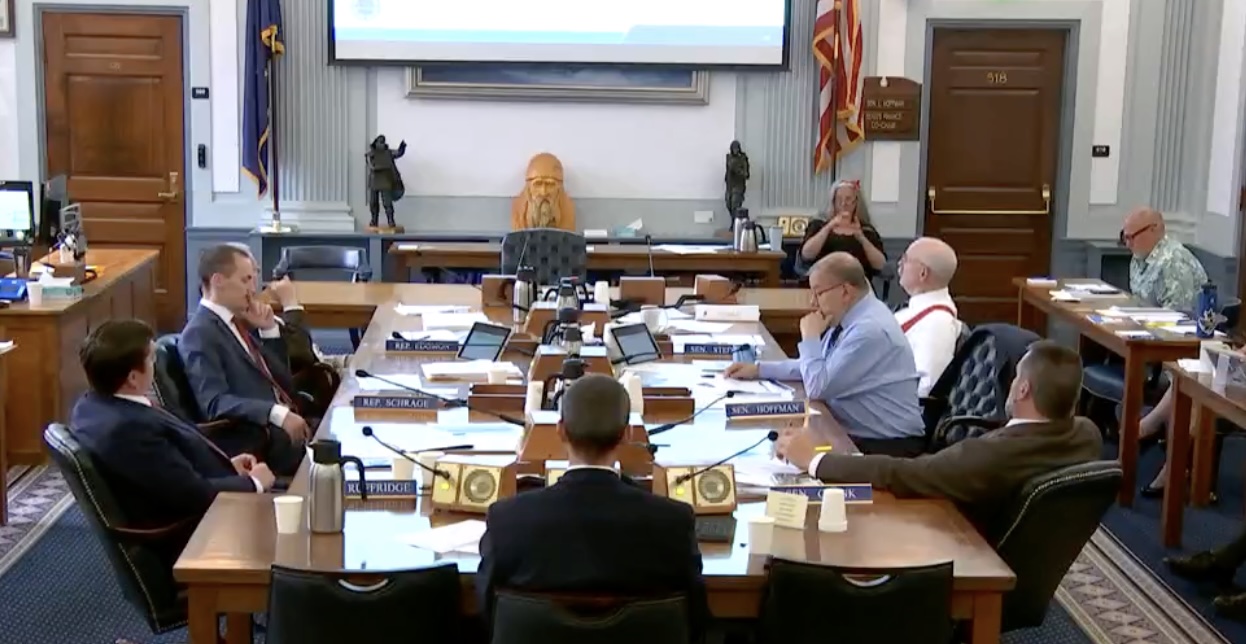
July 3, 2026 – As Alaskans head into the holiday weekend, the legislative conference committee negotiating gasline legislation released a new compromise draft, offering what appears to be a middle ground between the House’s cleaner version of the Alaska LNG tax package and the Senate’s more expansive rewrite.
The new conference committee substitute for House Bill 381, Version Q, preserves the core purpose of the legislation, which is establishing an alternative tax structure intended to make the Alaska LNG project more financeable, while rolling back or modifying several controversial provisions added by the Senate during the second special session.
The six-member conference committee consists of Reps. Calvin Schrage, Bryce Edgmon, and Justin Ruffridge, along with Sens. Bert Stedman, Lyman Hoffman, and Mike Cronk.
Among the most significant changes is the removal of the Senate’s “prevailing wage “requirement, a demand of the unions. The conference committee retained the project labor agreement language and apprenticeship utilization requirements but deleted the prevailing wage mandate that had been inserted. The legislative findings now state those remaining labor provisions are necessary because the state is expected to become a part owner of the gasline project.
The conference committee also backed away from the Senate’s changes to local school funding. Rather than reverting entirely to current law, the compromise restores the House approach, allowing municipalities receiving revenue from the alternative volumetric gas tax to count a portion of those revenues toward their required local contribution for education. It also maintains a four-percent annual growth cap on the required local contribution.
The revised legislation continues to exempt qualifying Alaska LNG project property from traditional municipal property taxes, replacing that system with the negotiated alternative volumetric tax intended to reduce construction-phase tax burdens while still providing long-term revenue to local governments.
The conference committee version also retains several transparency provisions relating to the Alaska Gasline Development Corporation. While allowing AGDC to continue using confidentiality agreements for commercially sensitive negotiations, the bill limits what information may be withheld from the public and lawmakers. Contract terms that could expose the state to significant financial obligations generally could not be kept confidential, although specific project cost information may remain confidential if disclosure would cause competitive harm and reasonable summaries are provided instead.
Another provision preserved in the compromise requires the Legislature to have an opportunity to disapprove any future transfer, sale, or disposal of an ownership or management interest in an AGDC subsidiary. Under the proposal, lawmakers would have 90 days to act before such a transaction could proceed.
According to a side-by-side comparison prepared for legislators, the conference committee removed the Senate’s revisions to the required local contribution formula while largely restoring the House language in that section. Other technical changes conform cross-references and definitions throughout the bill.
A legal memorandum from the Legislature’s Division of Legal and Research Services concluded the conference committee stayed within its limited authority. Chief Counsel Megan Wallace wrote that the committee did not alter provisions where the House and Senate had already agreed, nor did it add entirely new sections. Instead, the committee revised only those portions where the two chambers had previously differed.
HB 381 remains one of the centerpiece measures of the Legislature’s ongoing special session. The legislation is designed to establish a construction-phase tax framework that is necessary to improve the financing prospects for the estimated $44 billion Alaska LNG project while balancing concerns from municipalities, labor groups, and state policymakers.
The conference committee report now heads back to both the House and Senate, where lawmakers must vote to either accept or reject the compromise package. Neither chamber may amend the conference committee version, instead must take an up or down vote.



2 thoughts on “Conference committee unveils new version of Alaska LNG tax bill, strips some Senate add-ons”
What about the S corporation income tax?
What a coincidence.
.
Happened just after the lobbyist whose job, according to the “Alaska Lobbyist Directory”, is helping out with “All legislation and administrative action relating to taxation of resource industries in Alaska” …helped out with getting taxpayer-subsidized housing for legislators who, coincidentally, write the taxes on resource industries in Alaska.
.
“Reed Stoops, a lobbyist, is a member of the board of the Juneau Community Foundation and helped organize the latest housing donation. The ultimate goal is to give the Legislature more housing options to keep legislative sessions in Juneau, ‘especially during a special session like this,’ he said.”
(https://alaskabeacon.com/briefs/nonprofit-foundation-gifts-alaska-legislature-16-apartments-in-juneau/)
.
Seems like a pointed message, …this is how we the Ruling Class do things and there’s nothing you the masses can do about it.
.
Probably true, but can you imagine the mess if the masses accidentally regain control of Alaska’s election and grand-jury systems, or something like an Operation Greylord hits the Holy Party City of Juneau?