


By SUZANNE DOWNING
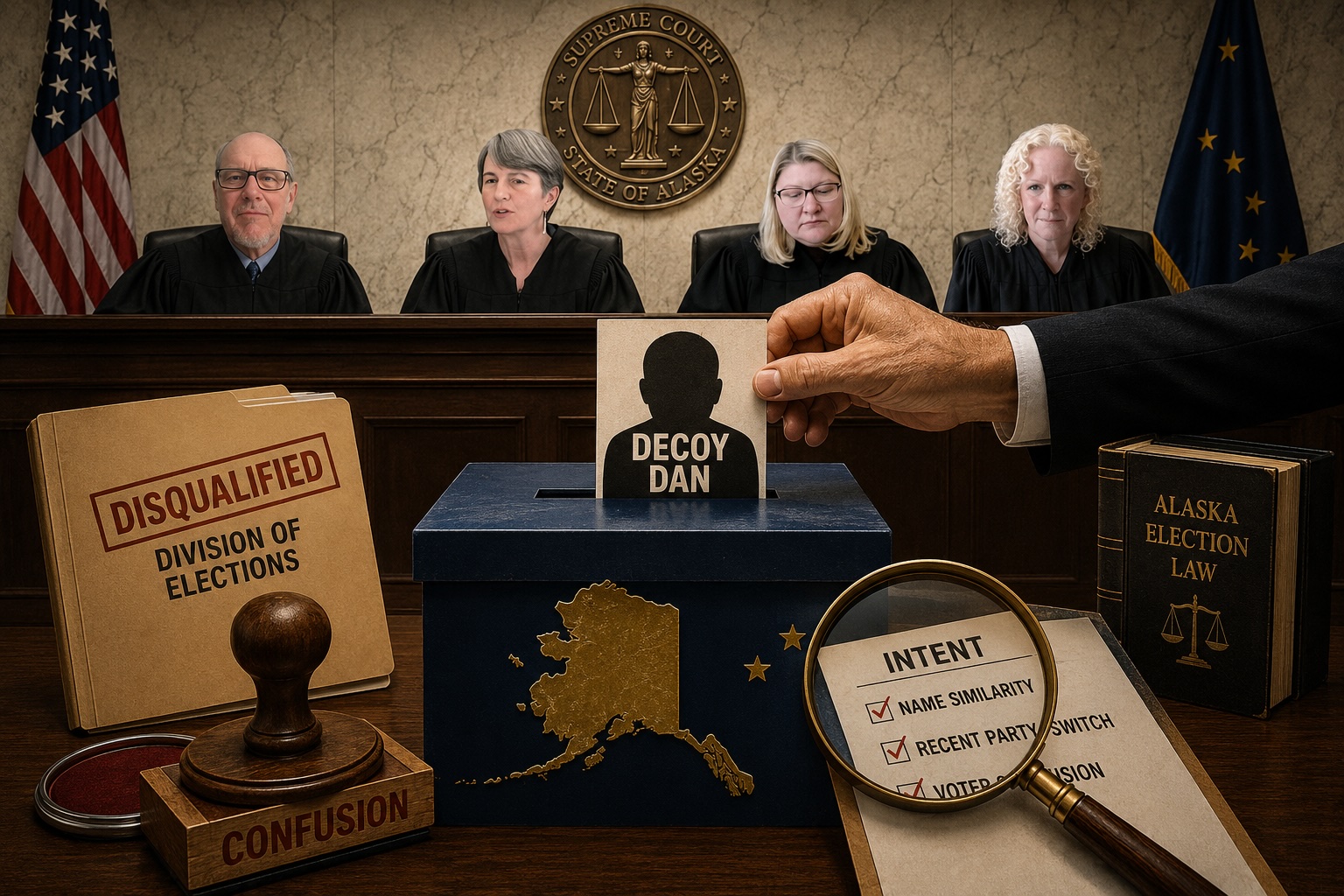
June 29, 2026 – The Alaska Supreme Court on Monday heard a full hour of arguments over whether Decoy Dan, Daniel J. Sullivan, should appear on the Aug. 18 primary ballot for US Senate after the Division of Elections determined his candidacy was not filed in good faith.
Each side received 30 minutes to make its case before the state’s highest court, which is being asked to overturn a Superior Court ruling that ordered Sullivan restored to the ballot. Because ballots must soon be finalized for printing, the Supreme Court is expected to move quickly.
One of the more unusual developments in the case occurred before arguments even began.
Justice Dario Borghesan recused himself after Sullivan retained Anchorage attorney Jeff Robinson, whose law firm employs Borghesan’s sister-in-law. Although there has been no suggestion of wrongdoing by the justice, the hiring had the practical effect of forcing his recusal from one of the state’s most closely watched election cases.
The move raised eyebrows because Robinson is best known as a criminal defense attorney rather than an election law specialist. It raises the question of whether the hiring was a strategic maneuver by Democrats designed to remove a conservative member of the court from hearing the appeal.
During oral arguments, the justices repeatedly focused on the central legal question: Where, exactly, does Alaska law require that a candidate file “in good faith?”
That question has been at the heart of the case since the Division of Elections concluded Sullivan’s candidacy was an attempt to confuse voters by exploiting his nearly identical name to incumbent US Sen. Dan Sullivan.
Assistant Attorney General Chris Murray, representing the State of Alaska, argued that while the phrase “good faith” does not explicitly appear in statute, the requirement is implicit in the law governing properly filed candidacies. He pointed the court to emails Sullivan exchanged with the Division of Elections before filing, noting that Sullivan initially attempted to appear on the ballot as “Daniel S. Sullivan” even though his legal middle initial is “J.”
According to Murray, those communications demonstrated an intent to capitalize on the incumbent senator’s name and mislead voters.
The justices, however, appeared skeptical that the argument ultimately carried legal weight, noting that the Division of Elections had already required Sullivan to correct his filing so the ballot would accurately reflect his legal name.
Murray also pointed to Sullivan’s decision to register as a Republican just two days before filing for office, arguing it further demonstrated that the candidacy was designed to create voter confusion rather than represent a legitimate political campaign.
But that argument likewise appeared to gain little traction with the court.
Robinson countered that regardless of what state officials believed Sullivan’s motives were, neither Alaska statutes nor Division of Elections regulations authorize removing a qualified candidate from the ballot based on perceived intent.
His argument closely tracked the reasoning adopted by Superior Court Judge Thomas Matthews last week, who ruled that while Sullivan’s motives might be questioned, the Legislature has never enacted a law allowing election officials to reject an otherwise qualified candidate because they believe the filing was made in bad faith.
Robinson did not agree with the justices who suggested the Division could help reduce confusion by putting the word “incumbent” by the sitting senator’s name on the ballot. Robinson called that an “honorific” that would give him a perceived advantage.
The hearing largely revisited the same legal issues argued before the Superior Court: whether election officials possess implied authority to reject filings they believe are deceptive, or whether that authority must be expressly granted by the Legislature.
The case has drawn nationwide attention because of the obvious similarities between the names of Daniel J. Sullivan and incumbent Republican Sen. Dan Sullivan. The Division of Elections previously concluded that the challenger was attempting to confuse voters and removed him from the ballot, due to the Division’s responsibility to voters and to reduce confusion. That was a decision Judge Matthews reversed last week.
The Supreme Court now must decide whether Alaska election law allows state officials to look beyond the technical qualifications for office and consider a candidate’s intent when determining whether a filing is valid.
With ballots needing to be printed, a decision is expected today.


5 thoughts on “Alaska Supreme Court hears case of Decoy Dan”
Boing boing the kangaroo court will do whatever the Democrats want
Dirty deeds done dirt cheap. Unfortunately, with RCV the real Dan S should start packing out his D. C. Office. RCV was made to order for the Alaska Dems and good ole Lisa.
Decoy Dan used Senator Sullivan’s middle initial S when corresponding with the election division but the Ak Supreme Court said it didn’t matter since the division required him to correct the misrepresentation. Any moron knows correcting the misrepresentation does not erase the obvious intent to deceive. The Alaska Supreme Court is a disgrace.
Got to give Peltola credit for being such a sharpshooter during this election cycle using the same tactics as a successful hunter/gatherer.
The hunter with the biggest “cache” at the end of the season always has the best lineup of decoys in the field to fool the “not so sharp” victims who cant spot an imposter.
The pile of cash she is receiving from DC also is proof she is very proficient at deception.
What ever happened to disallowing outside donations to our state elections?
Scott Kendall is another sharp shooter with a stack of decoys and continues to fool the dumb ones.
Alaska Supreme Court……fraudster Democrats in black robes thinking they know the law.