


By SUZANNE DOWNING
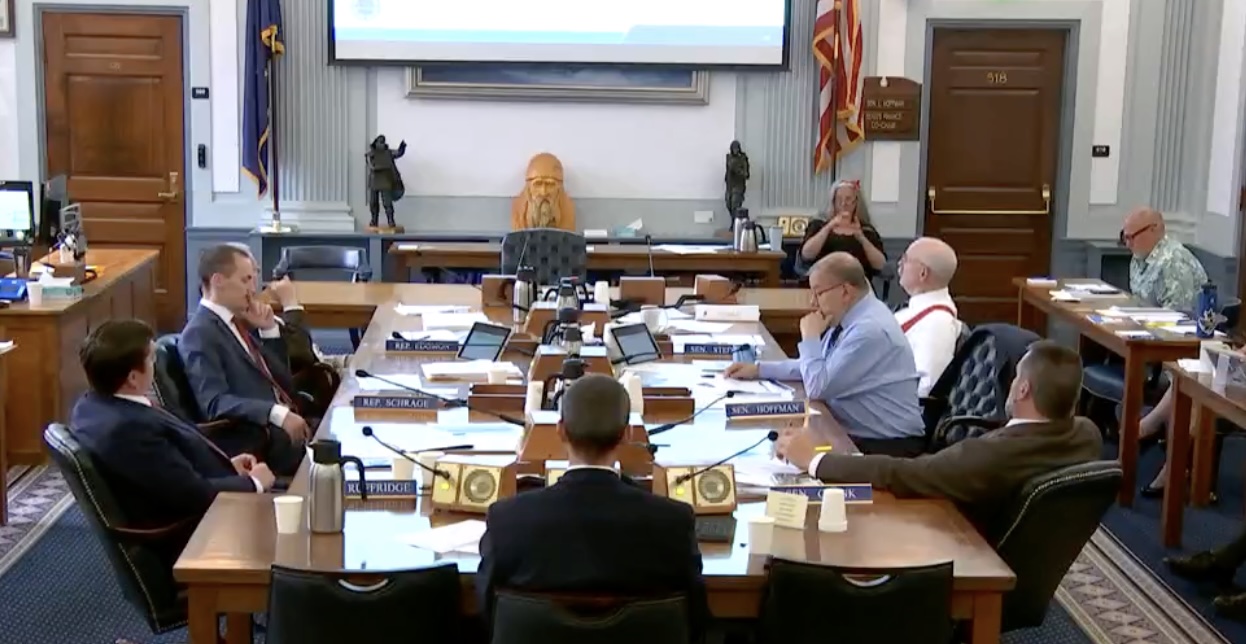
June 28, 2026 – The six-member conference committee tasked with salvaging Gov. Mike Dunleavy’s Alaska LNG tax package spent hours Saturday working through technical questions that could determine whether the state’s long-awaited gasline moves forward or becomes mired in a broader tax fight.
Lawmakers met throughout the day with representatives from the Alaska Gasline Development Corp., Glenfarne, and the Department of Revenue, attempting to reconcile sharply different versions of House Bill 381. No meeting was held Sunday. The committee is scheduled to reconvene Monday, with lawmakers expected to return to the Capitol on July 1, after which the full Legislature could be asked to vote on a compromise.
At the center of the dispute is an issue that was never part of Dunleavy’s original proposal: whether to impose Alaska’s oil and gas corporate income tax on pass-through entities such as S corporations, LLCs, partnerships, and sole proprietorships involved in the state’s oil and gas industry.
The governor called the special session for a straightforward purpose: to make the Alaska LNG project more financeable by replacing local property taxes during construction with a volumetric tax that would not begin until natural gas is actually flowing through the pipeline. The change is intended to eliminate billions of dollars in taxes that would otherwise accrue before the project earns any revenue.
But Senate leaders added the pass-through entity tax before sending the bill back to the House, where representatives refused to concur, forcing appointment of a conference committee.
Some lawmakers have long argued that privately held oil and gas companies should pay a corporate-style income tax similar to C corporations. That proposal would immediately affect companies such as Hilcorp and HEX, regardless of whether the Alaska LNG project is ever built, and supporters believe it could generate hundreds of millions of dollars in additional annual state revenue.
Opponents, including Dunleavy and Glenfarne, argue that the proposal has little to do with financing the gasline and instead represents a major policy change being attached to a narrowly focused development bill.
Mike Dunleavy: Alaska has waited long enough for the gasline
House Speaker Bryce Edgmon, an independent from Dillingham and one of the conference committee members, has acknowledged that the pass-through tax remains one of the committee’s biggest stumbling blocks.
The committee consists of Edgmon, Rep. Calvin Schrage, Rep. Justin Ruffridge, Sen. Lyman Hoffman, Sen. Bert Stedman, and Sen. Mike Cronk.
Dunleavy, who has consistently vetoed broad-based tax increases during his tenure as governor, called lawmakers into a second special session after the House rejected the Senate’s amended version of HB 381. In an opinion piece published Sunday in The Alaska Story, he again urged lawmakers to keep the legislation focused on making the Alaska LNG project economically competitive rather than using it as a vehicle for unrelated tax policy.
During Saturday’s meeting, the Department of Revenue’s Tax Division outlined how the proposed pass-through entity tax would operate and highlighted several administrative concerns.
According to Acting Tax Division Acting Director Brandon Spanos, the proposal would extend Alaska’s existing oil and gas corporate income tax to qualified pass-through entities earning oil and gas-related income in Alaska, including income from production, pipelines, LNG processing, gas treatment, carbon capture, and marine transportation of Alaska-produced LNG.
The proposal would apply graduated tax rates beginning with income above $1 million, eventually reaching a top marginal rate of 9.4% on taxable income exceeding $5 million.
Department officials explained that C corporations already paying Alaska’s oil and gas corporate income tax would remain exempt, as would public corporations. Income attributable to public ownership would also be exempt.
One presentation focused specifically on how the tax would affect the Alaska LNG project’s ownership structure.
Under the current arrangement, the project would be owned by 8 Star Alaska LLC, which is 75% owned by Glenfarne and 25% owned by the Alaska Gasline Development Corp. Because AGDC is a public corporation, approximately one-quarter of the project’s income would be exempt from the proposed tax.
Department officials explained that 8 Star Alaska, not Glenfarne directly, would file and pay the tax. The tax would become an expense of the project itself, reducing the earnings ultimately passed through to Glenfarne for federal tax purposes.
The Department of Revenue presentation also identified several unresolved concerns with the legislation.
Among them:
- Computing taxable income as though pass-through entities were C corporations could prove difficult and expensive for taxpayers.
- The bill authorizes the department to require both AGDC and Glenfarne to file returns, but the legislation is unclear about when that authority would be exercised or what type of returns would be required.
- Because the proposal creates an entity-level tax rather than a traditional pass-through tax, officials warned it represents a relatively novel approach that could create unintended compliance and administrative problems.
- Federally tax-exempt organizations other than public corporations would not automatically qualify for exemptions under the proposal.
- One federal statutory reference incorporated into the bill appears to rely on language from earlier drafts that focused only on S corporations, creating the potential for confusion or enforcement issues.
Those concerns add to those of conservative lawmakers who question whether such a sweeping tax policy should be added to legislation intended solely to improve financing for the largest energy infrastructure project in North America.
Whether the conference committee ultimately strips the pass-through tax from the bill or leaves it intact could determine not only the fate of HB 381, but also whether Dunleavy is willing to sign the legislation if it reaches his desk. He has indicated he will veto such a bill with tax add-ons.



2 thoughts on “Conference committee considers S-corporation tax as Alaska LNG bill hangs in the balance”
It doesnt matter what the Senate decides to do.
Willy Walker already promised Alaskans a gasline if they elect him as a Governor one more time.
The Chinese investors have already got the red carpet and a pair of knee pads ready for Governor Walker to make it easier to bow to their fearless leader.
Just think of the huge PFD all Alaskans will receive if we elect him one more time as promised???
Its banana republic stuff. tax Calvinball. They want to just make up the,rules as the whims strike them . ” the laws are dictated by our feeljngs” . business requires stability. Nobody with sense will invest in a place where the rules change unpredictably. Like Venezuela? This is how you get Venezuela. I’m not going to build you a,large, expensive asset,that you can just decide ” hey!, I want that !” And use state power to grab it without compensation