


By SUZANNE DOWNING
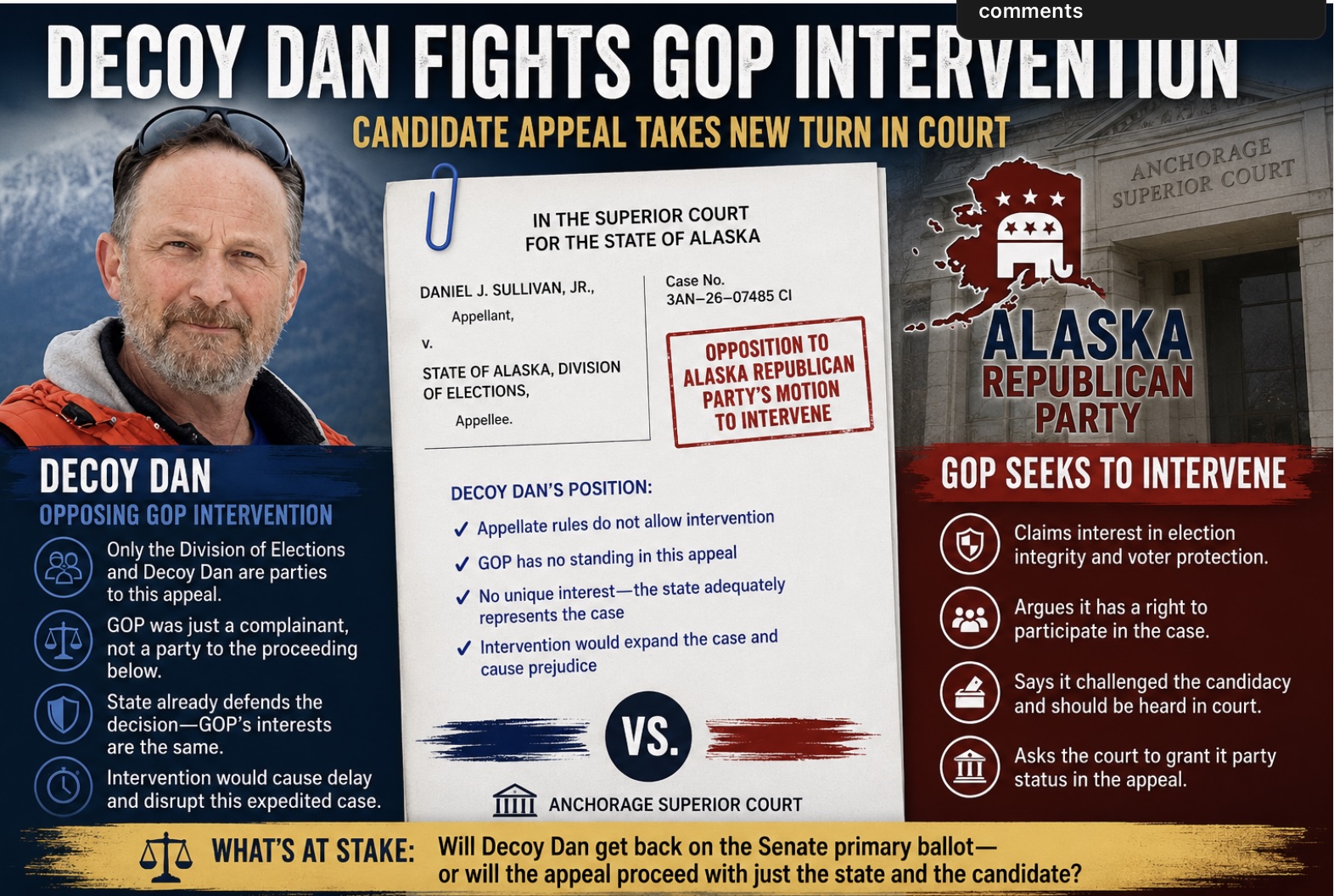
June 24, 2026 – Alaska’s Division of Elections has filed its answer to “Decoy Dan” Sullivan’s lawsuit, arguing that the Petersburg man was never removed from the US Senate ballot because of his qualifications, but because he deliberately sought to confuse voters.
In a forceful brief filed Wednesday in Anchorage Superior Court, state attorneys argue that Daniel J. Sullivan Jr. filed his candidacy “for the purpose of confusing or misleading voters” and compromising the fairness of Alaska’s election ballot.
The filing marks the state’s first full response to Sullivan’s appeal of Division Director Carol Beecher’s June 15 determination that he should not appear on the Aug. 18 primary ballot.
The state says the issue before the court is straightforward:
Did Sullivan properly file as a candidate, or did he seek ballot access primarily to create voter confusion by sharing the same name as incumbent Republican US Sen. Dan Sullivan?
According to the brief, Sullivan submitted paperwork requesting that his name appear on the ballot exactly as “Sullivan, Dan” — identical to the way the incumbent senator appears. He also switched his voter registration to Republican immediately before filing.
The Division says matters became even more suspicious after Beecher asked how he wanted his name displayed on the ballot.
Rather than use his actual middle initial, J., Sullivan reportedly asked to appear as “Dan S. Sullivan, ” using the same middle initial as the incumbent senator. State attorneys call the request “bewildering.” The email trail showing this will come out in discovery.
The state also points to evidence gathered during the investigation, including Sullivan’s campaign website, which closely resembles Sen. Sullivan’s website in design and appearance. It further notes that the website contained material apparently created by a consultant connected to one of Sen. Sullivan’s Democratic opponents.
Perhaps the most significant claim in the brief is the state’s assertion that Sullivan is not actually disputing the Division’s factual findings.
“Tellingly,” state attorneys wrote, Sullivan “does not appeal the substance of the Division’s decision, which was based on clear evidence that he sought to access the ballot in a manner designed to sow confusion and to compromise the fairness and neutrality of the election.”
Instead, the state says Sullivan is arguing only that election officials lacked authority to stop him.
The Division’s filing goes further, comparing the case to decisions in other states where courts blocked candidates whose actions appeared designed to mislead voters.
State attorneys cite a 1930 Nebraska case in which a candidate with a similar name was denied ballot access after officials determined he was attempting to confuse voters. They also cite cases from Florida and Louisiana involving candidates who sought to manipulate ballot design or naming conventions to create voter misunderstanding.
The brief argues that Alaska election law requires the Division to prepare ballots that are fair, clear, and accurately reflect voter intent. Election officials are not required, the state says, to place candidates on the ballot when evidence shows they are attempting to exploit the election process itself.
The state also raises a procedural challenge, arguing Sullivan waited too long to file his appeal. Attorneys note that he was aware of concerns about his candidacy for weeks before filing suit on June 22, leaving only days before ballot printing deadlines.
Meanwhile, Decoy Dan is separately asking the court to prevent the Alaska Republican Party from intervening in the case, arguing the party lacks standing and should not be allowed to participate as a party to the appeal. The Republican Party was the organization that originally challenged Sullivan’s candidacy before the Division of Elections.
Taken together, the filings reveal a central dispute that now faces the court: Whether Alaska election officials have the authority to stop what they believe is an intentional effort to create voter confusion, or whether anyone who meets the constitutional qualifications for office must be allowed on the ballot regardless of motive.
With ballots scheduled for printing no later than June 30, the court is under pressure to issue a ruling quickly. The Division is asking for a decision in time for review by the Alaska Supreme Court if further appeals follow and the judge has promised a speedy decision. Readers may expect important decisions on this case to occur today, Thursday, and Friday.


18 thoughts on “Division of Elections files response to fake Republican Decoy Dan’s challenge to ballot decision”
I’ve heard fellow Alaskans complain that Decoy Dan should be entitled to run for any office he chooses. I agree. However, if a preponderance of evidence shows a candidacy is a ruse to deceive voters then that candidacy should be rejected. There is truly no circumstance where lying is a good thing.
It’s just one more example the Democrats will do whatever they need to do to cheat.
January 6, Rich. Which party fomented that?
Democrats. Biden’s DOJ lured peaceful protesters into the Capital under a ruse, then electronically corraled them with surveillance equipment linked to their cellphones, identified them, then went and arrested them. That’s the Democrat’s brand of tyranny. So glad Trump won by a landslide in 2024.
Democrats. Biden’s DOJ lured peaceful protesters into the Capital under a ruse, then electronically corraled them with surveillance equipment linked to their cellphones, identified them, then went and arrested them. That’s the Democrat’s brand of tyranny. So glad Trump won by a landslide in 2024.
Now is an opportunity for Nancy Dahlstrom to shine. Give it to the Petersburg fraud, Nancy.
If Decoy Dan wins access to the ballot, expect several people to legally change their names to Lisa Murkowski and challenge her for US Senate in 2 years.
…….as Democrats, of course.
I need to get out of this mess.
He could point to a precedent common in previous elections. RCV ballot prop was misleading which promoted confusion. Duh, that’s one of the goals.
Twenty mil of soros bucks, the AK presstitutes, ad agencies cows always in rut, and a similar name to another candidate. I’d say the AK bar can make it happen.
So this is confusing These tactics are not new and state election offices for decades now have not allowed candidates to have the exact same name on the ballots. The state election office should have told Dan J no he could notbusebDan S on the ballot. And if they are going to say he is running intentionally to create confusion, the discovery on this is going to be interesting.
This should be over shortly, well this part of it anyways. We will see if Daniel J. Sullivan Jr. and whoever is footing the bill wants to take it to the next level after this is dismissed or the final determination is affirmed by the Superior Court in the next day or two.
Let’s have the Dans add where they are from. It can be a pick between Dan Sullivan, Petersburg Alaska and Dan Sullivan from Fairview Park Ohio.
Republicans will do anything to be the victim, even raise drama about someone’s name. Worried their voters are too stupid to tell the difference between Dan Sullivans, you should all feel insulted. Too conditioned to feel outraged instead, sheeple.
We absolutely need Petersburg Dan Sullivan on that ballot. In order to get rid of Donald Trump with an impeachment conviction by the USA Senate, we need to employ every dirty trick that we can muster, including fooling the public with confusion and vote chicanery. That’s how we Marxist Democrats can win. The only way. Aside from rigging elections with fraud, confusion, and skullduggery, I happen to be in a brotherhood of the fake Dan Sullivan. We are both political radicals and we both love alcohol. So much that I’m willing to campaign for the fake Dan Sullivan just in order to get more donation support for my little left-wing rag. And if my loyal readers (all 53 of them) can’t produce green for me, I would gladly take high volumes of whiskey, rum, or scotch. I love lots of alcohol. It keeps me functional. It keeps me raging. That’s what I live for. To hell with the truth. Let’s do what’s right for my liver. More liquor, please.
Derm the Mutt
Still Snorting and Farting Big Time
From Alaska
Suggestion:
Derm should donate his liver to science.
We can compare it to other Democrats who are riddled with liver dysfunction and try to learn how to make less volatile spirits. Forget about Derm’s brain being donated. We already know it’s weight would be less than half of a Republicans brain. And we must not confuse him with chronic brain injury from sports. Derm’s athleticism is limited to lifting the next bottle.
Maybe Derm needs rotator surgery. Does he pour with his right or left arm?
If anyone needs to know how an old, decrepit left-wing journalist spends his final days in rage, look no further than Cole. Could it be the alcohol, or is it genetic predisposition to unhappiness and failure?
His middle initial change request was his FAFO
This is likely a case going higher to the US Supreme Court because Alaskans have been cutting corners and incorrectly doing things for so long that our current leaders are confused. Starting with printing candidates names by what they are registered by. No more nicknames like Nick shorten for Nicholas for example.
If AKGOP leaders do not want to fight dirty with the dirty Democrats. Then do everything to the letter and correctly and be a real square about doing everything correctly.