


By SUZANNE DOWNING
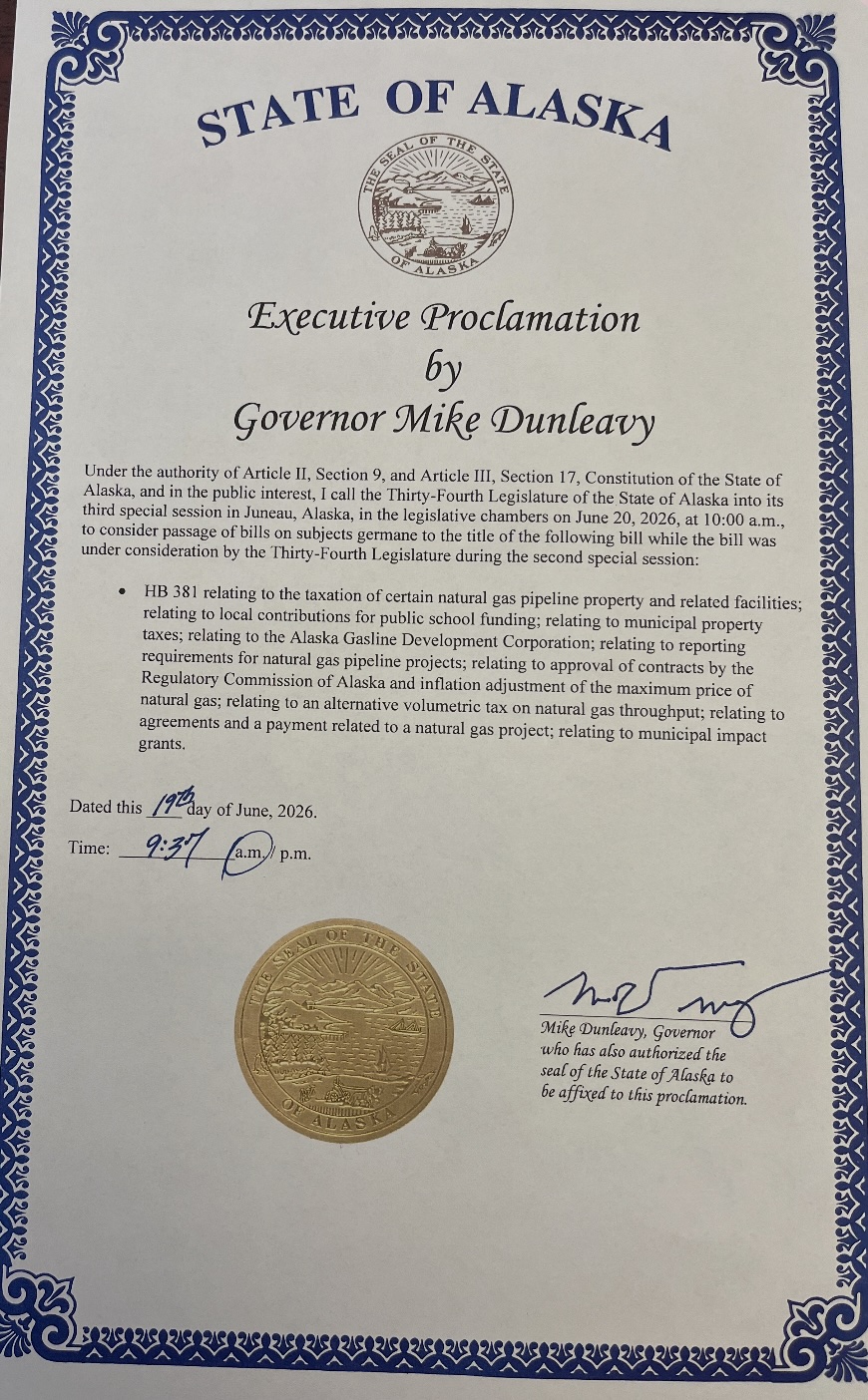
June 19, 2026 – Gov. Mike Dunleavy has already prepared for what appears increasingly likely: another special session of the Alaska Legislature.
On Friday morning, even as the Senate Finance Committee took up work on House Bill 381, the governor’s Alaska LNG tax legislation, Dunleavy released a proclamation calling lawmakers back into a new special session if they fail to complete their work before the current session expires at midnight.
The move comes after weeks of legislative maneuvering in reaction to the governor’s proposal to establish a predictable tax structure for the proposed Alaska LNG project, a measure supporters say is necessary to improve the project’s economics and provide certainty to investors and potential gas buyers.
The Senate is scheduled to convene at 11 a.m. Friday for what is expected to be the final day of the current special session. But after repeated delays, committee substitutes, and ongoing negotiations over possible amendments, there is growing skepticism that the Senate majority has the votes — or the desire — to move a clean version of the legislation to the governor’s desk.
Dunleavy’s proclamation does not necessarily mean another special session will occur. The governor retains the authority to withdraw the call if lawmakers pass legislation he finds acceptable before adjournment.
Still, the release of the proclamation while Senate Finance was actively meeting sent a clear signal: The administration is preparing for the possibility that the Senate will run out the clock without resolving one of the state’s top priorities.
The current special session was convened to address tax terms associated with the proposed Alaska LNG project, a long-discussed effort to bring North Slope natural gas to market through an 800-mile pipeline and liquefied natural gas export facility. The legislation seeks to replace certain construction-phase property taxes with a volumetric tax structure based on the amount of gas flowing through the system once operational.
The change is essential because traditional property taxation during construction would create billions of dollars in costs before the project generates any revenue. Already, Glenfarne, the company contracted to build the project, has laid out millions of dollars it cannot recover if the Legislature bolluxes up the terms. The proposed tax structure improves the project’s competitiveness against LNG projects in Texas, Louisiana, Qatar, Australia, and other global competitors.
The House passed the legislation last week with a bipartisan vote and sent it to the Senate. Since then, attention has focused on the Senate majority, where lawmakers have considered changes that critics say would alter the purpose of the bill.
Among the proposals discussed has been the possibility of attaching taxes on existing Cook Inlet gas producers organized as S-corporations, including Hilcorp and HEX Cook Inlet. Opponents characterize such proposals as a “poison pill” that would force the governor to choose between signing a tax increase on current Alaska gas suppliers or vetoing his own gasline legislation.
Because Cook Inlet producers supply much of Southcentral Alaska’s natural gas, critics argue any new taxes would likely be passed on to consumers through higher utility bills.
The legislative drama has unfolded against a hard deadline. Under the Alaska Constitution, special sessions are limited to 30 days. If lawmakers fail to complete action before adjournment, the governor may immediately call them back into another special session focused on the same subject matter.
The governor has repeatedly described the gasline legislation as a necessary step toward advancing what would be one of the largest private-sector construction projects in North American history. The development could support thousands of jobs and provide long-term energy security for Alaska while opening access to international LNG markets.
Whether lawmakers send the governor a clean bill, a substantially amended bill, or no bill at all may be determined in the final hours of Friday’s session.
If the Senate fails to act, Alaskans should not expect the debate to end. The governor’s proclamation suggests the fight over the gasline tax package may simply continue in another special session, potentially beginning within days.
The Legislature, on the other hand, controlled by Democrats and a few of their allies, could simply gavel in and gavel out, and give the governor a middle finger. That is within the realm of possibility this year. Some 80% of Alaskans want a gasline to be built, but the Alaska Senate is run by people who demand everything on their tax-and-spend terms.

5 thoughts on “Dunleavy signs proclamation for another special session on gasline”
He has yet to state why this is urgent. HB381 is a horrible bill for the state.
You haven’t been pay attention have you?
https://gov.alaska.gov/governor-dunleavy-introduces-legislation-to-advance-alaska-lng-project-with-alternative-tax-structure/
https://www.facebook.com/GovDunleavy/videos/if-we-dont-fix-alaskas-property-tax-so-aklng-can-move-forward-alaskans-are-going/2723906987978164/
https://pgjonline.com/news/2026/may/alaska-lawmakers-head-to-special-session-over-natural-gas-pipeline-bill
https://alaskabeacon.com/2026/05/22/dunleavy-pins-pipeline-fate-on-tax-break-he-wants-alaska-lawmakers-to-approve/
How is HB381 horrible for the state? Because it allows the state to make billions of dollars off of a commodity that is worthless to it when left in the ground? Because it would provide thousands of jobs for Alaskans? Or is because development in already developed areas of the state would revitalize those areas?
Happy Juneteenth, suckas. Enjoy your vacation in Juneau while your challengers are busy campaigning their asses off and raking in $$$.
Good to see that the Guv is using all the tools available. Senator Bert Stedman will do everything in his power to kill the gasline. If Bert had been around in 1975, he would have made a valiant effort to kill the TAPS line. Bert would have tried to scuttle Statehood if he had the chance.
Stedman = severe mental illness.