


By SUZANNE DOWNING
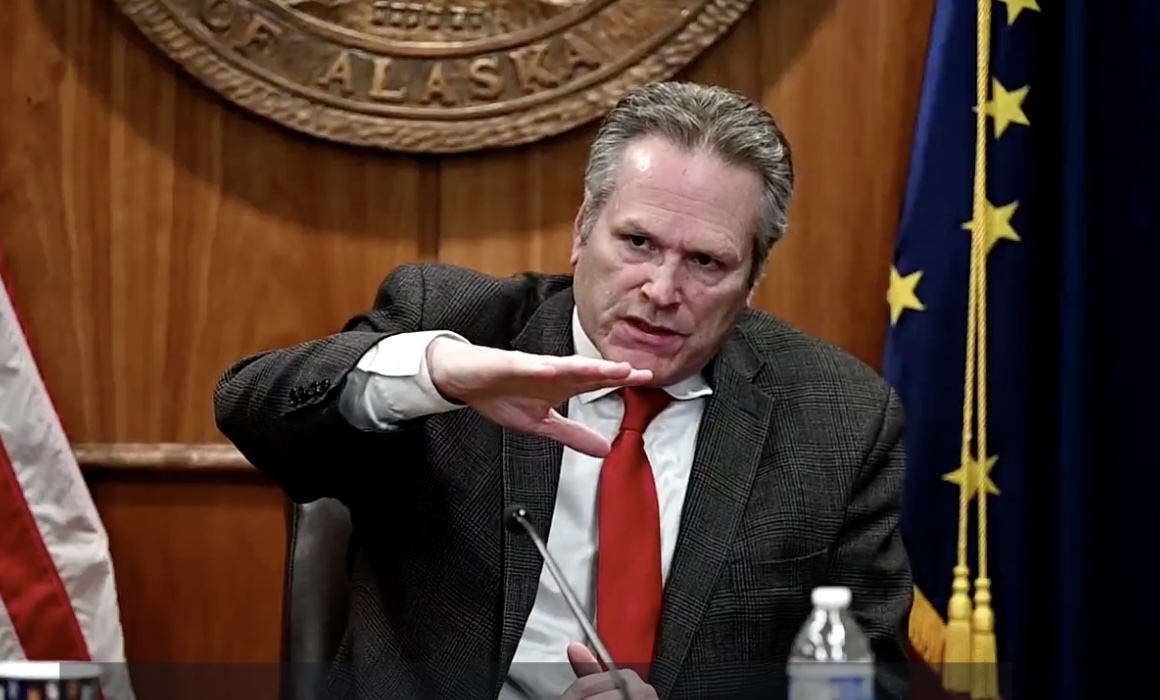
June 18, 2026 – Gov. Mike Dunleavy swung the veto pen Thursday, rejecting nine of the 24 bills that reached his desk at the end of the regular legislative session while allowing a major education funding package, House Bill 28, to become law without his signature.
The governor’s actions came on the final day of his constitutional review period, setting up potential veto override fights when lawmakers reconvene Friday, while also preserving a major increase in education funding that had been the subject of months of debate.
The highest-profile bill allowed to become law was House Bill 28, the broad education package that includes school district energy cost reimbursements, substitute teacher provisions, changes involving school board qualifications, a teacher student-loan repayment pilot program, and other education measures. Rather than sign the bill, Dunleavy allowed it to become law without his signature under Article II, Section 17 of the Alaska Constitution. The measure becomes Chapter 22, SLA 2026.
The governor’s vetoes reflected several themes that have defined his administration: opposition to expanding government regulation, resistance to new taxes, skepticism of state-run programs, and concerns about local control.
Among the vetoed measures was Senate Bill 41, which would have required development of mental health education in schools. Dunleavy said student mental health is important but argued decisions about sensitive classroom instruction should remain as close as possible to parents, local school boards, and communities.
He also vetoed Senate Bill 258, dealing with software licensing contracts. The governor said the measure would place rigid statutory restrictions on how state and local governments negotiate software agreements in a rapidly changing technology marketplace.
Another veto fell on House Bill 52, concerning oversight and reporting requirements for psychiatric hospitals serving minors. Dunleavy said the legislation would create duplicative inspection, reporting, and notification requirements for facilities already subject to extensive regulation and accreditation standards.
House Bill 24, a tobacco and nicotine regulation measure, was also rejected. While supporting efforts to keep nicotine products away from minors, Dunleavy objected to the bill’s new tax provisions and expanded regulatory requirements. He said Alaska should not adopt targeted taxes outside a broader fiscal plan.
The governor vetoed House Bill 23, which would have renamed the Alaska State Commission for Human Rights as the Alaska State Commission for Civil Rights and expanded the commission’s reach over nonprofit employers. Dunleavy said the measure could create uncertainty for charitable, educational, and religious organizations.
House Bill 21, establishing the Alaska Work and Save retirement program, was another casualty. The governor said encouraging retirement savings is worthwhile but argued the bill would create a new state-run investment program and impose administrative burdens on employers.
Dunleavy also rejected House Bill 195, a measure expanding pharmacist authority and changing the title “physician assistant” to “physician associate.” He said the legislation expanded pharmacist patient-care services too broadly without sufficient statutory safeguards or clarity regarding scope of practice.
House Bill 280, which would have changed how certain corporate income is apportioned to Alaska under the Multistate Tax Compact, was vetoed because the governor viewed it as a stand-alone revenue measure not tied to broader fiscal reforms and spending controls.
The final vetoed bill was House Bill 314, relating primarily to registered interior designers and extending the Board of Registration for Architects, Engineers, and Land Surveyors. Dunleavy supported extending the board but opposed creating what he described as a new state registration framework for interior designers, arguing the profession does not require a new layer of government regulation to protect public health or safety.
The nine vetoes represent more than one-third of the bills awaiting action on the governor’s desk. They also illustrate the continuing tensions between Dunleavy and the Democrat-dominated legislative majorities, tensions that have spilled into the ongoing special session over Alaska LNG legislation.
The Legislature is expected to try to convene in joint session on Friday to conduct veto override votes.
Scroll through the veto transmittal letters in this PDF:



7 thoughts on “Governor vetoes 9 of 24 bills that were reaching veto deadline. Which ones?”
I am heartened that he let HB 27 come into law today. A statewide system of care for stroke and cardiac disease, modeled after the statewide trauma system. A win for Alaska EMS. Also included was CPR in the Schools. I’ve been working this since 2005. A good day for all.
If Alaska built enough in-state gas infrastructure to prioritize Alaska consumers first, the home-heating model changes substantially.
The question isn’t simply “pipeline or no pipeline.”
The question is:
Does Alaska remain a raw-resource exporter, or does Alaska become a producer of finished energy products for Alaskans first and export surplus value second?
Scenario 1: Current Model
North Slope Gas → LNG Export Project → Global Market
Benefits:
* Royalties
* Production taxes
* Property taxes
* Construction jobs
* Export revenue
Challenge:
* Alaska households still buy energy from utility systems.
* Export economics may compete with domestic needs.
* Future supply can become dependent on contracts, infrastructure ownership, and market conditions.
Citizens benefit indirectly. And mostly not at all.
⸻
Scenario 2: Alaska-First Gas Model
North Slope Gas → Alaska Gas System → Alaska Consumers → Export Surplus
Priority order:
1. Railbelt homes
2. Railbelt electric generation
3. Fairbanks energy
4. Rural energy hubs
5. Alaska manufacturing
6. Exports
Effects:
Railbelt
Potentially:
* Lower long-term heating costs
* More stable electric rates
* Reduced import dependence
* Reduced exposure to global LNG prices
Fairbanks
Natural gas expansion could replace:
* Heating oil
* Fuel oil
* Some wood-burning emissions
Potentially reducing winter heating costs and air-quality issues.
Rural Alaska
This is where the biggest transformation could occur.
⸻
Today
Many villages pay:
* $6–15+ per gallon heating fuel
* $7–12+ per gallon gasoline
Most of that cost is:
* Transportation
* Storage
* Financing
* Risk
not the fuel itself.
⸻
If Alaska Refines More Energy In-State
North Slope gas can become:
* LNG for village storage systems
* Propane
* Synthetic fuels
* Electricity generation
* Industrial heat
Instead of shipping raw gas away.
Several rural communities around the world already use small-scale LNG distribution networks where fuel is liquefied centrally and shipped regionally.
The delivered cost would still be significant, but potentially much lower than today’s imported heating-fuel model.
⸻
The Economic Multiplier
The biggest overlooked issue is where value is captured.
Today:
North Slope resource
↓
Export
↓
Refining elsewhere
↓
Value-added jobs elsewhere
↓
Finished products sold back
Much of the value chain occurs outside Alaska.
⸻
Alaska Refining Model
North Slope resource
↓
Alaska processing
↓
Alaska transportation
↓
Alaska storage
↓
Alaska distribution
↓
Alaska households
More wages, taxes, and business activity remain inside Alaska.
⸻
What It Could Mean for a Typical Family
Illustrative example only:
Current rural household:
* $5,000–10,000+ annual heating costs
If an Alaska-centered gas distribution system reduced delivered energy costs by even 25–40%:
Savings:
* $1,250–4,000 per household annually
Across tens of thousands of households, that becomes a major economic stimulus because families spend those dollars locally instead of on imported fuel.
⸻
The Strategic Question for the Legislature
Most LNG discussions focus on:
“How do we finance the project?”
An Alaska-centered discussion asks:
“How much of Alaska’s gas should be dedicated to lowering the cost of living for Alaskans before maximizing exports?”
That is fundamentally a public-policy question, not an engineering question.
If Alaska can produce gas for decades, then one negotiating framework would be:
1. Secure long-term domestic supply.
2. Secure affordable in-state energy.
3. Develop Alaska value-added processing.
4. Export surplus production.
Under that framework, the success metric isn’t only LNG exports. It is whether Alaska families see lower heating bills, lower electric bills, and more economic activity retained within the state.
I don’t represent anyone and am not paid by anyone for my analysis.
The amount of gas that the entirety of Alaska would consume if we ran pipelines to every village is a rounding error in the amount that would be processed into LNG and sold on the worldwide marketplace.
Replacing a propane stove with a natural gas stove costs up to $1500, $2500 for a heater. When they ran a gas line to Homer from Anchor Point each and every property in the assessment was charged somewhere around $3300…it’s 15 miles or so from Anchor Point to Homer.
Rate payers could never come up with the amount of money needed to pay investors for a phase 1 gas line and the big dog oil producers would never support a phase 2 export line because it would compete with their LNG overseas LNG portfolio interests., Source, Google AI Mode.
Summarize; No pipeline.
I think your analysis, while long is flawed. There simply isn’t a large enough market in Alaska to support the use of natural gas for in-state use as the step to exporting it. If those economics worked, they would have worked for oil off Prudhoe, which they haven’t for a half a century. If you are bootstrapping, you have to make enough with in-state sales to pay for export infrastructure. And yes, infrastructure is everything.
Your question: “Does Alaska remain a raw-resource exporter, or does Alaska become a producer of finished energy products for Alaskans first and export surplus value second?” This route requires endless subsidies, likely from the Permanent Fund, as the in-state marketplace simply isn’t large enough for a viable business, much less one that creates enough additional profit to justify an export business.
Today, there are 4 natural gas options. All are based on exports: the long pipeline from Prudhoe to Kenai, the short pipeline from Prudhoe to Kotz, and finally, the ship directly off the Slope to the Pacific Rim. No reason the occasional LNG tanker couldn’t stop at Kenai from time to time. There is a final option that I neglected – Gas to Liquids (GTLs) off the Slope through TAPS, batch shipped with crude. Costs and benefits with all 4 options.
There is a reason the Bush (and a lot of the rest of us in a smaller way) use propane (mainly for heating) rather than natural gas. Propane is well behaved. Infrastructure is in place and well known. We know how to use and resupply it. Great for remote use. Drawback is that it is difficult to use at -50F and will have to be manufactured for any expansion.
Appreciate your effort, but I think you are neglecting basic economics. Cheers –
Steve, I think you are discussing infrastructure while I’m discussing negotiation.
Rural Alaska doesn’t need a natural gas pipeline to every village to be included in Alaska’s economic future.
The red flag for me is when Alaska starts negotiating taxes before it negotiates opportunity.
Glenfarne has successfully demonstrated that global investors, labor, lenders, and buyers are interested in Alaska’s gas.
Good.
That means Alaska has leverage.
The Legislature’s duty is to negotiate from Alaska’s assets—not from the cost of dependency.
The question isn’t whether Alaska can export gas.
The question is whether Alaska will negotiate measurable opportunity for Alaskans before it legislates concessions for everyone else.
What concerns me is that Glenfarne has already returned to the Legislature seeking additional concessions.
If the answer today is tax certainty, what is the next request tomorrow?
At what point does Alaska stop negotiating what it is willing to give and start negotiating what it intends to receive?
The world wants Alaska’s gas.
The Legislature was elected to negotiate from the strength of Alaska’s assets and authorities—not simply ratify concessions one request at a time.
— Trudy Sobocienski
interesting gas range conversion if the stove didn’t come with the kit about 40.00
furnace would be costly but pay-back would be quick.
all other debate is moot, gas line was mandated for Seward many years ago. market just doesn’t support it.
line without export will not be built.