

By SUZANNE DOWNING
June 16, 2026 – If the Alaska LNG project dies in the Alaska State Senate this week, don’t expect the people responsible to stand on the Senate floor and explain why.
That’s because the “bipartisan” Senate majority has a convenient escape hatch known as the “Rule of 11.”
It’s not in state law. It’s not in the Uniform Rules. It’s not even an official Senate rule.
It’s a private caucus agreement.
Under this arrangement, no major legislation moves to the Senate floor unless at least 11 members of the majority caucus agree behind closed doors to advance it. If they don’t reach that number, the bill never sees daylight. It simply disappears into the procedural swamp.
And that appears to be exactly what is happening to Gov. Mike Dunleavy’s special-session gasline legislation.
The governor called lawmakers back to Juneau for one purpose: Remove tax obstacles that could undermine financing for the largest private construction project in Alaska history.
The House did its job and passed the legislation. Now the bill sits in the Senate, where members of the majority caucus have scheduled yet another technical session for Wednesday as the clock runs out on the special session. Friday is the end date.
The message could not be clearer: They’re stalling.
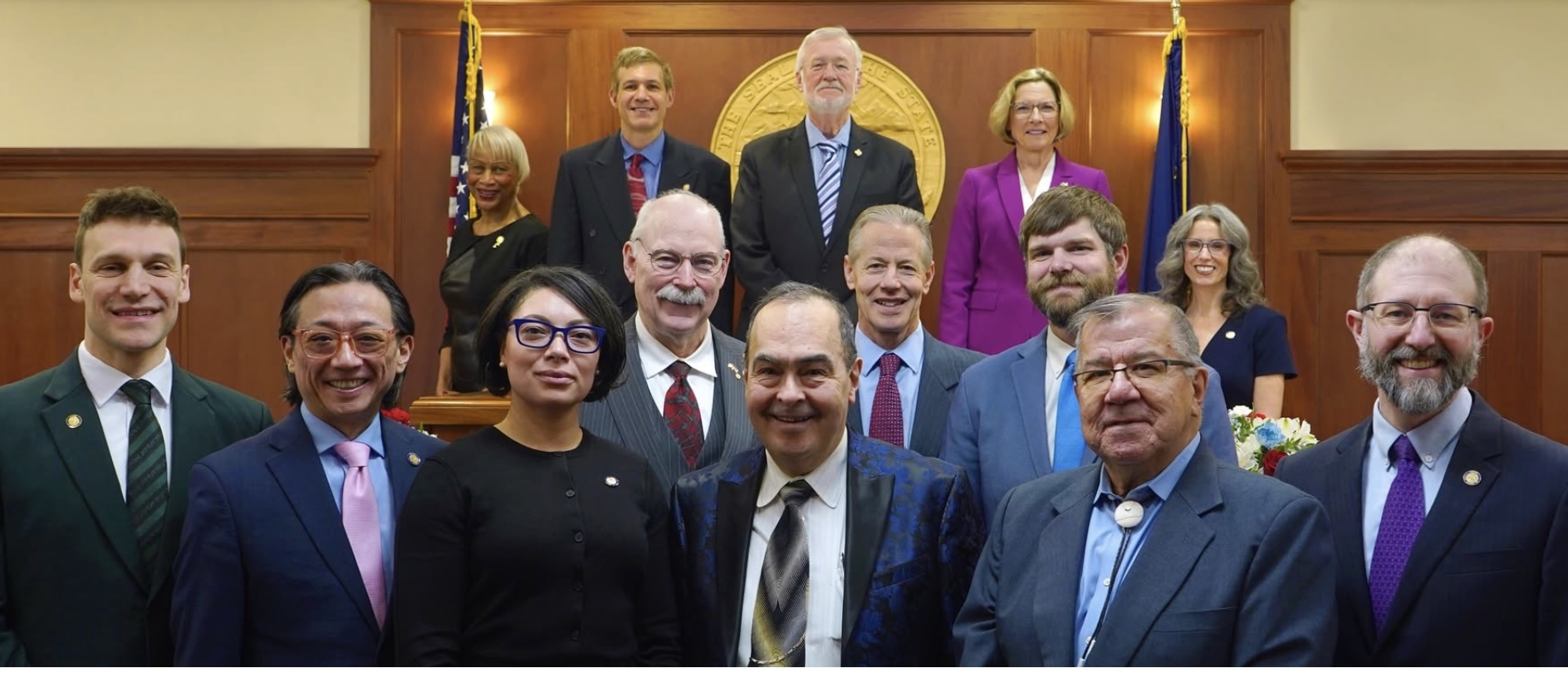
The Senate majority consists largely of Democrats and a handful of Republicans who govern as a coalition. Among them are Senate President Gary Stevens, Majority Leader Cathy Giessel, Rules Chair Bill Wielechowski, and members Scott Kawasaki, Kelly Merrick, Matt Claman, Forrest Dunbar, Jesse Bjorkman, Jesse Kiehl, Bert Stedman and others.
Collectively, they control whether this bill reaches the floor.
The Republican minority can do nothing about it. They can wait. They can plead. They can make speeches. But unless the majority chooses to move the bill, it stays trapped in caucus.
That’s the beauty of the Rule of 11: Nobody has to vote no. Nobody has to explain themselves to constituents. Nobody has to appear in campaign ads opposing thousands of construction jobs, manufacturing opportunities, and a project capable of changing Alaska’s economic trajectory.
Instead, they can simply hide behind a secret caucus vote that the public never sees.
This is the same coalition has lectured Alaskans about transparency, accountability, and open government. They have demanded disclosure from everyone else while conducting some of their most consequential business behind closed doors.
Now, when Alaska faces a decision that could shape its economic future for generations, the transparency crowd has gone silent.
The public won’t know who supported moving the bill or who opposed it.
The public won’t know who in the majority killed it because that information remains locked away inside caucus meetings.
A special session called to advance a gasline will end without accomplishing its central purpose.
And the result will be thousands of potential jobs lost, affordable long-term energy killed, and the politicians responsible can walk away claiming they never voted against any of it.
This is why the Rule of 11 exists. It’s to avoid accountability, which is what Democrats like to do.
The most revealing comment may have come from Senate President Gary Stevens himself:
“Hopefully the governor’s getting the message that we want to see very few vetoes.”
There you have it. That statement tells Alaskans everything they need to know. This is no longer primarily about natural gas.
It’s about leverage, using Alaska’s largest economic development opportunity as a bargaining chip in unrelated political disputes.
In other words, it’s blackmail dressed up as legislative process.
A serious Senate would put the bill on the floor and vote.
Let every senator explain his or her position and allow the public to see who supports the project and who opposes it. Let the chips fall where they may.
Instead, the Senate majority is going to hide behind an unofficial caucus rule and let time do the dirty work.
If the gasline dies this week, remember that it wasn’t defeated in public.
It was smothered in a back room.
And that’s exactly how the architects of the Rule of 11 prefer it.
Suzanne Downing is founder and editor of The Alaska Story and is a longtime Alaskan.


29 thoughts on “Suzanne Downing: How the Senate Majority plans to kill the gasline without leaving fingerprints”
Dunleavy should call them back into special session as many times as needed. Since he will need to give them the required 30 day notice it will give them time to hear from their constituents and give them time to think about why they were elected in the first place.
“……..Dunleavy should call them back into special session as many times as needed……..”
Agreed. Let them spend the summer in Juneau.
That would be cruel and unusual punishment, especially for those in political races this fall. Big Mike is still the Man.
Absolutely. Let them have a fun summer in Juneau
This was a given. 36 meetings in Senate Resources and not a single thing done by the gang of four to get a workable tax plan..
Governor should veto every damn thing that went into increasing the budget by 10% over last years.
This is your green energy Dimwit platform on display.
They’re all scum suckers in the Senate majority.
Kelly Merrick is an absolute embarrassment but even I can’t believe she’s gonna kill all these jobs. She’s a total Union shill and unions want good paying jobs. Cowards the whole lot of them.
We may never know how any of them WOULD have voted. They need to drop the smokescreen they are hiding behind and act like grown ups. I think we need to just consider the whole lot of them guilty of legislation failure! Why do these people get reelected?
If Alaska does not codify the tax changes, the consequences depend on whether Glenfarne can still assemble financing and reach Final Investment Decision (FID) under the existing tax structure.
There are several potential outcomes.
Scenario 1: The Project Slows Down
This is probably the most immediate risk.
Glenfarne has argued that tax certainty improves project financeability and reduces investor risk. If the Legislature refuses to codify the requested changes, lenders, export credit agencies, and equity partners may require higher returns or additional guarantees before committing capital.
Potential impacts:
* FID delayed
* Financing takes longer
* Additional negotiations required
* Higher cost of capital
* Project schedule slips
This is the argument project supporters are making.
⸻
Scenario 2: Alaska Retains Negotiating Leverage
This is the counterargument.
The world has not suddenly stopped needing natural gas.
Alaska still possesses:
* one of the largest undeveloped gas resources in North America
* existing federal permits
* rights-of-way
* strategic Pacific access
* growing Asian LNG demand
Refusing immediate codification does not necessarily kill the project.
Instead it preserves leverage for Alaska to negotiate:
* stronger local hire requirements
* Alaska business participation
* municipal protections
* downstream processing
* Alaska-owned infrastructure interests
* workforce commitments
In this scenario, the Legislature is essentially saying:
“We are not saying no. We are saying show us what Alaska receives in return.”
⸻
Scenario 3: Glenfarne Revisits the Deal Structure
This is the outcome that receives less public discussion.
If tax incentives are denied and project economics weaken, Glenfarne may need to revisit:
* ownership structure
* risk allocation
* financing terms
* Alaska participation
In many large infrastructure projects, when economics tighten, parties return to the negotiating table.
The question becomes:
Is Alaska’s leverage stronger before codification or after codification?
Many negotiators would argue it is stronger before.
⸻
Scenario 4: Alaska LNG Never Gets Built
This is the worst-case outcome.
If:
* financing cannot be assembled,
* global LNG markets change,
* costs continue increasing,
* investors choose other LNG opportunities,
then Alaska LNG could once again stall.
Supporters of codification argue this risk is real because competing projects already exist in places like Qatar, Canada, and the U.S. Gulf Coast.
Their position is straightforward:
A project that never gets built creates zero jobs, zero gas deliveries, and zero revenue.
⸻
The Real Strategic Question
The debate is often framed as:
Codify = Project Lives
Don’t Codify = Project Dies
Reality is probably more nuanced.
The real strategic question is:
Does Alaska gain more value by granting tax certainty today, or by using tax certainty as a negotiating asset to secure additional Alaska-owned benefits first?
That is fundamentally a negotiation question, not an engineering question.
⸻
What the Senate Would Be Betting On
If Alaska codifies:
The bet is: certainty attracts capital and accelerates construction.
If Alaska does not codify:
The bet is: Alaska’s gas remains valuable enough that investors will continue negotiating.
Those are two different risk calculations.
One prioritizes speed and investment certainty.
The other prioritizes retaining leverage and maximizing Alaska’s share of future economic benefits.
The consequence of not codifying is therefore not automatically “no project.”
The consequence is that Alaska and Glenfarne may have to continue negotiating until both sides believe the allocation of risk, ownership, incentives, and benefits is acceptable. Whether that ultimately produces a better deal or causes the project to stall is the central uncertainty facing the Legislature today.
Excellent review, Trudy. Unfortunately, you’ve completely ignored Railbelt gas needs in your review. Apparently the state has already fubar-ed the project for long enough to force Enstar into an “interim” LNG importation investment so our homes don’t freeze up. I’m not sure how that effects a future export gas line if the Legislature screws this up yet again, but I fail to see how it won’t.
This has gotten so screwed up, I really don’t care if it ever gets built. I want/need natural gas to heat my home. I don’t need a job, I don’t need more Alaskans filling the streets, and I don’t need iffy investments that will create PFDs for folks. If that gas has to be imported as LNG for me and MEA (to generate electricity), fine, Let that gas pipeline die an undignified death. I really don’t like being held hostage. I’m looking for an opportunity to pop the hostage taker alongside his hard head.
Reggie, I appreciate the comment because it highlights an issue that deserves attention.
You’re right that Railbelt gas security is not an abstract policy discussion. People need affordable, reliable natural gas to heat their homes and generate electricity today—not ten years from now.
My concerns about governance, valuation, risk allocation, and legislative oversight are not intended to delay or prevent gas from reaching Alaskans. In fact, they stem from the opposite concern: if Alaska enters into major commitments without fully understanding the transaction, the risks ultimately fall on Alaska families and businesses.
I don’t view these as competing objectives. Alaska should be able to pursue all three:
Reliable and affordable gas for Railbelt consumers.
A commercially viable LNG export project.
A negotiated structure that protects Alaska’s long-term interests.
If Enstar is being forced toward LNG imports because local supply concerns have gone unresolved, that is itself evidence that Alaska needs a durable gas strategy rather than continued uncertainty.
The question before the Legislature is not simply whether a pipeline gets built. The question is whether Alaska secures domestic energy reliability while also negotiating a fair return for the public assets and authorities being placed on the table.
Alaskans should not be forced to choose between heating their homes and asking hard questions about a multi-billion-dollar transaction. We should demand both.
Nice outline of potential outcomes. Yes, it would be nice to have less expensive and a consistent, reliable source of natural gas. But at this point things are set up so Genfarne holds most of the cards and benefits. Alaska needs to have more control over a pipeline that is gong to impact so much of the state. We need to stand up to them and require that they respect us and the land.
To be clear, my opinion is that the Senate should not pass this legislation until terms are renegotiated.
Alaska is now receiving a “capital-call” from Glenfarne under the guise of collaborative mega-project development.
Glenfarne owns 75% and if it does not have the capacity to finance with the expansive value Alaska already transferred to them, then Alaska needs to demand additional tangible terms, I.e. take back majority control of the decision-making at the board.
What we need is an executive who will use his power of law and order and root out and expose and arrest and try these crooks.
The senate is full of crooks who can no way cover all their crimes.
Unfortunately we have a governor who is too weak ad feckless.
And until Alaskans know what the senate is doing to undermine us and vote these scum out…we will lose gererational wealth while they enrich themselves.
Dunleavy has always faced he is “damned if he did, damned if he don’t”
His use of the veto pen is his right to use and no more than right even if a governor is Democrat to use the veto pen when a legislature is controlled by a strong Republican majority fighting for dominance. It’s part of maintaining a balance of power.
These games is how the AKDemocrats moved the state of Alaska Left of the aisle with Republicans afraid of not being looked as bi-partisan to the position today’s AKGOP is helpless after thirty years being bi-partisan
The Republicans if the AkGOP ever sees another strong majority of Republicans in both House and Senate. Take notes from the Democrats how to dominate and impede the progress of a Democrat Governor with smaller group of Democrat legislators to support him and their party goals.
But. I doubt seeing an AkGOP majority is very unlikely for a longtime.
Don’t get caught up feeling like a victim of the political game today’s Democrats and Republican-Democrats are playing. Learn from your mistakes. Democrats are doing what Republicans should had done in 2002-2006 when Governor Frank Murkowski was governor and Republicans (comfortably) controlled both House and Senate.
That was the time Republicans were allowed time to get more work done to had changed the political direction of Alaska moving it right.
The future shows they wasted time being bi-partisan while today’s Alaskans we live on the left of the aisle and living under Democrat leadership and control.
But then in 2002-2006 the AkGOP leaders were no less and no more government dependent than today’s Republicans. Their interests were more on remaining and maintaining government dependency than using their power moving the state right of the aisle, smaller government, less spending on government, and increased natural resource development. Instead of thinking yourself a victim because you are on the losing team. Learn from the Party’s past mistakes what caused them lose and what needs to be done differently so next season the losing team comes back stronger.
They might try to hide, but they can’t. Should the senate majority caucus manage to kill the gasline, our response is simple. Remove as many of them from political office in August and November as humanly possible. If they are doing their best impression of speed bumps, the response is easy. Cheers –
The other thing that comes to mind is now that the unions, which hold their collective leash are onboard with the gasline, what is the union response when their lapdogs kill it. Should be a fun summer and fall. Cheers –
Except the bi-partisan Republicans sit very comfortably in their districts with most of their Republican voters just as government dependent as their Democrat neighbors; they will continue supporting the Rhino.
We’ve already seen some cracks in the facade. Chuck Kopp led the passage in the House.
In the Senate, we have Kelly Merrick, who is tied to the hip with the trade unions. The public employee unions control the Senate, putting Kelly in a difficult position. Should be an interesting couple days. Cheers –
All of the Alaska state senators I know who believe in human-caused climate change also believe that arctic petroleum extraction must be stopped. They all serve in the current senate majority. I expect they all see a state income tax as a moral imperative and a fiscal reality. In this big election year they will be stealthy as they deal with this legislation. We are fortunate to have The Alaska Story.
A picture of suck. Each and everyone a criminal stealing out pfd dividends. Worth less.
There is only one certainty with the Alaska legislature and that is they will screw up anything and everything.
Forget fingerprints or DNA left behind. The evidence is a turd-print. And we all know who the turds in the Senate are.
Sorry, but that evidence locker is completely full.
All pathetic losers.
How and why does this wonderful State have such a lousy government?
What are we doing wrong?
I mean, I understand Washington, California, New York, Oregon etc, but here?
> What are we doing wrong?
A nice little capitol somewhere on the road system and a nice little government that does not tax or regulate much if at all. It does not seem like it is too much to ask for.
Rule 11! Can it really be? Rule 11 groupie persons to get your Samurai sword out and slice and dice that critter bill till it is shreds. Throw it in the shredder and don’t leave one finger print before you go fishing. Promise me there will be nothing left and its a done deal down the septic tank of Glenfarne dream schemes. Yahoo!!