


By SUZANNE DOWNING
May 17, 2026 – As Alaska prepares to host the fifth annual Alaska Sustainable Energy Conference this week in Anchorage, momentum around resource development and energy policy is taking center stage, even as some legislators in Juneau attempt to hold the state’s future hostage by blocking legislation that would allow a natural gas pipeline project.
The conference, scheduled for May 19–21 at the Dena’ina Civic and Convention Center, has become one of the signature initiatives of Gov. Mike Dunleavy during his time in office. First launched in 2022, the event was designed to showcase Alaska’s role as an energy powerhouse at a time of increasing global demand for oil, gas, minerals, and emerging energy technologies.
Now in its fifth year, and with Dunleavy in the final year of his administration, the conference arrives amid renewed federal interest in Alaska development under the Trump Administration and growing debate over the state’s economic future.
Saturday night in Fairbanks, US Interior Secretary Doug Burgum joined roughly 250 Alaskans at the Pipeline Training Center for an event that attendees described as unusually optimistic and energetic compared to the gridlocked tone of state politics in Juneau.
Inside the packed venue, speakers including US Sen. Dan Sullivan, Congressman Nick Begich, and Burgum repeatedly emphasized opening Alaska for greater resource production, infrastructure development, and economic growth.
The audience applauded frequently as speakers discussed expanding federal leasing opportunities, streamlining permitting, opening access corridors, and increasing throughput in the Trans-Alaska Pipeline System.
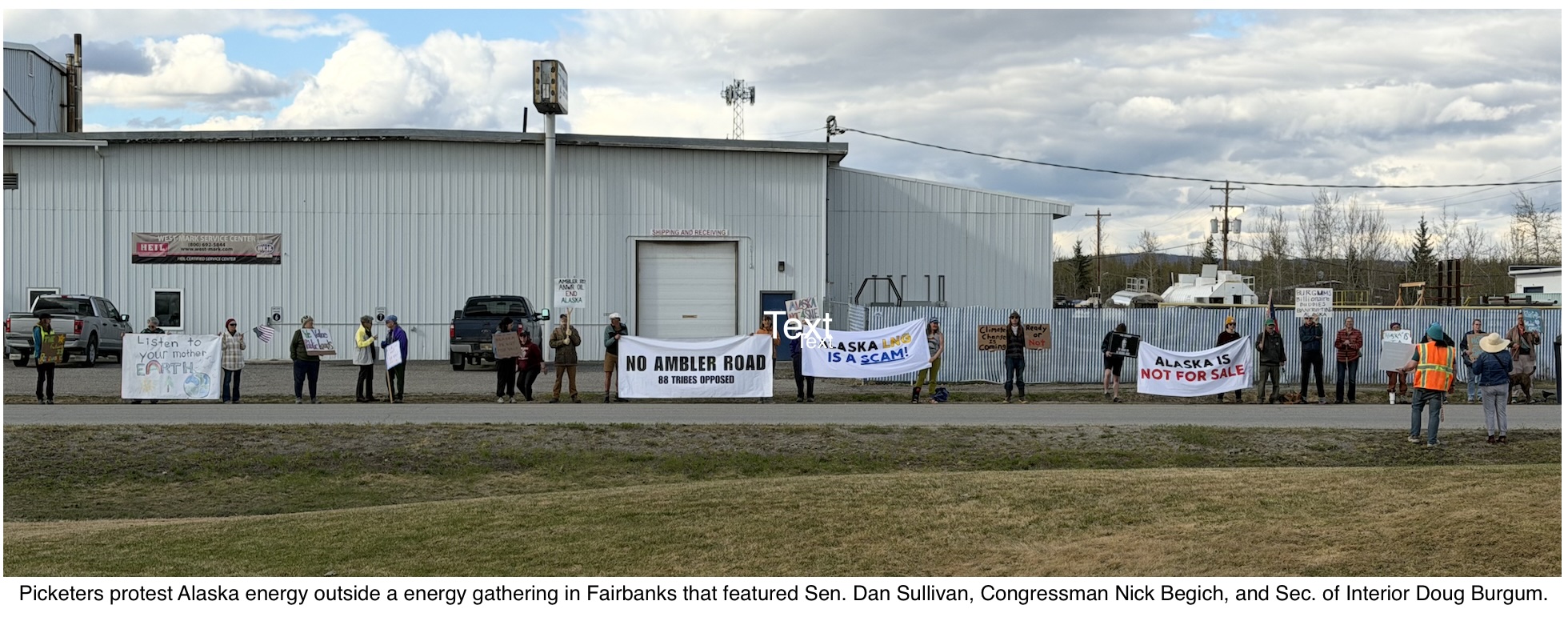
Outside the event, approximately 30 protesters demonstrated against expanded resource development projects, including the Alaska LNG project and Ambler Road. Protesters are also expected to picket the energy conference in Anchorage.
What appeared to resonate most with attendees, however, was the sense that Alaska is once again being viewed by federal policymakers as strategically important, not only for domestic energy production but also for national security, manufacturing reshoring, artificial intelligence infrastructure, and critical mineral supply chains.
Burgum’s appearance in Fairbanks was a prelude to this week’s Anchorage conference, where he and Dunleavy are expected to headline Tuesday’s keynote luncheon session focused on Alaska’s role in America’s energy future.
According to conference organizers, the event will bring together policymakers, investors, researchers, entrepreneurs, industry leaders, and foreign delegations to discuss a wide range of topics, including liquefied natural gas exports, North Slope development, advanced nuclear power, carbon capture, renewable energy, hydropower, geothermal energy, critical minerals, and Arctic infrastructure.
The conference has increasingly promoted an “all of the above” approach due to rising global energy demand that requires expansion of every available energy source rather than replacement of one form with another.
Alaska officials have increasingly tied that message to national discussions surrounding artificial intelligence and data centers, which are expected to dramatically increase electricity demand over the next decade.
Conference materials emphasize Alaska’s unique combination of conventional oil and gas reserves, renewable energy potential, strategic Pacific location, and mineral wealth.
Saturday’s Fairbanks gathering also included discussion of long-standing Native allotment issues affecting Alaska Native veterans and unresolved federal land claims dating back decades. Speakers additionally addressed the crisis of missing and murdered Indigenous persons, with calls for greater accountability and federal engagement.
The contrast between the aggressive development posture coming from federal officials and the slower pace of Alaska’s state Legislature was difficult to ignore.
While federal officials spoke about accelerating permits, opening leases, and building infrastructure, the Legislature remains bogged down in fights over budgets, pension policy, and major energy legislation, including unresolved gasline measures that appear to be purposefully stalled late in session, with May 20 the adjournment date.
The conference itself reflects Dunleavy’s broader political identity and governing philosophy. Since taking office, he has consistently framed Alaska’s economic future around resource production, infrastructure expansion, and energy exports.
This year’s conference may also serve as something of a capstone event for that agenda as his administration enters its final months.
Beyond the political messaging, the conference has evolved into one of Alaska’s largest business and policy gatherings, featuring networking receptions, exhibitor halls, panel discussions, Alaska Railroad excursions, and direct access to state commissioners and agency leaders. It’s a “who’s who” event in Anchorage.
Among the featured speakers this year is entrepreneur and author Magatte Wade, alongside energy executives, researchers, and government officials from across the United States and abroad. Absent will be most of the legislators, who are trapped in Juneau due to the Democrat-controlled majorities that are trying to kill the gasline project.

One thought on “Sec. of Interior Doug Burgum in Alaska this week for energy events; protesters show up in Fairbanks”
Funny how the politicians and the King salmon simultaneously migrate to Alaska every year.