



By SUZANNE DOWNING
April 28, 2026 – A student organizing handbook widely circulating ahead of Friday’s May Day protests is explicitly instructing young activists to identify and “villainize” individuals, companies, and political leaders as part of a broader strategy to mobilize demonstrations.
The guide, tied to the nationwide “Workers Over Billionaires” movement previously reported by The Alaska Story, lays out a detailed playbook for organizing student-led actions on May 1. But beyond logistics, one section stands out for its emphasis on framing political conflicts in stark, adversarial terms.
May Day protests planned across Alaska, tied to national ‘Workers Over Billionaires’ movement
Organizers are told that every campaign must define three core elements: a demand, a target, and a “villain.” The handbook advises students to clearly assign blame for perceived problems, naming examples such as “Trump, ICE, and the billionaires who rigged the system.”
The repeated use of the term “villain” is not incidental. In multiple campaign scenarios, students are guided to portray corporations, wealthy individuals, and government entities as morally culpable actors. For example, in campus-based campaigns, students are encouraged to frame Immigration and Customs Enforcement and affiliated companies as entities that “terrorize communities” or deny workers dignity.
Copy of Students Rise Up Guidebook
The handbook provides sample campaign language that goes further, encouraging students to demand their schools sever ties with businesses labeled as “ICE enablers,” including companies in the hospitality and transportation sectors. These campaigns are designed to apply reputational pressure on targeted organizations.
The strategy extends beyond messaging into escalation. Students are told that their targets are unlikely to comply voluntarily and that organizers must “apply increasing levels of pressure” until those targets “choose to side with us instead of siding with the villain.”
It’s a good-versus-evil narrative that encourages students to adopt a confrontational mindset.
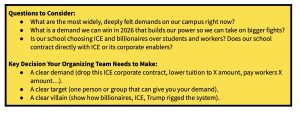
The handbook also outlines how to expand participation by recruiting classmates, building coalitions with national activist groups, and capitalizing on emotionally charged “trigger moments” to bring new people into the movement.
But it is the emphasis on identifying villains that may prove most controversial, especially as the guide is aimed at students, including those still in high school.
With May Day demonstrations approaching in Alaska and across the country, the handbook offers a revealing look at how national organizers are shaping the actions of young activists.


12 thoughts on “May Day ‘Rise Up’ student handbook teaches activists to ‘pick villains,’”
Complete ‘lunatics’ that should be admitted to API (immediately).
This is DIRECTLY out of Saul Alinsky’s “Rules for Radicals”. It is fair to conclude that Alinsky’s playbook is a practical way to carry on the class struggle central to Marxism and Communism. And thus, here we are at May Day.
It is baffling any thinking person would fall for such ridiculous foolishness. Alas, ‘thinking’ is now a rarity,
Spoon fed students with no intentions of ever working or holding a real job make perfect participants for this protest.
Any school district employee or volunteer found distributing this type material should be immediately suspended for promoting their private political beliefs at their government-funded job.
Of course, if you let them hand out child porn, your squawking is a bit compromised…
I sense fear among the broom-riding Right. Maybe get out there and counter protest. That’s one of the fundamental concepts of American democracy.
Evan, so you are okay with students walking out in protest of atheist teachings to stage a revival for Jesus in the parking lot of the school??
Wut?
Most of the students probably need someone to read it to them
I would like to know who is distributing this and how, as it mentions high school students? I thought all outside publications had to be vetted by some ASD committee (remember the Hillsdale flyer uproar) prior to distribution or use in the classroom.
Anyone know?
I support their right to assemble and their right to protest. What they have absolutely NO right to do is brainwash other people’s kids . Imagine how it would go over if a public school teacher or administrator distributed pro-life materials in a public school. The squeals from communist NEA members would be deafening. I absolutely agree with Freefall, this has no place in our schools. 4/29/26 12:38 AK time
M. John, I agree that young people have the right to protest, but they should be required to do it on their own time and not on school property. The community is funding their education and using their learning time and the property for some political cause, they most likely know very little about anyway, is not acceptable. Our kids are not props!