


By BARBARA HANEY
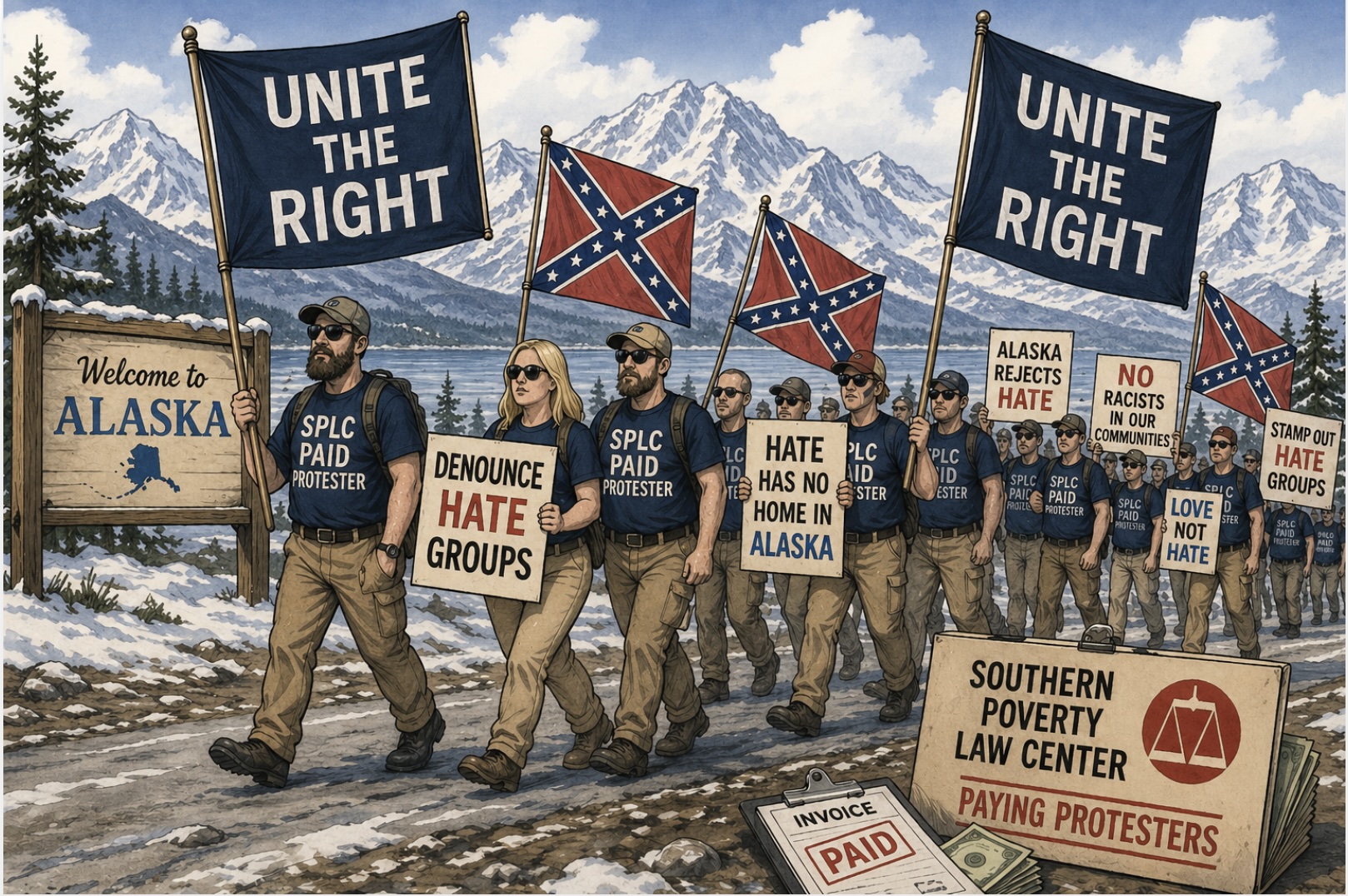
April 27, 2026 – It happened at a Fairbanks borough assembly meeting. It happened at a Tanana Valley State Fair board meeting. For years, it happened in military training rooms at Joint Base Elmendorf-Richardson and Fort Wainwright: Soldiers in uniform being told that their Alaskan neighbors belonged on a list of hate groups alongside the Ku Klux Klan.
The instrument in each case was the same: the Southern Poverty Law Center’s hate map. The method was the same. Wave the list. Attach the label. Let the social consequences do the rest. There was no evidence presented, no due process offered, no appeal possible. It was just the “moral” authority of an organization that spent decades positioning itself as the nation’s final word on who is and isn’t a legitimate participant in public life.
Most Alaskans know the historical name for that kind of tactic. It’s McCarthyism.
Fairbanks Has Seen It Up Close
Community member David Leslie has made the SPLC hate map list his instrument of choice in local public forums. At a Tanana Valley State Fair association board meeting, he cited the SPLC’s designation of Moms for Liberty as an “anti-government extremist” hate group to argue the board had failed by allowing a member to seek election. “Hate groups are dangerous,” he told the board. “People die because of hate.” The implication was clear: Anyone associated with a group on the SPLC list has no business sitting on a community board.
Last Thursday, at the FNSB Assembly’s public hearing on renaming Pioneer Park, Leslie appeared again. This time he was framing opponents of the name change planned for the park in the language of harm and exclusion. The SPLC label wasn’t deployed as one data point among many. It functioned as a conversation-ender. It was the modern equivalent of “are you now, or have you ever been (a communist)?”
That rhetorical move of using an outside organization’s unilateral designation to delegitimize a neighbor in their own community meeting is precisely what made McCarthyism so corrosive.
You don’t have to argue the merits. You just point to the SPLC list.
What makes Thursday’s assembly vote particularly shameful is that the merits were never seriously in dispute. The Alaska State Legislature named the park Pioneer Park in House Concurrent Resolution 18, passed in 1961. That original legislative intent, established by an act of the Alaska Legislature itself rather than by a local resolution, reflected a foundational decision about how the state would honor the people who built Alaska. The 2001 borough assembly action that restored the name after a brief rebranding was simply honoring what the Legislature had already made clear.
For the FNSB Assembly to overturn that intent by voice vote, in a hearing where opponents of the change were framed as harmful by association with a now-indicted labeling organization, is both politically troubling and a disregard for the deliberate will of Alaska’s own legislature. The residents of Fairbanks deserved better than a vote taken in the shadow of a list that a federal grand jury is now calling a fraud.
It wasn’t only Fairbanks
The same playbook has been run across Alaska.
In 2019, soldiers and civilian employees at Joint Base Elmendorf-Richardson in Anchorage were required to attend an Equal Opportunity training session that displayed the Alaska Family Council — one of the state’s longest-standing pro-family advocacy groups — as a hate group alongside the Ku Klux Klan, the Nation of Islam, and white nationalist organizations. The source was an SPLC infographic. The session was simultaneously teleconferenced to Fort Wainwright in Fairbanks. Military personnel with careers, families, and security clearances were being instructed that their neighbors in the pews occupied the same moral category as the Klan.
JBER eventually issued a formal apology and pulled the SPLC material from its training decks. Alaska Family Council’s Jim Minnery raised a question then that was never fully answered: how many other installations, how many other training rooms across this state and country, ran the same session without anyone speaking up?
More recently, the Mat-Su chapter of Moms for Liberty was added to the SPLC’s Alaska hate map. Parents who drove to school board meetings — the most basic act of civic participation available to an American — were officially catalogued as extremists by an organization that was simultaneously cutting checks to members of the Ku Klux Klan.
The list was a lie
Last week, a federal grand jury indicted the Southern Poverty Law Center on 11 counts of wire fraud, bank fraud, and conspiracy to commit money laundering. According to the Department of Justice, the SPLC secretly funneled more than $3 million in donor money to individuals affiliated with the very violent extremist groups it claimed to be dismantling, including Klan members, neo-Nazis, and Aryan Nations affiliates.
To conceal the payments, the organization allegedly set up fictitious shell companies and made false statements to federally insured banks. Acting Attorney General Todd Blanche was direct: The SPLC was manufacturing extremism to justify its own existence and keep the donor money flowing.
McCarthy had his list of communists. The SPLC had its hate map. Same playbook. The mechanism was to compile a roster of enemies, attach a damning label, and let institutional authority do the rest. The genius of the system, like McCarthy’s, was that challenging it seemed to confirm the accusation. Question the list, and you must be defending what’s on it.
The federal indictment raises the question that should have been asked of every SPLC designation from the beginning: was this label the product of honest research, or was it manufactured — shaped by paid informants inside extremist groups, inflated to justify fundraising, and deployed as a political weapon against organizations that simply disagreed with the SPLC’s big government philosophy?
The groups on that list never had a hearing. They were never shown the evidence against them. They had no recourse. They were simply named. And in modern America, being named meant being deplatformed by tech companies, defunded by charitable intermediaries, shunned by corporate partners, and cited in public testimony to exclude them from their own communities.
At what cost?
The consequences in Alaska were real. Pro-family Alaskans sat in uniform and were told that their neighbors’ advocacy organization belonged alongside the Klan. Parents in the Mat-Su were branded as extremists for attending school board meetings. Fairbanks residents heard a fellow community member invoke the list at a state fair board meeting and a borough assembly hearing to suggest that disagreement itself was dangerous. An elected assembly then voted to overturn both a 24-year-old community decision and a 65-year-old legislative one while that poisoned atmosphere hung over the chamber.
Nationally, the stakes were higher still. In 2012, a man walked into the Family Research Council’s Washington headquarters with a gun, telling investigators afterward that he found his target on the SPLC hate map.
In 2025, Turning Point USA was added to the map. Months later, its founder Charlie Kirk was dead.
McCarthy’s defenders said the communist threat was real and the tactics were necessary. The SPLC’s defenders say the same today. The test of any blacklist, however, is whether the list is honest, whether the names on it reflect evidence or politics.
A federal grand jury has now suggested, in the most formal terms available under American law, that the SPLC’s list was neither honest nor neutral. The organization was manufacturing the very threat it claimed to oppose, pocketing donor money meant to fight extremism, and pointing its finger at American civic organizations, including Alaskan ones, to keep the revenue coming.
At the Army-McCarthy hearings in 1954, attorney Joseph Welch finally looked at the senator and asked: “Have you no sense of decency?”
Alaska deserves to ask the same question of everyone who has waved the SPLC list in a public meeting, a military training room, or a borough assembly chamber to shut down their neighbors.
The list was a lie. The authority behind it has collapsed. And the Alaskans it was used against deserve an apology.
Barbara Haney, Ph.D., is an independent economist with a Ph.D. from the University of Notre Dame and more than 34 years analyzing issues unique to Alaska’s economy.


6 thoughts on “Barbara Haney: Alaska’s new McCarthyism, the SPLC indictment and what it means for our state”
Of course, the difference is that McCarthy was correct. Communists were taking over the government and Hollywood, and that has led to this idiocy by the SPLC. Apparently the left still believes that the end justifies the means. And folks end up ruined and dead.
What most forget about McCarthyism is that for the most part McCarthy was correct, however some of the tactics would be best described in modern vernacular as cancel culture or similar to a witch hunt by those who take part in woke culture.
Good article, Barb.
Now the Justice Department needs to set its sights on the SPLC’s compatriot – the ADL!
Excellent article. Definitely captures the essence of the Left’s playbook. And all the while, they perpetuate the majority of the actual violence–against the unborn, against their political opponents, against law enforcement, etc. Thank you to the Justice Department for pursuing this. And thanks to the author for putting together this article.
Respectfully suggest, Dr. Haney, McCarthy’s problem was that he distracted attention from the real issue and became the issue himself.
.
For those ancient enough to remember, it was Edward R. Murrow’s “See It Now” program, in which he confronted McCarthy, that was a key factor in turning public opinion against McCarthyism.
.
Sadly, Alaska has no Edward R. Murrow, nothing resembling “See It Now”, no John Patrick Hunter, no Joseph Welch.
(https://captimes.com/news/local/govt-and-politics/50-years-ago-fear-ruled-fourth-reporters-petition-measured-effect-of-mccarthy/article_5bfca087-91d7-5574-a130-e52382bc45b1.html)
(https://www.senate.gov/about/powers-procedures/investigations/mccarthy-hearings/have-you-no-sense-of-decency.htm)
.
Fascinating that, unlike McCarthy himself, his legacy found a resting place in, of all places, the radical, communist Left.
.
No? Remember China flu hysteria, modern McCarthyism on steroids, reinforced again by complicit news media, state government using power not for public good, but for public bad, to sicken and kill Alaskans, wreck their livelihoods, abrogate their constitutional freedoms, all for what, just to show they could?
.
Was it an experiment that worked, will it work next time? Better to figure this out beforehand than to demand apologies afterwards, no?
.
Recall Biden weaponizing the Justice department to investigate parents who disagreed with school boards, weaponizing the CIA and FBI to to take down a sitting President, using fear to stifle dissent, using pressure to assure media compliance? Modern McCarthism at its finest, but this time with presidential power behind it, no?
.
That wasn’t bad enough, now we have what looks alarmingly like the streamlined version of New McCarthyism: assasinate people and presidents who don’t accept the radical Left’s way of doing things.
.
Saying someone “deserves an apology” says you’re negotiating from weakness. People who are okay with killing babies, mutilating children, burning buildings, assaulting cops, trying to assasinate presidents thrive on others’ weakness, do they not?
.
Don’t assume authority behind it collapsed. Nobody committed hara kiri over it. They can come back just like any other insufficiently treated social disease.
.
So we made the SPLC Hate List, this achievement should stop us from being proud Americans, enjoying life, responding with equal force when threatened?