


By SUZANNE DOWNING
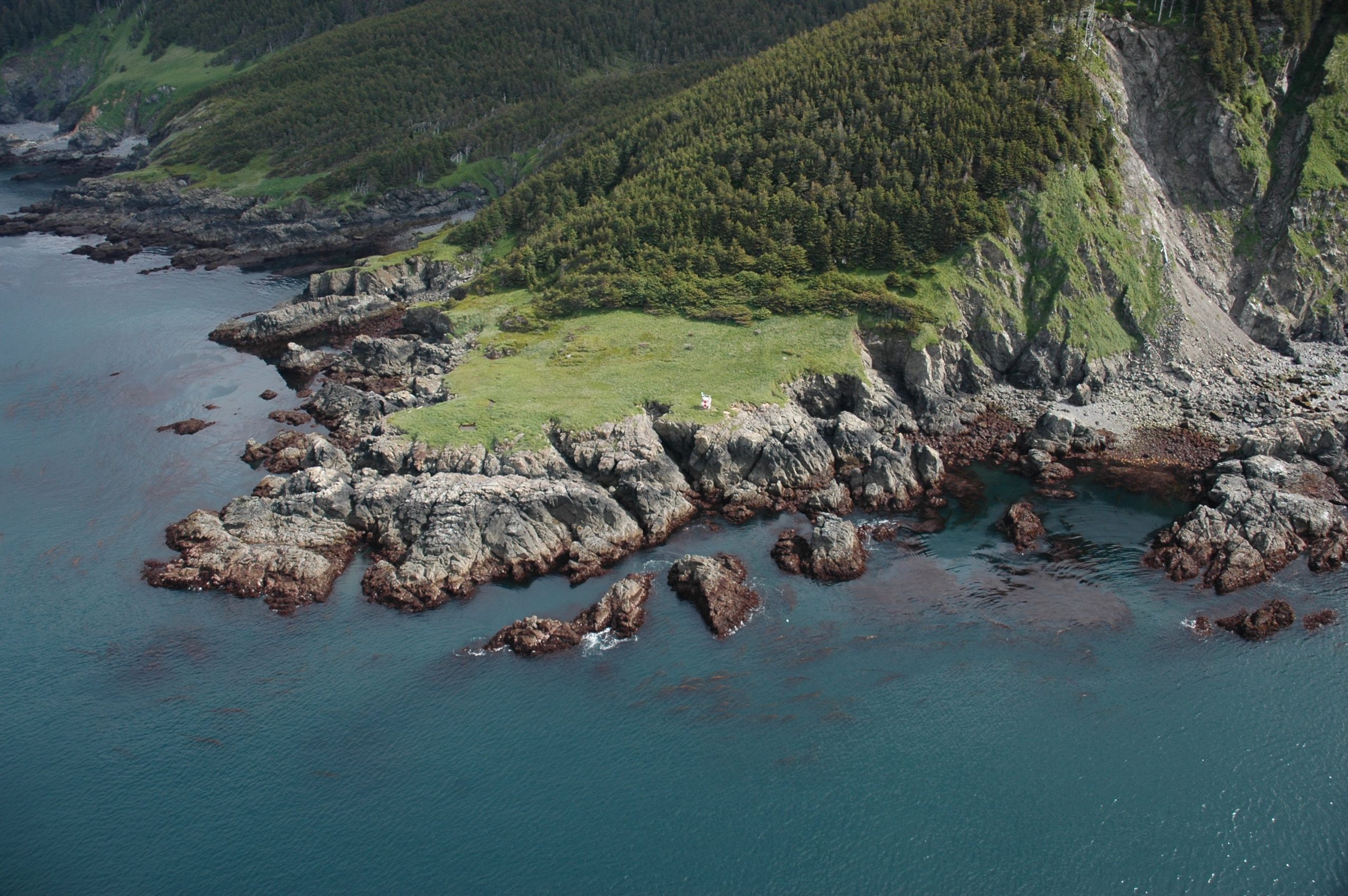
April 12, 2026 – On this day in 1794, British explorer George Vancouver sailed his ships into what is now called Cook Inlet, chasing one of the great geographic mysteries of his time: a navigable route through North America to the Atlantic: the fabled Northwest Passage.
He didn’t find it there.
Careful soundings, tidal observations, and weeks of charting revealed an enclosed body of water that was neither river nor passage through the continent. It was just an inlet. A bay fed by rivers.
Vancouver would ultimately name it after his former commander, James Cook, who had explored the same waters in 1778 but left lingering uncertainty about what it might have led to.
By the time European ships probed these waters, the region had already been occupied by Alaska Native peoples for thousands of years.
The Dena’ina people had established villages throughout the upper inlet, while the Sugpiaq (Alutiiq) inhabited coastal areas earlier, adapting to a rich environment of salmon, beluga whales, and marine resources.
When James Cook had entered the inlet in 1778, he initially believed it might be a massive river leading inland—or even a passage connecting to northern seas. His frustration grew as the waterway narrowed into what he famously named Turnagain Arm, a dead end that forced him to “turn again.”
Russian fur traders had already been working the region by then, establishing outposts like Fort Nikolaevskaia near the Kenai River in the 1780s. They noted oil seeps and built trade networks, often clashing and negotiating with local Native populations.
But it was Vancouver’s expedition—methodical, disciplined, and backed by years of experience—that settled the geographic question with precision.
After entering the inlet, Vancouver’s crews split into survey parties. He personally explored Knik Arm, while others mapped Turnagain Arm in detail. They tracked tidal extremes, measured depths, and confirmed what Cook had suspected but not definitively proven: the mountains closed in, the waters became shallow, and no passage lay beyond.
By early May 1794, the ships reunited and departed south. The verdict was clear: No Northwest Passage here.

11 thoughts on “On this day: George Vancouver sailed ships into Cook Inlet”
The Russians also married local natives. Historians estimate there were never more than 400 Russians (from Russia) in Alaska at any given time through 1867. But many of them married natives. Still to this day, from Nulato to St. Paul to Unalaska to Sitka, many Alaska Natives have Russian blood.
No No NO!
.
It is NOT “Cook Inlet”! That is just the imposed nomenclature of white eurocentric colonialist patriarchal misogynistic homophobic anti-trans-gendered imperialists! Its real name is Ek’ntkidniklaqwits’nodklukedniqwxa’kzqw’xqk’w’k, which means “Waterway leading to place of much whiskey” in the language of the Knikq’wak’wazatlnad’nuesqk’xex’ti Indigenous Aboriginal First Nations People.
A bigot AND a racist!
Go wallow in your imaginary “racism” self-perceived victimhood elsewhere, Mr. Singed.
.
By the way, what is wrong with being a racist, anyway? The vast majority of people throughout history, and indeed the vast majority of the people in the world today, are unabashed racists. Have you EVER spoken at anyone from China, or sub-Saharan Africa, for example? THERE is some REAL racism for you!
.
Different races and different cultures ARE different, and some are inherently inferior to others in certain aspects. That is not bigotry — that is just fact. A fact that, like so many others, you radical leftist extremists desparately try to deny, as you routinely deny many other aspects of reality.
Evan S Singh says:
April 8, 2026 at 1:44 am
ohmygawd ohmygawd ohmygawd. I agree with both Jefferson AND Micah.
Jeff,
I’m glad to see that you are acknowledging and sharing your worldview with the rest of us. You do a brilliant job of showing those of us who view the world differently than you the thought process of those who share your viewpoint.
Just a note of correction to your obviously inflammatory tone on this comment. Liquor wasn’t introduced to Alaska until the Russian arrived in the early 1740’s and when liquor from Russia was introduced it was most likely rum, brandy, and/or vodka, whiskey wasn’t introduced until later when Americans began to arrive.
Esteban,
I am glad to see that you feel the need to stalk me wherever I post in order to make the gratuitously self-righteous and malignant comments for which you are known so well. Your dishonesty and disingenuosity are exceeded only by your raging arrogance. They are also exceeded, incidentally, by your bitterness and your consistently complete lack of any sense of humor, the latter being a noted character trait of sociopaths.
Jeff,
I remember the racist and antisemitic “jokes” you’ve made in the past, do you want me to share them with the rest of the class? I have a memory that while not quite photographic is pretty close, I can’t remember if that is a noted character trait of sociopaths though.
I would like for you to share more of your racist beliefs though, your relationship with words and their definitions has historically been lacking so if you can expound upon which races and cultures you find inherently inferior and superior to yours I think it would be helpful for the rest of us to understand.
Blah blah blah blah blah blah blah blah blah blah.
.
That all was much more relevant, and intelligent, than your specious, pointless and hateful diatribe.
.
Steve-O, establishment defender and conformist extraordinaire.
Now this is some serious next level woke right mind virus stuff here, Jeff. I’m sorry I missed your response earlier because this is gold right here!
You find what I wrote to be “specious, pointless and hateful diatribe” somehow, while you defend being a racist who isn’t somehow an antisemite regardless of all the antisemitic stuff you profess. You are against having your antisemitic comments called out for being antisemitic, but you see nothing wrong with racism…please do explain that.
The days before government dependency when every man, woman, and child each worked to some capacity and each pulled their own weight. meaning they weren’t dependent on taxpayers to keep them employed.
“… Boy, the way Glenn Miller played
songs that made the hit parade
Guys like me we had it made
Those were the days
Didn’t need no welfare state (or government jobs dependent on taxpayers. People created wealth instead)
ev’rybody pulled his weight
gee our old LaSalle ran great
Those were the days
And you knew who you were then men
Girls were girls and men were men ..,,” 🎵🎵🎵