


By SUZANNE DOWNING
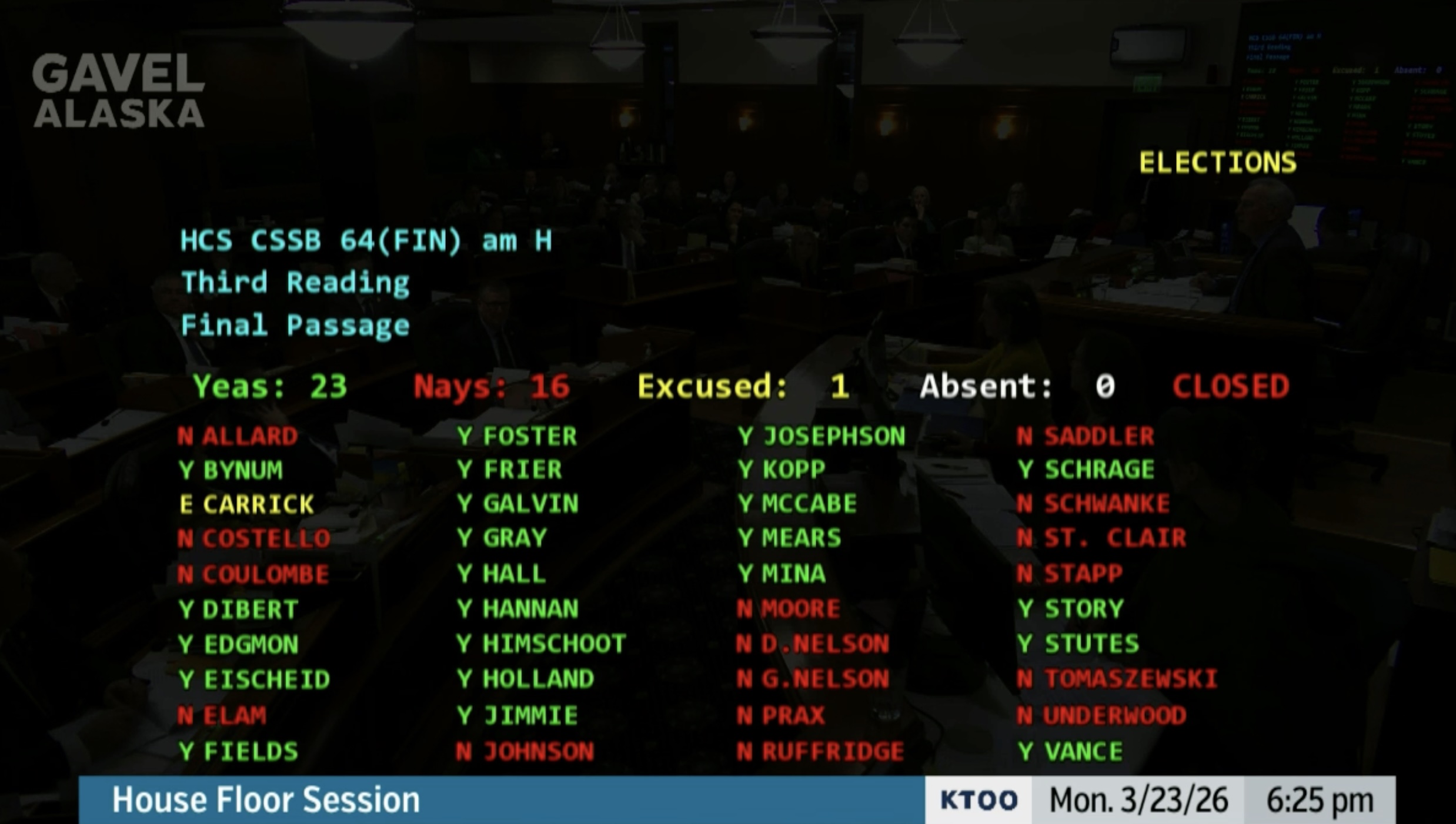
March 23, 2026 – After hours of feisty debate on the Alaska House floor, lawmakers on Monday passed Senate Bill 64, a massive rewrite of the state’s election laws, with nearly all Republicans voting against the measure and Democrats and independents uniting in support.
The bill passed 23–16. Rep. Ashley Carrick of Fairbanks was absent. Only three Republicans voted in favor: co-sponsor Rep. Sarah Vance, along with Reps. Kevin McCabe and Jeremy Bynum. All Democrats and independents voted for the bill.
Brett Huber: SB 64 is lipstick on the pig of ranked-choice voting
SB 64 has emerged as one of the most divisive measures of this session and one of the most divisive in many years, drawing sharp disagreement over voter identification requirements, ballot curing provisions, and whether the Division of Elections can realistically implement the changes before the next statewide election.
During debate, Rep. Justin Ruffridge raised concerns about the timeline for implementation, arguing the Division of Elections lacks the staff and resources needed to carry out the extensive changes before voters head to the polls again. He also questioned whether lawmakers should be passing rules that would directly affect elections in which they themselves will appear on the ballot, suggesting the effective date should have been delayed. That floor amendment had been voted down earlier.
House Finance rewrite of SB 64 changes voter-ID rules, sets up new fight over Alaska elections
Supporters promoted the bill as strengthening voter rolls and modernizing election procedures. But the provisions described as “cleanup” tools largely duplicate authority the Division of Elections already has. For example, language allowing the division to review property tax rolls in other states “to the extent practicable” when determining residency is an ability the division already has.
A proposed amendment that would have required a state-issued photo ID to vote was voted down. During debate, Rep. Steve St. Clair of Wasilla pointed out that Alaskans are required to present identification for many routine activities, including obtaining services and licenses, yet the state will not require photo ID for voting.
Another flashpoint was language allowing certain tribal IDs to be used for voting. Tribal identification does not necessarily verify Alaska residency or even US citizenship. Rep. Jeremy Bynum, whose district includes Metlakatla, spoke in favor of allowing tribal identification, noting the community’s unique status and arguing residents should be able to vote using tribal-issued ID.
Why I oppose Senate Bill 64, the election bill that Democrats love
Ballot curing provisions, which allow voters to correct errors on absentee ballots after submission, also drew opposition. Ccuring tends to benefit Democrats more than Republicans; the side with the most organized outreach infrastructure will gain an advantage by contacting voters to fix rejected ballots. They contended the measure effectively gives voters “a second bite at the apple.” More mistakes are made on Democrat-cast ballots, which will benefit from the curing.
Rep. Jamie Allard said that the bill disenfranchises military members.
The bill’s origins also fueled political tension. SB 64 has been closely associated with Rep. Sarah Vance, who has worked on election reform proposals for years, but the final version reflects priorities long championed by Sen. Bill Wielechowski and groups supporting Alaska’s ranked-choice voting system.
Organizations backing the legislation included The Alaska Center (for the Environment), the Alaska Federation of Natives, and Alaskans for Better Elections — all Democrat surrogate groups. The provisions marketed as conservative reforms were overstated and that the bill ultimately expands processes favored by progressive election groups.
Vance, long viewed as a principled conservative voice, broke with most Republicans to support the measure, a move that has alienated her from the Republican caucus.
With the House vote complete, attention now turns to Gov. Mike Dunleavy, who will decide whether to sign or veto the measure. Given the narrow margin and strong Republican opposition, it is unclear whether lawmakers would have the votes needed to override a veto. The outcome could determine whether SB 64 becomes law. The political fallout from the vote may also carry into this year’s primary and general election.


2 thoughts on “Senate Bill 64, complicated election rewrite, passes House after contentious debate”
I am so disillusioned at this point, don’t know what to think. Vance? McCabe? WTH is going on !!?
The State has complete control over all election results and they decide who are the victors and who are the losers. The actual voter is just for show these days. Nobody’s vote counts. Elections have not been decided by voters in Alaska since at least 2010 when Murkowski magically became the very first US Senator is all of US history to win as a write-in candidate since she wasn’t even on the ballot. The Ranked Choice is blatant government election fraud to give the State more control over who gets elected. Why do they even bother pretending that elections matter any more?