


By SEN. ROBERT MYERS
March 3, 2026 – In my last article, I wrote about the true state of Alaska’s economy. On top of that poor performance, we have the state government’s financial woes. This coming year, we’re looking at a budget deficit somewhere in the neighborhood of $1.8 billion. That would likely be filled by continuing to draw down the Permanent Fund dividend, dropping it even lower than the $1,000 from last year. That’s not counting any additional spending that the legislature might add this year or the usual escalators like negotiated employee contracts.
A common refrain among Republicans is that we can fix both of these problems with more resource development. I refer to this as the “return to the 1980s” plan. We could put people to work, refill the state coffers, and pay a statutory dividend (or at least larger than the most recent ones).
On a side note, there are a lot of Democrats who effectively argue the same plan but with oil taxes rather than oil production or other development. From an economic standpoint, the plan of resource development is partially correct. We should have more resource development to boost our economy. But from the perspective of the state budget, it is completely wrong.
Starting with oil as the largest component of the value of both our resources in general and state taxes in general, the simple fact is that the oil business has changed. The fracking revolution that hit the industry about twenty years ago drastically altered both the amount of oil available and the business of getting it out of the ground.
I don’t want to go into all of the details here, but the short version is that the competitiveness of Alaska vs the Lower 48 has changed. Fracking allows oil drillers to get their money back much quicker. Down south, frackers can make investment decisions and see their returns in weeks or months. In Alaska, we’re looking at years if not decades. Alaska is the place where we build large, long-term projects that will have to just take the price that the market offers, not a place where we can move quickly to take advantage of high prices and pull back when prices are low.
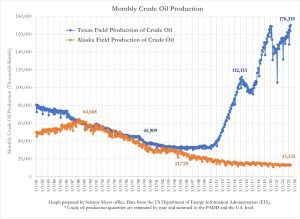
As one example, the oil pocket that both the Pikka and Willow projects are tapping into was first discovered in 2013. That oil will finally start flowing from Pikka this year and from Willow in 2029. While we are finally seeing the oil flowing through the pipeline rise for the first time since 1989, and we want to see that continue, we aren’t going back to the 1980s in large part because the business has changed. The types of projects that are viable in Alaska have drastically altered.
The results of these changes are in the following chart.
As the business has been changing, costs have gone up. As just one example from my own industry, the cost of trucking a load from Fairbanks up to Prudhoe has nearly doubled since 2020. Costs for labor, steel pipe, and other capital costs are going up. As a result, the operating deductions for oil taxes are going up. We’re going to make less money from the same amount of oil because the oil companies are making less money.
At the same time that costs are going up, we’re also getting less money because of our oil tax structure. The analyses of Willow and Pikka that were released by the state’s Department of Revenue late last year made it clear that we won’t be getting significant oil taxes from either project for nearly a decade (we will still receive corporate taxes, property taxes, and, in the case of Pikka, royalties). Does that mean that we should change our tax structure to get more money?
Maybe, maybe not. It might also mean that those types of projects end up not getting built. With the oil industry changing so that the quick cash from small projects has moved down south, that leaves Alaska in the position of depending heavily on large projects with long lead times. That is what our oil tax structure is geared towards. At the same time, raising taxes while telling industry that we want them do invest more in the state is a mixed message.
So what about growing other industries to get more money for the state? I’m all for growth of industry, but let’s be honest about what each will bring to the state coffers. They aren’t pretty either. Mining appears to be poised to grow, both for traditional metals like gold and silver as well as rare earth elements. But the mining tax for the state is small. The larger impact is usually much more important to local communities through property taxes.
More importantly, the capacity in mining to make up for the drop in oil revenue just isn’t there. As one example, Kinross (which operates the Ft Knox mine outside of Fairbanks and the Manh Choh mine outside of Tok) recently announced they made roughly $132 million in profit in the last quarter of 2025 before accounting for taxes and royalties.
In contrast, ConocoPhillips announced it made $730 million in profit after paying $1.3 billion in taxes and royalties to the state and federal governments during the same time period. More importantly, high costs like electricity rates are making Ft Knox less attractive to future investment to keep the mine open compared to lower-cost operations in places like Nevada. That poses a challenge if we think we can make more money from mining by increasing the taxes.
Fishing is a traditional industry for the state that contributes to the state budget, but its capacity is also limited. We are facing collapsing stocks across the state, and we have families that have been fishing for generations going under or getting out. There are things we can do (mostly at the federal level) to improve the situation, but it will take years and likely still won’t contribute a significant amount more to the state’s coffers.
Outside of these industries, no other business meaningfully contributes to state revenue. Many others (like tourism) are significant sources of tax dollars for local government, but not the state. In a sense, every other industry is a net drain on state revenue because they attract people to work here who require state services such as road maintenance and public safety.
The simple version is that we cannot grow the private sector to fix our state’s fiscal situation. Every one of these things would be great for the private sector growth and would help stop the outmigration of working-age people. But under our current structure, we don’t have any mechanism that directs money out of the state’s private sector into government the way that a broad-based tax does in most states. That doesn’t fix the incentives caused by a lack of connection between the private sector and government. I absolutely want to grow our private sector, but I also want to be completely honest about what that does in our current fiscal system. It won’t bring in any significant revenue; instead, it will just add more pressure to spend.
Looking at the one industry that does significantly contribute to state revenue, let’s think about what it would mean to try to grow our oil and gas sector. Besides all of the issues with oil taxes and how long we have to wait for meaningful revenue to make it into state coffers, increasing our economy’s reliance on oil has other side effects. It leaves us dependent on outside forces like international oil prices, federal permitting, and financial decisions made by international companies far away from Alaska. It leaves us as Alaskans in a passive state at best and a victim mentality at worst.
It’s also not great for our job market. Oil is a capital-heavy industry and is becoming even more so as technology advances. Over the last decade or so, oil has contributed roughly 20% of our state’s GDP, but it only provides about 4% of our jobs.
Please do not hear what I’m not saying. I want us to drill for every barrel of oil that we can economically. We are going to be dependent on resource extraction for a while. But we need to concentrate on what we can do to expand away from straight resource extraction, whether that would mean value-added processing of our resources or completely unrelated industries. We’re not getting rid of oil and gas any more than Kansas is getting rid of farming, but we need to diversify beyond oil.
The problem is that we need to do now what we should have done 50 years ago. We hitched our wagon to oil, and, other than the creating the Permanent Fund, we didn’t acknowledge that oil would shrink eventually. It would have been easier to make these changes before we had built up both the government spending and the economic structure based on oil, but we still need to make this switch even with all of the pain that it will involve.
We have to give state government a reason to care about the economy because that is where they get their money from. We have to put our resource wealth in the hands of individuals rather than directly into the hands of government, with individuals getting scraps.
Our economy needs more people making long-term, economic decisions rather than short-term, political decisions.
Senator Robert Myers was born in Fairbanks and spent much of his young childhood at the Salchaket Roadhouse, owned by his parents. He attended the University of Alaska Fairbanks, where he studied philosophy, political science, and history. While in college, he drove for a tour company, sharing Alaska with countless visitors. He currently drives truck and travels the Dalton Highway (Haul Road) frequently. He ran for office because he wants an Alaska his children will choose to make their home down the road. When not working for his Senate District B, North Pole, he enjoys reading, history, board games, and spending time with his wife Dawna and his five kids.
Sen. Robert Myers: Why is our state’s economy flat outside of oil and government?
Sen. Robert Myers: Why is the Permanent Fund managed for steady spending instead of maximum returns (and why we’re not Norway)?
Sen. Robert Myers: If the Permanent Fund dividend is so important, why do we keep cutting it?
Sen. Robert Myers: Why do so many Republican legislators support higher spending?
Sen. Robert Myers: With so much money in government per state resident, why don’t we build anything meaningful?
Sen. Robert Myers: Why do we spend so much money but have such poor quality services?
Sen. Robert Myers: Why is it so impossible to cut spending unless the state runs out of money?
Sen. Robert Myers: Why does Alaska hold all of the subsurface mineral rights?
Sen. Robert Myers: Why does Alaska look so good on paper, but perform so badly?

10 thoughts on “Sen. Robert Myers: Why can’t we just drill our way out of this mess?”
The above article has a lot of good analysis.
I suspect the article would ultimately like a state income or sales tax imposed upon us, to supposedly strengthen “the connection” between legislators, the people, and the private sector. I think there is already plenty of “connection”. I like to watch “Gavel Alaska” TV on channel 9.9, here in Fairbanks, which shows ive action of our representatives in Juneau. On Feb. 5, 2026, I testified to the House Finance Committee in Juneau, about HB-284, from my home in Fairbanks.
.
There is nothing evil about a state income or sales tax, if the state really needs it.
But there is something very evil about sucking out such taxes from hard working Alaskans, while at the same time handing out free money to all the citizens, many of whom are not working, or are newcomers who don’t deserve wads of scarce free cash from the state.
A dividend should only be paid out if there is surplus money remaining after essential services and infrastructure has been paid for. To ensure that such a surplus exists, and to get a bigger PFD, citizens should suggest where any fat can be trimmed from the budget. My suggestion is to get rid of collective bargaining for state employees and teachers.
Yes. There is sake tax nothing wrong with a the income tax and sales tax. However what common sense is there in giving Alaskans a New revenue source when they had not learned how to be disciplined and live within a budget or under budget. This legislature need to cut what ever is costing them their 1.8 billion deficit plus more so then decide if new taxes are needed or cs we kick that can down the road after after eliminating the deficit.
Running in the red is Not responsible nor controlling spending. These legislators who have children under 17. I bet saying No to them is much easier when they are a parent and their child is asking for something the legislator parent doesn’t want to give them. So why cut they say No to the people of Alaska instead of running a deficit on our behalf? It’s not hard to manage a budget in the black and live without some things.
Hmmm(!?!?) … I believe the State of AK has a serious spending problem rather than a revenue problem, most certainly that additional taxes, fees, etc. can’t resolve. Guv’ment frugality and efficiency is the appropriate path forward. No modern successful society taxes themselves to vast prosperity and opportunity.
It all depends on the people of Alaska as well as it all depends how many people open their heart up to God and his Word and what it says about depending on all things except Him. Moves to common sense and conservatism can’t come until peoples hearts are changed. Today they will never accept seeing government departments and programs receiving slimmer down versions for example.
I pray Alaskans don’t have to learn the hard way about depending on government because sometimes God lets us go our own way and suffer heartbreaking spirit crushing consequences (huge financial losses that are personal) before we realize our errors. God doesn’t want us to suffer. Sometimes though it’s through our sufferings disobedience we find humility and openness to change because going our way didn’t work. I think this is another reason why Christians must stay active and present on the community God planted them, sowing seeds, instead of running to greener pastures or other states for comfort like all the atheists do when they think a land can offer them nothing or its too expensive to live comfortably. Because for those who don’t have the means to move, somebody needs to be able to give them hope anvshiw them In God all things are possible and yes there is still life facing the most hard circumstances, he cares for us he is with us and he will sustain an help us through what we are going through.
I must be honest here. A few months ago in my prayers I was praying I asked God. If your have to break us that is Alaskans in order that a multitude here can be saved in Christ by receiving him. Then Do whatever needs to be done to crush the proud spirit on Alaska in order to rebuild us in Christ saving our souls up here.
I don’t want to go through tougher times but it might get tougher.
All we can do is encourage one another get away from whatever they are dependent upon by government and move toward God. Then maybe we can be spared from experiencing really tough times from our own doing because we chose Government dependency.
Disagree with a few points. FWIW:
We’ve fracking in the Prudhoe Bay fields for decades. The problem is taxation rather than technique. When the taxation regime is unstable, like it has been since Frank jacked up oil taxes, this is rolled into the producers’ calculations and their $$$ goes elsewhere like West Texas. There is a Prudhoe Bay equivalent of oil and natural gas in each of NPR-A, ANWR and offshore. We also have a CTL / GTL option batch shipping syn product down TAPS with crude. Solve the taxation instability and the producers will return. Problem is the majority caucuses have decided to fund government with the Permanent Fund and have no incentive to do so.
Strongly disagree with the notion that commfish revenue is limited. It is ONLY limited by economic illiteracy, the continuing ban on fish farming (onshore and offshore) in Alaska since 1991. Since that time, commfish has learned nothing and are completely unable to compete in the current marketplace for fish on the table 85% of which is farmed. There is a limit to wild caught. There is a limit to ocean ranching. There is no limit to what is possible to sell if you farm it.
Otherwise, another in a series of good pieces. Cheers –
“………There is a Prudhoe Bay equivalent of oil and natural gas in each of NPR-A, ANWR and offshore……… Problem is the majority caucuses have decided to fund government with the Permanent Fund and have no incentive to do so………..”
All three areas are federal. They have control, and have no reason to pump it all out so Alaskans can continue to get dividend checks (even though the IRS collects 18%-22% of that dividend money in individual income taxes). The feds are going to sit on that resource like they sat on it from 1908-1970’s.
Respectfully disagree. ANWR and NPR-A were opened under Trump 45, closed under the Potted Plant and opened again last year. It’s not the feds. it’s the greens aided and abetted by democrat federal judges (Sharon Gleason comes to mind) in the way. Don’t forget the death of 1,000 cuts waged by O’Bama on Shell’s effort to put a rig in the Chukchi chased them out of state entirely.
The feds are encouraged to pump more, as they make money when we do. Republican administrations like that expansion. Democrats, not so much. Cheers –
I disagree with the following statement in the above article:
“The problem is that we need to do now what we should have done 50 years ago. We hitched our wagon to oil, and, other than the creating the Permanent Fund, we didn’t acknowledge that oil would shrink eventually.”
.
However, the 1976 “State of Alaska Official Election Pamphlet” which explains about the candidates and ballot propositions, says something that contradicts the above excerpt, in my opinion.
The election pamphlet presents vital information about the ballot proposition for creating the Permanent Fund (50 years ago in 1976). The legislature had already passed it (in 1976) and the final step was for it to be approved by more than 50% of the citizen voters, so that it could be added to the Alaska Constitution.
.
In the election pamphlet there was a statement in favor of the creation of the Permanent Fund, and there was a statement against creating it.
In the “pro” statement is the following excerpt:
“Today, as the result of anticipated oil and gas revenues, Alaska stands on the brink of unprecedented prosperity. No one, but no one, argues that these non-renewable resources will last but for a few decades. Similarly, no one should fail to recognize that in those years ahead the cost of state government will continue to spiral upwards. Now is the time to ask ourselves the question: “When the oil and gas is depleted, where will the funds to feed our giant government come from?” The answer is: the “Permanent Fund”.”
.
Well, the above excerpt is from the State of Alaska Official Election Pamphlet for the November 1976 general election.
So, you can see, we Alaskans certainly did “acknowledge that oil would shrink eventually.”
.
In 1976, a majority of the voters went ahead and voted to approve establishing the Permanent Fund.
Also, nowhere, in the 1976 election pamphlet did it say anything about a “PFD” or free money being handed out. That idea came about 4 years later in 1980, when the flow through the Alaska oil pipeline was increasing more and more, and the Alaska treasury was overflowing with money. The flow rate reached its peak in 1988, and then started its natural decline.
Sen. Myers raises several real points about how the oil industry has changed, and I appreciate the honesty in acknowledging that Alaska cannot simply rewind the clock to the 1980s. But I believe the conclusion misses a critical part of Alaska’s constitutional and economic structure.
Alaska was never intended to operate like most states. Under Article VIII of the Alaska Constitution, our resources are to be developed for the maximum benefit of the people. For decades that meant oil production funded government while the state invested in the infrastructure needed to unlock our vast land and resource base.
Today we face a different challenge. Instead of using our accumulated wealth to expand production and infrastructure, we increasingly rely on financial draws from the Alaska Permanent Fund Corporation to fill government deficits. That represents a major shift from building Alaska’s productive economy toward relying on passive investment income.
The real question is not whether oil alone can fix the budget. Of course it cannot. The real question is why Alaska — with one of the largest sovereign wealth funds in North America — has invested so little of that capital into building the infrastructure that unlocks our resources and supports long-term economic growth.
Ports, roads, rail access, energy projects, mining corridors, processing facilities, and industrial infrastructure are what expand production, stabilize population, and generate long-term public revenue. These are the foundations that allow private industry to invest and families to stay.
Right now Alaska faces another warning sign: our population and workforce are shrinking. That is not just a demographic statistic — it is an economic alarm bell. When workers leave, businesses shrink, schools close, and the tax base erodes. Waiting for market forces alone to reverse that trend is a risky strategy.
That is why I have proposed a practical tool that Alaska has rarely considered: issuing Alaska Public Obligation Infrastructure Bonds, purchased in part by the Permanent Fund. Properly structured, long-term bonds could finance the infrastructure that opens access to our resources and strengthens regional economies across the state. Instead of exporting our capital to markets around the world while our own economy stagnates, we could responsibly invest a portion of that wealth in Alaska’s productive future.
The choice is not simply drilling more oil or imposing new taxes. The real choice is whether Alaska will remain passive — waiting on outside forces and financial markets — or whether we will use our own capital and constitutional mandate to build the economic foundation that keeps Alaskans working and communities growing.
Alaska’s problem is not simply oil dependence.
It is that we allowed our capital to become passive while our economy remained underbuilt.
Putting Alaska’s wealth to work inside Alaska may be the most responsible step we can take to reverse both our fiscal challenges and our population decline.
— Edward D. Martin Jr.
“Where the Spirit of the Lord is, there is liberty.” — 2 Corinthians 3:17
Sen. Myers, More good economic information, and some interesting historic data, and what I’m taking as a hint towards a possible solution. The thing is, you and I both know that we could institute the hypothetical 2-4% broad based tax, and the PFD situation would remain the same, also, in a very short time the state would somehow be facing the exact same “revenue crisis”, at which point they would, of course have “no choice” but to raise the tax rate. If you pour gasoline on a fire, the gasoline just burns up. Right away.