


By SEN. ROBERT MYERS
Feb. 24, 2026 – I’ve focused most of this series on problems within or related to government. There is good reason to focus on government, especially its finances, with all of the chaos that creates, but the point needs to be the private sector. That is where most of us make a living and find life’s daily necessities. It’s the portion of the world that creates things.
Even if state government lives off of the Permanent Fund (the direction we’re headed), it’s still living off of the private sector, albeit the private sector of the country rather than Alaska.
We’ve already looked at the history of state spending. Let’s start with a history of the state’s economy.
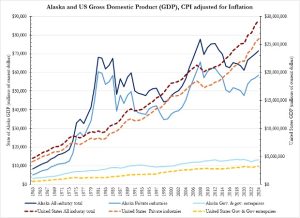
The solid lines are Alaska while the dashed lines are the rest of the country. From each set, the lower lines are government, the middle lines are the private sector (not adjusted for how much of private business is funded by government spending), and the top line is the total.
At statehood, Alaska was not doing well. The state’s two traditional industries, fishing and gold mining, were both in trouble, the first from poor resource management and the second from rising costs and stagnant prices. At the same time, the military was reorienting away from Alaska as Vietnam ramped up. That persisted until the early 70s when oil money started to flow, both to the government and through the private sector for oil field and pipeline construction. The second price jump in 1979 just added fuel to the fire even after TAPS construction had finished and oil had started flowing.
Economic activity had a sudden crash in 1986 as oil prices fell, with a bump in activity from the Exxon Valdez cleanup around 1990. We settled down close to the national average growth rate for most of the 90s as oil prices stayed low and the military drew down at the end of the Cold War.
A price drop in the late 90s was followed by a price rise and increased military spending in the 2000s. The big oil price spike of 2006 to 2014 led us to believe that the heady days of the late 70s and early 80s were back, but it didn’t last long. The price drop caused by the oil price war between OPEC and the frackers in the Lower 48 brought reality back in 2015, and we’ve muddled along ever since with some moderate improvement lately, mostly due to increased activity on the North Slope. But let’s unpack the last two decades and what was being masked by all of the Slope activity.
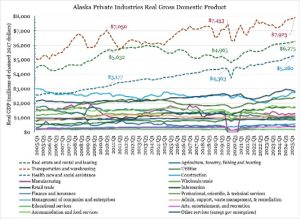
The chart above is Alaska’s economy by private industry except for oil and mining (which would dwarf the rest). While the immediate takeaway is that Alaska is more volatile than the country as a whole (a combination of smaller population and dependence on oil), the true story is deeper. Once we take away government and oil, the recent picture is much bleaker. Nearly all growth in the last few years has come from those two industries. Without them, the state’s economy has effectively been flat over the last two decades.
Three industries stand out as growth sectors, but the picture for the private economy there isn’t all that rosy either. The top red line is transportation. It’s shown some moderate growth, but it is heavily tied to the oil industry, both for trucking freight up to the Slope and shipping the oil through the pipeline. As TAPS ages, the maintenance required to keep it operational creeps up, raising the size of the sector but not really producing anything new for the economy. The one bright spot is the increase in international cargo over Alaska, mostly through Anchorage.
The green line is real estate. While there was some growth during the last oil boom, it quickly settled down. That’s been followed by a more recent rise, but that’s driven mostly by the rise in rents, not increased building or actual higher value.
The blue line is health care. While it’s an industry that provides a lot of good-paying jobs, the rise is driven primarily by two factors: demographics and government spending. Roughly 60% of the spending on health care in Alaska was paid for by government in 2010, and that was before both the Affordable Care Act and Medicaid expansion in 2015. At the same time, we’re getting older as a group and needing more care, much of it paid for by Medicare. More dependence on government and an aging population do not herald glad tidings for the private sector.
So why is the rest of the economy outside of oil and government largely stagnant? Let’s consider two things. First, resource-based economies grow and diversify by getting royalties or other ownership shares in the hands of individuals.
As I discussed early on, Alaska has the vast majority of royalties flowing straight to the state, not first to the private sector with a portion taxed back to the state later. That removes the capital that is needed to grow business, especially business in unrelated industries.
We already have a shortage of capital in this state, and this structure just adds to that problem. As the PFD was growing into the $2000 range in 2016, we cut it off right at the point it could have started to take on that role as capital for business. Then we wonder why business growth is slow without Outside investment.
The second problem is that the state doesn’t have to care about the private economy. Because the state gets the majority of its money from the Permanent Fund with most of the rest coming from oil, economic growth in any sector besides oil is a cost to the state, not a benefit. Economic growth means more people in the state, which means more kids in school, more road maintenance needed, and more Troopers to keep us from doing stupid things on Friday night.
But the state won’t get any more money to fund these things because there is no direct tie from the economy to state finances. We can make political decisions that hurt the economy without feeling the consequences. Instead, economic stagnation, if not outright contraction, is better for politicians because it leaves them more money to spend on services that benefit their preferred groups to help them get reelected instead of benefiting the people as a whole.
So what does caring about economic development look like in the political process? The legislature has held lots of hearings and spilled a lot of ink about not having enough people to process SNAP and Medicaid paperwork, but it’s been crickets on not having enough people to properly process permits for mines and other resource development.
Behind closed doors, oil industry people are telling me it’s easier to permit oil drilling in California compared to Alaska. The timber industry needs longer leases to properly manage forests for sustainable harvest rather than handwringing about the state losing control of land.
Increased timber harvest is critical if we want to build more affordable housing in the state. From 2012 to 2022, we added twenty occupations to the list needing a license to work in the state, making it harder to work at the same time that we were losing working-age people to the Lower 48. We should be making licensing easier with more work permitted under each license, not harder with less.
To reiterate, the one exception to this rule is jobs dependent on direct government spending. Those jobs, politicians care about a lot. They don’t help grow the state’s treasury, but they do help with reelection. Most of us live and work in the private economy that isn’t dependent on state spending, but we get forgotten.
But if we could get the economy growing again, would that help us out of the state’s long-standing fiscal quagmire? Could we pay for the better road maintenance we’d need to grow? I’ll address that next week.
Senator Robert Myers was born in Fairbanks and spent much of his young childhood at the Salchaket Roadhouse, owned by his parents. He attended the University of Alaska Fairbanks, where he studied philosophy, political science, and history. While in college, he drove for a tour company, sharing Alaska with countless visitors. He currently drives truck and travels the Dalton Highway (Haul Road) frequently. He ran for office because he wants an Alaska his children will choose to make their home down the road. When not working for his Senate District B, North Pole, he enjoys reading, history, board games, and spending time with his wife Dawna and his five kids.
Sen. Robert Myers: If the Permanent Fund dividend is so important, why do we keep cutting it?
Sen. Robert Myers: Why does Alaska look so good on paper, but perform so badly?

10 thoughts on “Sen. Robert Myers: Why is our state’s economy flat outside of oil and government?”
This is one of the best, most cogent summaries I’ve ever seen of the fiscal tug of war between the public and private sectors in this state. It also opened my eyes a little to the possible role of the PFD as an economic driver. Unfortunately, the aforementioned tug of war has been consistently won by the public sector, severely limiting our state’s future. Big government has become a cancer here, and I’m not sure it’s reversible.
Great article! Thanks for that. I have a comment/question on this:
“………Alaska has the vast majority of royalties flowing straight to the state, not first to the private sector with a portion taxed back to the state later. That removes the capital that is needed to grow business, especially business in unrelated industries.
We already have a shortage of capital in this state, and this structure just adds to that problem. As the PFD was growing into the $2000 range in 2016, we cut it off right at the point it could have started to take on that role as capital for business. Then we wonder why business growth is slow without Outside investment……….”
The reason why royalties from resource extraction go to the state/feds and not to the private sector is because the private sector owns none of it. Before ANSCA, just 0.5% of lands in Alaska were privately held, and that hasn’t changed much except for Native holdings (natives now own 10% of Alaska’s lands, and “private” people own 1%………and an amazing number of those people are non-residents). The PFD clearly is mostly a boon for the retail sector. Sales of burgers, barbeques, and jet skis are not going to grow much meaningful business growth. When the mining died, the pick and shovel salesmen left as fast (or before) the miners did. Taxing individuals (and even businesses) while simultaneously distributing a negative tax does not seem to be an answer to anything except the Andrew Yang socialist dream of Guaranteed Basic Income for a society that no longer needs as much human labor and has nothing else to do with people who need Troopers to deal with after doing stupid things on Friday night.
Are you suggesting that the PFD/GBI is our salvation?
As is often the case, the simplest answer is right in front of our nose: get the Green Lobby off our back. And because the federal gov’t, through entrenched bureaucracies that care not a whit who controls Congress or the White House, and will be enlarged as soon as the Mad Democratic Party returns to power, Alaska will continue to flounder economically. It’s been planned that way. The solution is what the ALASKAN INDEPENDENCE PARTY has insisted all along: claim unilaterally, that the statehood vote of 1958 was fraudulent. We deserved four options, not two. This would start through a gutsy governor, a reluctant but willing legislature and questionable congressional delegation (Murkowski, NEVER; Sullivan, DOUBTFUL; Begich, MAYBE). Once we made this claim, the Lower 48, Green Lobby and Congress would go APE, but they would be cornered, because Guam, Puerto Rico and the Virgin Islands are all provided these four options! To keep us in the union, our resources would then be removed from the tyranny of fake science and climate fears. Mr. Meyers, tell me where I am mistaken.
Doesn’t help that Majority of Alaska land is held in trust by the US federal government
Meaning not much land can be sold into private ownership while Native villages don’t even allow homeownership for non tribal members
Senator Myers, are you implying that the legislature must continue to rob us of our PFDs, because there is no growth to tax? I’ve had this discussion with Sen Stedman – he acknowledged that if we fill the pipeline, the State’s fiscal issues vanish.
First CUT the size and scope of State government. Bill Walker’s excuse for needing to steal the PFD was because of Medicaid expansion – this is where to start the necessary reduction. After right-sizing government for the State’s income, do everything possible that makes fiscal sense to expand oil and gas production. Then, with the State’s coffers filling, pass incentives to expand and diversify business. Of course it’s complicated… but this is what must be done – not steal the PFD, pulling that money from the economy.
What are we doing to fill the pipe?
Nice one! “…are you implying that the legislature must continue to rob us of our PFDs, because there is no growth to tax?”
.
So Stedman acknowledged a full pipeline means the State’s fiscal issues vanish.
.
Does that mean Alaskans better build a pipeline, and fill it, every few years to keep the State’s fiscal issues vanished?
.
Did Stedman just admit in his own special way that state spending -will- rise to meet, and exceed, income and we who provide the income can’t do a thing about it?
Morrigan, the numbers I’ve seen show the oil pipeline at 1/3 capacity. We can fill it just with ANWR 1002 and part of what used to be called Pet 4 – Naval Petroleum Reserve 4. And the subsequent lowering of worldwide oil prices would boost everyone’s economy – okay, 3x the oil and only doubling the State’s income. Of course the bureaurats would want to double spending – we must rein them in – legislatures and governors too. Use that new income to stimulate diversification. I do believe Mr. Stedman would find ways to overspend no matter how much income we have. No, after AKLNG, no more large pipelines should be needed, just feeder pipes.
A poster that sold in gift shops in the late 1980s, picturing a man on his knees with hands folded in prayer captioned: “Please Lord, just one more pipeline… We promise not to piss this one away” – referencing the economic boom of the ’70s building the TAPS.
“………the oil pipeline at 1/3 capacity. We can fill it……….”
And sell it to………….who? California (where most Alaskan oil has gone over the past half century) just saw two refineries shut down.
I agree with Mr. Myers, I would like to add that any society without an agriculture base is doomed to a boom and bust economy, mostly bust. In order to improve the private sector, any money spent should be on developing lots of cheap electricity, and roads to make land accessible. Teachers Unions need to be eliminated, schools should only have basic classes in reading, math, science, history and a comprehensive vocational program that is a sequential 4 year program that includes most trades including agriculture with a FFA leadership component. The state should use a 0 based budget using only the money from a 3% income tax.
Any remaining money should be spent on the above projects. It would take a few austere years but then watch the economy grow.
Just dreaming. We need a constitutional convention or like Bob said go back to being a territory.
Yes, the dividend is the most efficient way to grow the economy.
No taxes do not solve budgetary problems. One look at our federal government should teach you that! Ever rising taxes for over 100 years and a deficit of $38 trillion that’s enough money to run Alaska’s budget for over 200 years. There is a better way and it is not the way we have been going.