


A new independent scientific review commissioned by the Alaska Industrial Development and Export Authority concludes that the proposed Ambler Access Project is unlikely to have significant negative impacts on the Western Arctic Caribou Herd, one of Alaska’s most closely watched wildlife populations.
The report, A Review of Information on Caribou (Rangifer tarandus) in Relation to the Ambler Road Project in Northern Alaska, was prepared by wildlife geneticist Matthew A. Cronin, Ph.D., of Northwest Biology and Forestry Company. It evaluates decades of caribou movement data, existing infrastructure impacts, and the proposed design and operating rules of the 211-mile private road that would connect the Dalton Highway to the Ambler mining district.
Concerns about the Ambler Road have largely been from anti-mining entities and have centered on whether a road corridor could disrupt migration routes or reduce herd numbers. Cronin’s review found those outcomes unlikely, based on both the limited physical footprint of the road and the historical resilience of caribou herds to similar infrastructure in Alaska and Canada.
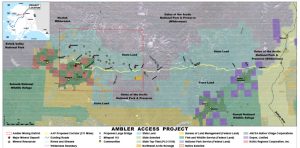
According to the report, the road would affect less than 0.005 percent of the Western Arctic Herd’s 92.2-million-acre range. The analysis also found that major migration routes for the herd historically run west and north of the proposed alignment, with relatively few collared caribou crossing the road corridor during fall migration and winter in past years.
The report notes that the proposed road and associated mines are located more than 150 miles from the herd’s core calving grounds, which lie primarily in and near the National Petroleum Reserve-Alaska. That distance significantly reduces the risk of impacts to calving behavior, one of the most sensitive phases of the caribou life cycle.
Cronin also examined how caribou respond to existing roads, including the Dalton Highway and the DeLong Mountain Transportation System that serves the Red Dog Mine. Observations show that caribou regularly cross these corridors. The Red Dog road and port infrastructure, operated by AIDEA, has long been cited as evidence that industrial development and subsistence resources can coexist when roads are designed and managed with wildlife movement in mind.
The report challenges environmental groups’ claims that the Red Dog Road significantly harmed migration, noting that those assessments often failed to account for hunting pressure and predator activity. Predation from bears and wolves, along with winter weather and icing events, were identified as the primary drivers influencing herd size and calf survival, far outweighing the likely effects of the Ambler Road.
Larry Westlake Sr., a Kiana elder and co-chair of the Ambler Access Project Subsistence Advisory Committee, said the findings align with long-held local knowledge. He said the report reinforces the importance of predator control as a tool for supporting herd health.
Tristen Pattee, a subsistence hunter from Ambler, said the report highlights how the project builds on established best practices from the Red Dog transportation system, including operational standards designed to protect caribou migration.
Under the current proposal, the Ambler Road would be a private industrial road, closed to public traffic. Only mining vehicles would be allowed, and hunting would be prohibited on or from the road. The Subsistence Advisory Committee has adopted and strengthened wildlife and subsistence policies modeled after Red Dog, and has asked the US Department of the Interior to allow predator control on federal lands where permitted to reduce pressure on the herd.
AIDEA said commissioning the report reflects its responsibility to evaluate potential impacts on subsistence resources using available science and real-world experience in Alaska.
The Ambler Access Project remains under federal review, and the report does not replace required environmental analysis. However, it adds to a growing body of evidence suggesting that, with modern design and management, transportation infrastructure in northern Alaska can coexist with wildlife and subsistence use without causing the widespread harm often predicted in early stages of development debates.



One thought on “New report shows Ambler Access road will not impact Western Arctic caribou”
Just like elsewhere in AK907, resource development industry has proven to be great partners all the while having all due respect (care and concern) for the ecosystems. I truly believe that the Ambler Road will not harm the arctic caribou herd, in no way shape and/or form. They will most likely thrive, in abundance and health, just like they do from Willow to Pt Thompson.