


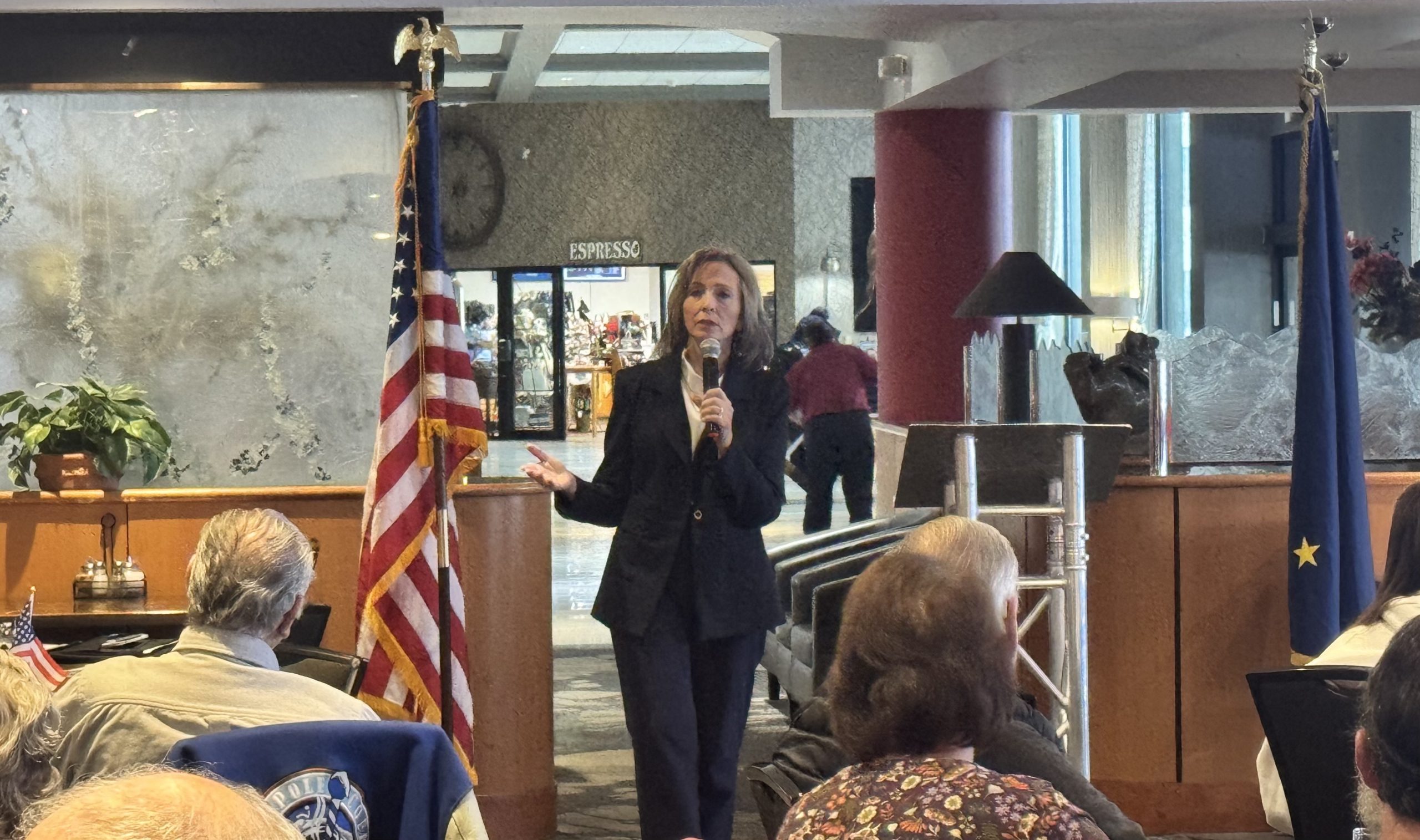
Sen. Shelley Hughes’ resignation from the Alaska Senate on Friday, a move made so she could focus on her run for governor, triggered immediate backlash among conservatives, many of whom argued that her departure shifted the political math in a way that could jeopardize the appointment process for filling Sen. Mike Shower’s now-vacant seat.
Shower resigned several days earlier to join gubernatorial candidate Bernadette Wilson’s ticket as her lieutenant governor pick. With two Mat-Su Senate seats now open simultaneously, some conservatives voiced concern that Hughes’ timing put Shower’s replacement at a disadvantage by reducing conservative votes on the Senate floor at the crucial moment when confirmation decisions are made.
But Hughes says that criticism is based on a misunderstanding and she is urging Alaskans to look at the numbers.
In a written statement to The Alaska Story, Hughes said the voting math for confirming Shower’s replacement is identical whether she remained in the Senate or not.
“My staying a few more days made NO difference mathematically on Shower’s Senate replacement,” Hughes wrote. “Why? Because both require yes votes from the Minority + 1 Majority yes vote. BOTH require one yes vote from the Majority. It’s the same either way.”
Under Senate rules, a nominee must receive a majority of the seated Senate for confirmation. Hughes explained it this way:
-
If she had still been in the Senate: The confirmation would require 6 yes votes out of 10 — five from the Republican minority and one from the bipartisan majority.
-
Now that she has resigned: The threshold is 5 yes votes out of 9 — four from the minority and one from the majority.
Either way, she said, the decisive factor is unchanged: one member of the majority would need to vote yes. Even with her still seated, Hughes said, the minority alone would not have had enough votes to confirm without at least one member of the majority coalition joining them.
“Now that I’m out,” she wrote, “it’s 5 out of 9. (4 votes from the Minority and 1 vote from the Majority.). Suzanne, I love you but you stirred up something here inaccurate… and people are condemning me as selfish, dumb, hurting the conservative cause, etc., and it’s simply not true.”
Hughes acknowledged that many conservatives are upset, but she insists the frustration is rooted in a misconception.
“A lot of people are upset, unnecessarily, and they need to know the truth,” she wrote.
Her decision leaves two seats open in one of the most conservative regions of the state, giving Gov. Mike Dunleavy the task of appointing successors to both Shower and Hughes before the Senate reconvenes.
Those names must then be confirmed by the Senate , a body currently controlled by a bipartisan coalition dominated by Democrats and a handful of moderate Republicans who broke from the GOP majority two years ago.
That dynamic was the underlying concern for many activists who reacted sharply to Hughes’ timing. But Hughes maintains the coalition’s veto power was the same before and after her resignation and that whether conservatives like it or not, any confirmation was always going to hinge on getting one vote from the majority.
The Alaska Story is publishing this article to provide full clarity on the math behind the replacement process as the debate continues among Mat-Su Republicans, statewide activists, and the Senate itself.



5 thoughts on “Shelley Hughes responds to critics of her resignation timing”
Thank you, Suzanne, for your clarification article. I would not do something that would put the Mat-Su in jeopardy. Waiting a few days would have accomplished nothing. There is no time limit on how long the Senate Republicans have to take the confirmation vote once they receive the appointee’s name from the governor. I was not going to risk that the people that I served for more than 12 years were going to be without a senator and even without possibly a house rep when the gavel comes down in Juneau in January. They deserve to have their representation in place.
Ms. Hughes. Thank you for restoring my faith in you. You (still) have my vote in the ‘rumble in the jungle’ primary. 🥰🥰
Thanks for the clarification on how the sausage is made, it’s always good to learn something new.
Actually, the more important question is: “Why would “moderate” Republicans in the State Senate vote against one of the candidates selected by the MatSu Republican Districts”? Would these “moderate” Republicans really want to disenfranchise these district voters? What about “democracy”? Oh, then there was the Laddie Shaw vote to disenfranchise the voters. This had better not be another disenfranchisement.
Besides, we do not need another Republican circular firing squad. This tends to be just another “look, squirrel” aka “another bright, shiny object”.
Gone is gone. Move on!