



By SUZANNE DOWNING
Sept. 25, 2026 – For weeks, I’ve been sounding the alarm about “rank the red.” It may make perfect sense inside a room full of Republican activists. But Alaska’s election will not be decided inside that room.
We have nearly 300,000 voters registered as undeclared, more than 82,000 registered as nonpartisan, and about 6,000 Libertarians. Compare that with roughly 142,000 registered Republicans. Party registration does not tell us how any of those Alaskans will vote, but it should tell every campaign something about the audience it needs to reach.
“Rank the red” speaks to the party faithful. It asks everyone else to adopt a party identity before they have even considered the candidates.
Now look at the graphic circulating for Jonathan Kreiss-Tomkins. Its headline is “Rank Alaska, Not a Party.” It shows a sign pointing one way toward the Republican Party and another toward Alaska. On the sample ballot, JKT gets the first ranking. At the bottom: “It’s about Alaska — not politics.”
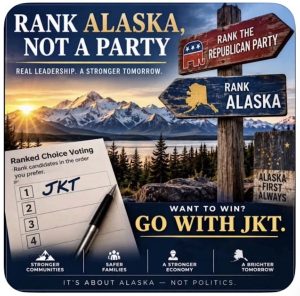
That is some pretty sharp messaging. It takes the Republicans’ own ranking theme and turns it into an argument against Republicans, and it’s aimed at voters who don’t belong to either major party.
Now, I disagree with the conclusion the graphic wants them to reach. I can still recognize a message built for the people who will decide this election.
Republicans have been here before. “Rank the red” was the rallying cry in 2022, and it did not deliver the outcome its advocates wanted. I have written about this extensively. In 2024, the message shifted toward consolidation. Nick Begich won Alaska’s US House seat because Nancy Dahlstrom graciously withdrew, leaving a clear path.
Those two elections involved different candidates and different circumstances, but the lesson should have stuck. The Democrats did learn from the Republicans: They got Tom Begich out of the race so they could consolidate.
For Republicans, after this year’s primary, “rank the red” came roaring back across social media.
Republican influencers repeated it as though the words alone could solve the problem of multiple Republican candidates on the general-election ballot. But only for the governor’s race, mind you, not the other ones.
They cannot convince anyone but the already convinced. They cannot convince the confused — and there are many of those out there.
Bernadette Wilson led the Republican field in a crowded primary — there were 12 Republicans. Dave Bronson and Treg Taylor, who finished fourth and fifth behind her, remained in the contest rather than uniting behind her. That is their (unfortunate) choice,; I’ve criticized that decision in previous columns. It leaves Republicans with a harder job: explaining three candidacies and a ranking strategy to voters who may have little patience for either.
Some Republicans are now moving toward “Rank all three or get JKT.” It’s a new slogan.
At least that tells voters what those Republicans believe is at stake. But it is still a message about ballot mechanics. Democrats have put forward a message about Alaska.
One side is asking voters to work through a party’s predicament. The other is telling them they can put the state first. Never mind that the graphic then directs them to rank the Democrat first and only. As campaign messaging, it meets voters where many of them already are.
Republican activists should be willing to hear this without taking offense. An undeclared voter is not a Republican who forgot to fill out a form. A nonpartisan voter may share conservative views on taxes, energy or public safety and still have no interest in taking instructions from a party slogan. In Alaska, the nonpartisans tend to lean left. Those voters deserve an argument about the future of Alaska, not just a mnemonic for filling in ovals.
This is a column about messaging because messaging is how campaigns reveal whom they think they are talking to. Right now, the Democrats’ graphic speaks to the broad electorate. Too much Republican messaging still sounds like Republicans talking to their own bubble.
As of Sept. 25, there are 39 days until the Nov. 3 general election. Early and absentee in-person voting begins Oct. 19, just 24 days away. Division of Elections That is a short time to make a case to hundreds of thousands of Alaskans outside the Republican registration column.
The Democrats understood the assignment. Republicans still have time to show that they do, too.
Suzanne Downing is founder and editor of The Alaska Story and is a longtime Alaska who is former communications director for the Alaska Republican Party.


One thought on “Democrats understood the assignment on ranked choice. Republicans are still arguing over the slogan”
The polls show this is very close. MAGA’s need to flood their candidates with whatever funds they have available. All hands on deck! You don’t need that savings for the kids college or grandchildren. Just throw it all to the superpacs. Tommy Tuberville is amongst the wisest on the right and he is warning you about the furries and the litter boxes in the schools. Trump has been reminding us all that gasoline prices are falling quickly along with grocery costs. So what are you saving that money for? Ken Paxton is one of those fine Republican candidates in a close race. Throw some cash his way!