


By SUZANNE DOWNING
Sept. 8, 2026 — The Alaska State Fair is famous for carnival rides, enormous cabbages, livestock competitions, and concerts. But during an election year, it also becomes one of Alaska’s most important political gathering places.
The fair reports an average attendance of about 295,000 visits during its annual run, an enormous audience in a state with fewer than 750,000 residents. Fair officials describe it as Alaska’s largest annual event, drawing people primarily from communities connected to the road system, including Anchorage, the Mat-Su Valley, the Kenai Peninsula and Interior Alaska. The fair also attracts visitors from rural communities and Southeast Alaska.
For candidates, that makes the Palmer fairgrounds one of the best places in the state to shake hands, listen to voters and introduce themselves to Alaskans outside their usual political circles.
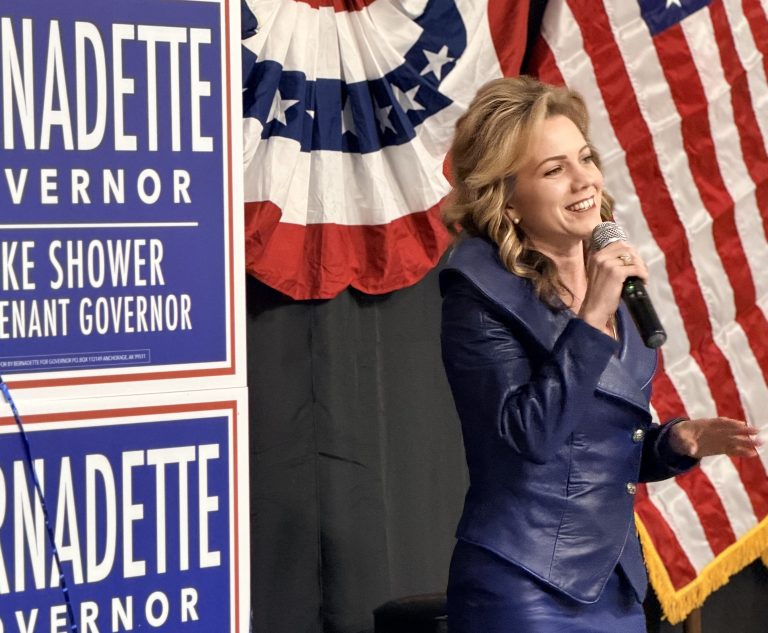
Congressman Nick Begich and US Sen. Dan Sullivan were among the elected officials greeting the crowds this year. Republican gubernatorial candidate Bernadette Wilson and other state and local candidates also made appearances.
But the political activity apparently crossed the fair’s clearly written boundaries in at least one case.
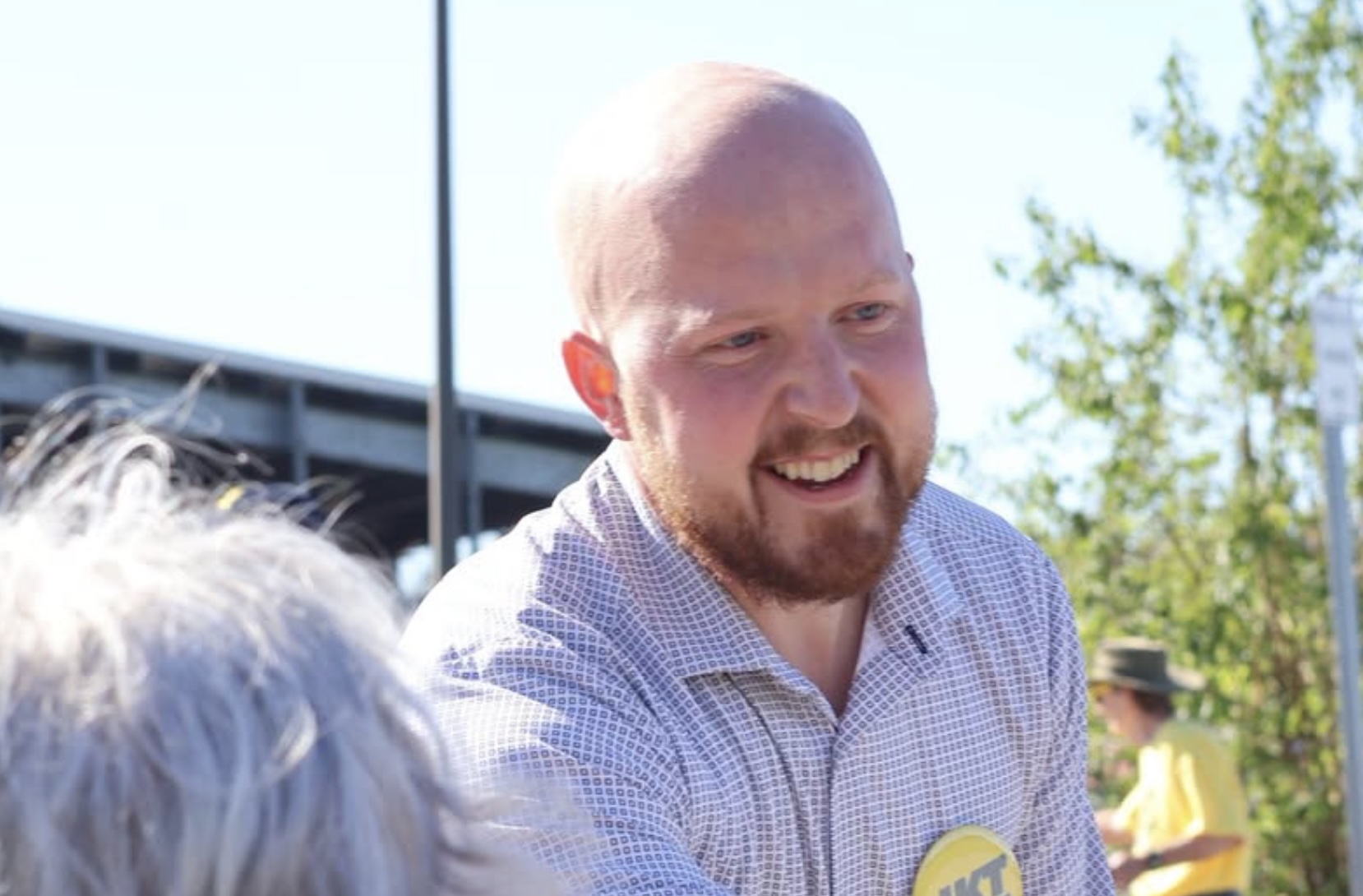
Democratic gubernatorial candidate Jonathan Kreiss-Tomkins, known as JKT, was seen walking from booth to booth and approaching fairgoers while distributing campaign literature.
A photograph sent to The Alaska Story shows the glossy JKT campaign piece that was handed out at the fair. The literature identifies Kreiss-Tomkins as a candidate for governor and promotes him as a “lifelong Alaskan” and “10-year legislator” offering “new ideas” and “new energy.”
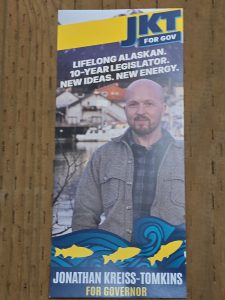
The distribution appears to violate the Alaska State Fair’s rules against roving solicitation. It’s considered a form of harassment.
The fair is private property operated by a nonprofit corporation. Its 2026 Vendor Handbook says solicitations and sales must take place within leased booth space.
“No one shall be allowed to solicit or distribute materials in aisles, or while roving on the grounds,” the handbook states. Violators are subject to immediate removal from the fairgrounds.
The rules also say political advertising or propaganda may be displayed or distributed only when an individual lease agreement specifically permits it.
Candidates and political organizations may lease booths and distribute literature from inside those designated spaces. The prohibition is against roaming through the grounds, approaching people and handing out campaign material outside an authorized booth.
Kreiss-Tomkins’ literature distribution was not merely a candidate shaking hands or talking casually with voters. Passing out printed campaign material while moving through vendor areas is precisely the activity addressed by the fair’s written rule.
The incident follows another political controversy at this year’s fair involving Democratic US Senate candidate Mary Peltola.
On Aug. 27, the alternative rock band CAKE brought Peltola on stage during its ticketed performance at the fair’s Borealis Theatre. Concertgoers had paid both fair admission and a separate concert ticket to see the band.
CAKE frontman John McCrea introduced Peltola and gave her an “I Love Democracy” shirt while discussing politics with the audience. Peltola later promoted the appearance through her campaign-related social media and Substack accounts, writing that she had driven to Palmer “to join one of my favorite bands, CAKE, on stage.”
The appearance raised a more complicated question under federal campaign-finance law: Did Peltola’s campaign receive something of value through the use of the stage, sound system, and access to a captive, ticket-paying audience?
Federal Election Commission guidance says free goods or services provided to a federal candidate can constitute an in-kind contribution. An expenditure made in cooperation or consultation with a campaign, or at the request or suggestion of a candidate or campaign, may also become a reportable contribution.
The legal answer would depend on facts that have not been made public: Who arranged the appearance, whether the campaign coordinated with CAKE or the fair, whether the band had contractual authority to turn part of its concert over to a candidate, whether comparable opportunities were offered to other Senate candidates, and whether Peltola’s campaign paid the normal commercial value of the opportunity.
The concertgoers themselves did not make campaign contributions merely by buying tickets. Their money purchased admission to the fair and the CAKE performance, not access to a Peltola campaign event. The potential contribution would instead involve the value of the platform and promotional opportunity supplied to the candidate by the band.
The State Fair has long been woven into Alaska’s political history.
In August 2008, then-Gov. Sarah Palin was at the fair when she received a call from Republican presidential nominee John McCain. Palin traveled to Arizona two days later and was offered the vice-presidential nomination. McCain introduced her as his running mate in Dayton, Ohio, on Aug. 29.
That history helps explain why candidates continue to make the annual pilgrimage to Palmer. With nearly 300,000 visits, the fair is one of the rare places where politicians can meet a broad cross-section of Alaska without flying thousands of miles between communities.
Shaking hands is part of the tradition. Renting a political booth and talking with visitors is allowed.
But turning a paid concert into a federal candidate’s political showcase raises campaign-finance questions. And JKT walking the grounds handing campaign flyers to people is expressly prohibited by the fair’s own rules.


28 thoughts on “Alaska State Fair is political heartbeat — but JKT’s roving campaign literature crossed the line”
The state fair board has become very liberal like Many other fairs around the state. They have done the same thing they turn their heads for their liberal
Friends!
Judy, besides being one of the noise makers on the Right. If you reside inside Anchorage not Eagleriver. I hope you serve as council member in your local community council. Considering your age that you actively get your GenXer and millennial neighbors voting right to serve alongside you.
Had either of these violations been by Republican candidates it would be ‘front page news’ with immediate consequence. The ‘party of relativism’ always manages to slither just at the edge of the boundaries and rules.
Absolutely correct, Elizabeth. That’s the way the left-wing media rolls. I’ve spent my entire career in the propaganda arts, trying to destroy Republicans. My drinking habits have all but ruined my liver, and my brain, but I still have one last election cycle in me. No one’s going to stop me before I kick the last can down the road and support Mary Peltola and this apparent little gay man from Sitka.
I love them both and I want to see Alaska run by Communists and LGBTQ persons.
.
Derm The Mutt
Snorting and Still Trying to Fart From Alaska
First honest comment I ever heard from Cole.
More democrat dirty tricks.
The question is what will/can Dahlstrom do about it.
I’m expecting a firmly worded memo.
If Republicans don’t like the favoritism. Then you don’t have to support the Alaska State Fair every year.
Just like the Alaska Performance Arts Center is finding out the hard way about Republicans and Conservatives pulling their support from the center.
The last time I visited the Palmer State Fair was 2015 because it’s not that great of an event. Nothing to do there except for a group of people to eat and get fat.
You know Tina, I generally dismiss or ignore your posts. However this I could not let stand without comment.
The AK State Fair is one of the largest events in South-central and I will be damned if I let some pinhead politician (or you) keep me from supporting the young people, who have labored all year to raise livestock or the quilters and the incredible pieces of art they display. The gardeners, who raised pumpkins, cabbages and other edibles, all the bakers and photographers showing off their craft along with those who keep traditions like canning and brewing alive, deserve to display their hard work. The food vendors, who work hard to introduce new food items or serve you old favorites. The exhibits the fair puts on every year are wonderful (I remember the Da Vinci exhibit a few years ago was excellent). In years past the Ninja Warriors put on a show, entertaining, encouraging and inspiring people of all age to get off the couch and exercise. It is a great place to meet aspiring politicians and representatives of the state face to face and ask them hard questions. In other words a great place to have fun, learn something new, appreciate the skill of others and enjoy the day!
That you see only food and fat is solely a ‘you’ problem.
Instead of a boycott you should call on the AK State Fair board to investigate and enforce their rules, regardless of who breaks them.
Is JKT what Alaskans want? Really? A gay man trying to redress himself as a man’s man, but only temporarily, because he is a full-on LGBTQ puppet of the left. Democrats try and hide their real identities during the campaign period, then they show their true colors once elected. Mary Peltola is the primary example in 2022 when she won a congressional seat vis a vis RCV. She became Joe Biden’s rubber stamp and hardly ever went to work except to hold veterans in contempt and to vote against Alaska resource development. And now she’s trying to repeat 2026. Mary Peltola and JKT are luring Alaskans into a destructive path. Both of these creatures needs to be stopped on election day before they sink our state.
so Scott Bessent is ok because he is a full-on LGBTQ puppet on the right. Kind of odd that Trump doesn’t have a problem letting that flaming fag run the country.
Conservative fags are a rare exception.
Liberal commie fags are a dime a dozen. The giveaways: voice inflection, two earrings, gait, eye contact with other men, hands, Subarus. These are no brainers. Teach your children the signs.
….and Volvos.
He’s not OK in my book. Shouldn’t be there.
Why?
I don’t think Bessent is anybody’s puppet. Either was Rick Grenell in the first term. Somehow neither ever made their sexuality an issue like those on the left seem to always be doing. Cheers –
Every picture makes me think of Porky Pig saying “That’s all folks!”
LOL…..well, not quite. He has a few more bangs left in him.
You mean “chops.”
😆
Gives new meaning to “getting porked.”
Demoncrats don’t play by any rules. They follow the “rules for thee, but not for me” narrative and cheating is part of their DNA. One need only look at the bald faced lies in the Paytola 💰 ads to see the evidence.
Rules do not apply to the entitled, Yale-educated JKT. He exists at a level far above insignificant working people.
Uhh….JKT never graduated with a degree from Yale. He was too anxious to get his brand of communism started in Sitka and dropped out of college. Poor f*ckers in Sitka didn’t know any better.
JKT is already talking to Dunleavy political appointees of various State of Alaska Agencies feeling out the status quo. Talk about in your face.
As far as the Homosexual from Sitka is concerned He is in transition to the Governor’s office. Done deal.
So him prancing around the Alaska State Fair is not surprising. After all his profession is a Political Consultant.
JKT says he has fresh ideas, really, you know kinda like Obama when he
said “ I am going to fundamentally change America.” Obama succeeded.
As will JKT fundamentally change Alaska with his Leftest Homosexual Agenda.
That’s all folks. See porky pig comments above.
> It’s considered a form of harassment.
There will be a lot of “harassing” if this ladyboy becomes guv.
Come on Alaska. Let’s not go full clown show.
To the person or persons who gave Suzanne this report, please file a complaint with the DOE, the AK state fair board and APOC. I bet in this day and age someone has video of Boy-Wonder handing out flyers in the middle of the fairway.
Out of idle curiosity I perused his website and for the life of me could not find one NEW idea, only old mantra of funding schools, defined benefits, or protect medicaid expansion…etc. I see a lot of “support this or that”, “tax this or that” (Going after second homes and HilCorp) but not one actual detail or plan on HOW he wants to accomplish any of that and what it will cost each Alaskan.
No thank you!
JKT probably will be Alaska’s next Governor. I don’t see how Ranking the Red out of order will work for the AKGOP like they think. Or like they are hoping. The most likely result that’ll come from ranking the red is No one even JKT won’t receive a 50plus1 percent (because Democrats are a minority and they need Republicans and undeclared to help) the vote and a runoff will likely happen between the two highest candidates to get a 5oplus1 percent to certify the election.
The moto of the left is “the ends justify the means.” They are crooked as all get out.;
JKT &Mary at the fair
Dan J and the 907 initiative
And I seem to remember something about Lisa and gifts to voter in the village during the write in campaign.