


By SUZANNE DOWNING
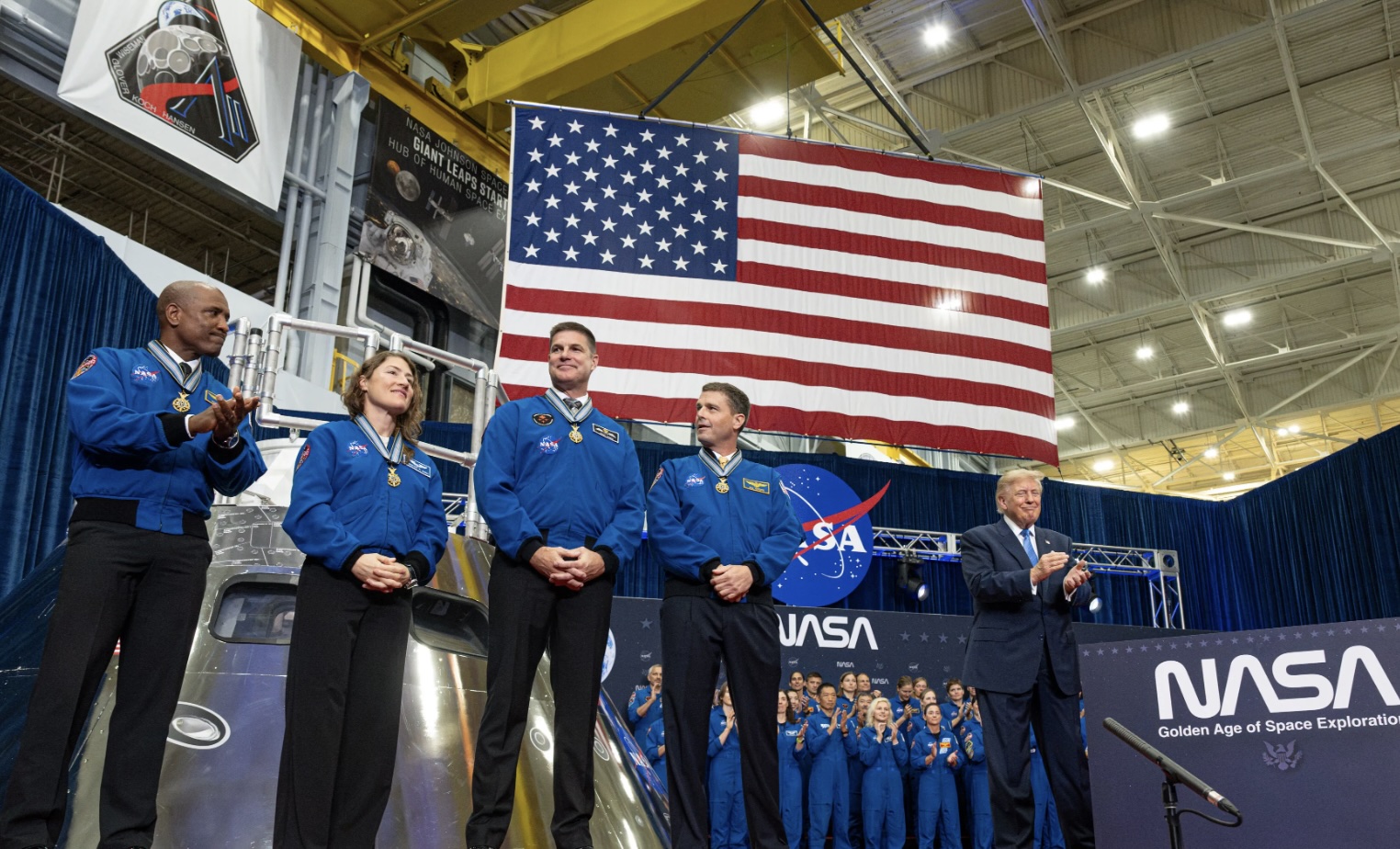
Aug. 30, 2026 – President Donald Trump on Friday awarded the Congressional Space Medal of Honor to the four astronauts who flew around the Moon aboard Artemis II, including Christina Koch, whose path to NASA’s astronaut corps ran through Alaska’s North Slope.
During the same Aug. 28 ceremony at NASA’s Johnson Space Center in Houston, Trump signed an executive order beginning the process of creating the nation’s first United States Space Academy. The proposed federal academy would educate and train future astronauts, scientists, engineers, military personnel, space operators, and other professionals needed to maintain American leadership in space.
The two actions connected the accomplishments of the current generation of space explorers with the administration’s plans to develop the next one.
Koch received the nation’s highest spaceflight honor alongside Artemis II commander Reid Wiseman, pilot Victor Glover and Canadian Space Agency mission specialist Jeremy Hansen.
“We gather on these historic grounds to celebrate the immense courage of four intrepid space heroes whose sense of daring and adventure led them further from Earth than anyone has ever traveled ever before,” Trump said. “Today we’re proudly awarding the Congressional Space Medal of Honor to the remarkable crew of Artemis II.”
Trump also recognized the engineers, scientists, launch specialists and others who supported the mission.
The Congressional Space Medal of Honor was authorized by Congress in 1969 to recognize astronauts who distinguish themselves through exceptionally brave and meritorious service and contributions to the nation and humanity. The Artemis II crew members were the first recipients since 2023, bringing the total number honored since the beginning of the American space program to 34.
Artemis II launched April 1 aboard NASA’s Space Launch System rocket. The crew flew aboard the Orion spacecraft, which they named Integrity, and splashed down safely in the Pacific Ocean off San Diego on April 10 after nearly 10 days in space.
During the lunar flyby, the astronauts traveled 252,756 miles from Earth, farther than any humans before them and beyond the distance record set by Apollo 13 in 1970. The mission covered 695,081 miles in all and marked the first crewed flight of both the Space Launch System rocket and Orion spacecraft.
For Alaska, the mission carried a special connection through Koch.
Before NASA selected her as an astronaut in 2013, Koch lived and worked in Utqiaġvik, then commonly known as Barrow. In 2012, she served as a field engineer at NOAA’s Atmospheric Baseline Observatory, about five miles northeast of the North Slope community near the Arctic Ocean.
The remote facility monitors atmospheric gases, aerosols and long-term climate conditions. Koch maintained and operated sensitive scientific instruments through extreme cold, isolation and harsh Arctic weather.
It was while stationed more than 500 miles north of the Arctic Circle that Koch submitted her application to NASA’s astronaut program.
As The Alaska Story reported previously, her Alaska assignment was part of a career spent working in some of the world’s most unforgiving environments. Koch also served in Greenland and Antarctica, including a winter at the Amundsen-Scott South Pole Station.
The isolation, technical responsibilities and severe conditions of those assignments helped prepare her for the demands of spaceflight.
Koch later spent 328 consecutive days aboard the International Space Station, setting what was then the record for the longest continuous spaceflight by a woman. With Artemis II, she became the first woman to travel beyond low Earth orbit.
“The response to our mission here on Earth was beyond anything we ever imagined and all we ever hoped for,” Koch said during Friday’s ceremony. “As team members on this shared mission, we accept this award to honor those who made it happen, from factory floors to clean rooms and mission control rooms.”
Koch is the only member of the four-person Artemis II crew with a documented personal or professional connection to Alaska.
Trump’s executive order signed during the same ceremony declared space a critical arena for national security, economic growth, science and technological development.
“American superiority in space depends on the strength, skill, and character of those who explore, secure, and build the industries critical to it,” the order states.
The order establishes a Presidential Commission on the United States Space Academy, chaired by NASA Administrator Jared Isaacman. The president’s science and technology adviser and economic policy adviser will serve as vice chairs, while the NASA deputy administrator will serve as executive director.
The commission also will include representatives from the Department of War, the Air Force, the Office of Management and Budget, the National Security Council and other federal offices.
“Given the rapid growth of the U.S. Space Force and commercial space industry, and the expansion of our ambitions to the Moon and far beyond the Moon, it’s clear we will need to educate and train an entire generation of skilled service members, engineers, and civil operators,” Trump said.
The proposed NASA-led academy would combine technical education with leadership development, discipline and a commitment to public service. Graduates could be required to serve in the Armed Forces or civilian federal agencies.
The commission has 120 days to submit recommendations to Trump concerning the academy’s structure, accreditation, curriculum, degree programs, admission requirements and graduate service obligations. It also must recommend a process for choosing a permanent location and identify any legislation Congress would need to approve.
The order begins the planning process rather than immediately opening an academy. Its eventual establishment could require congressional action and federal appropriations.
NASA said the academy would help supply the workforce needed for future lunar missions, development of a permanent Moon base, nuclear power projects, commercial activity in orbit and eventual human missions to Mars.
Koch’s career illustrates the kind of unconventional path that can lead to that work. Long before she traveled farther from Earth than any previous astronaut, she was maintaining scientific instruments on Alaska’s Arctic coast and sending an astronaut application south from Utqiaġvik.
On Friday, she returned from that journey with the nation’s highest award for spaceflight as the president laid out a plan to train those who will follow.
The White House executive order establishing the Space Academy commission and video of the medal ceremony are available online.
From Utqiaġvik to the Moon: Artemis II astronaut built her resumé on Alaska’s North Slope



2 thoughts on “From Utqiaġvik to the Moon, a Medal of Honor and the launching of the Space Academy”
Go spacemen and spacewomen!
Will.thoseattending the Space Academy be known as Space Cadets?