


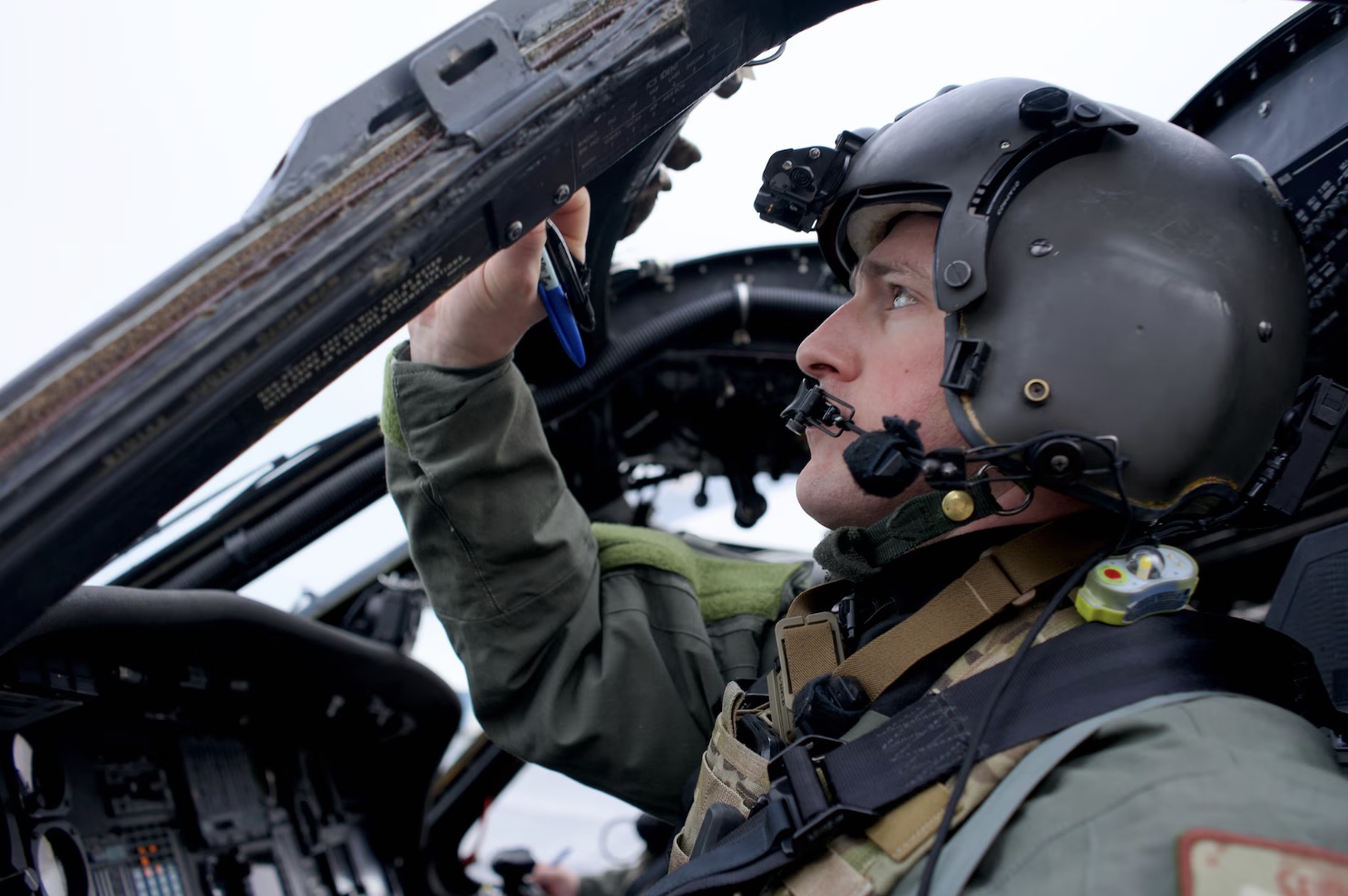
Photo credit: Alaska Air National Guard
By THE ALASKA STORY
Three people survived a Cessna 180 crash near Bettles after an emergency locator beacon and a satellite communication device guided Alaska Air National Guard rescuers to the remote site.
The crash occurred Aug. 18 about 200 miles northwest of Fairbanks, according to the Alaska National Guard.
The Alaska Rescue Coordination Center at Joint Base Elmendorf-Richardson opened the mission after receiving a signal from the aircraft’s 406-megahertz emergency locator transmitter.
The 176th Wing dispatched an HH-60W Jolly Green II helicopter from Eielson Air Force Base. The aircraft carried pararescuemen from the 212th Rescue Squadron.
While flying toward the location transmitted by the emergency beacon, rescuers received more precise coordinates from a commercial two-way satellite communication device carried by the occupants. They had used the device to contact the owner of a lodge in Bettles, who relayed their coordinates to the rescue crew.
The helicopter crew found the wreckage and lowered pararescuemen to the ground a short distance from the victims to prevent rotor wash from affecting the crash site.
One acutely injured person was secured in a Stokes litter and hoisted aboard the helicopter. The other two occupants were then lifted into the aircraft.
All three were flown to Fairbanks Memorial Hospital, where an ambulance was waiting at the hospital helipad.
Alaska Air National Guard Maj. Tyler Seibold said the satellite device sharply reduced the area rescuers had to search. Although a 406-megahertz emergency beacon can alert authorities to a crash, its coordinates may require crews to search an area spanning a mile or more. The satellite device allowed the helicopter crew to locate the victims within about one-tenth of a mile.
“It minimizes the time searching for someone in the Alaska wilderness,” Seibold said. “So, if their medical condition is dire, that is extra time that we can get treatment on the patient.”
Many satellite devices can also send text messages when connected to a smartphone, allowing people in distress to provide rescuers with information about injuries, weather and conditions at the scene.
“If they still have battery power on their phone, they can message the Rescue Coordination Center,” Seibold said. “And sometimes we will have the PJs in the back of the helicopter start messaging and asking about patient status and the weather conditions on the ground.”
The Guard did not release the identities of the three occupants or information about what caused the Cessna to crash.
Seibold said the successful rescue illustrated the importance of carrying emergency equipment when flying or traveling through Alaska’s backcountry.
“[The plane’s occupants] did everything they could by the book, and that really cut down on how long it took us to get to them and get them to a higher level of medical care,” he said.
The rescue took place two days before another Cessna crashed near the Cape Newenham Long Range Radar Site in Western Alaska.
All eight people aboard that aircraft — two pilots and six passengers — were killed Aug. 20 when the Security Aviation Cessna 441 went down while attempting to land in thick fog and sharply reduced visibility. The charter flight was carrying two U.S. Army Corps of Engineers employees and four contractors in addition to its pilots.
Federal investigators said the Cape Newenham aircraft crashed during its second landing attempt near the remote, mountainous airstrip. The National Transportation Safety Board is investigating the cause of that crash.

4 thoughts on “Satellite messenger helps Alaska Air Guard rescue three after plane crash near Bettles”
With hunting season almost upon us, there will be more flight accidents in Alaska. The best precaution is to make sure that all safety gear is onboard:
Locators, communication devices, first aid boxes, warm clothes, and food.
Be safe!
I read somewhere, maybe in ADN, that “a crash a day is the Alaska way”.
[…] Satellite messenger helps Alaska Air Guard rescue three after plane crash near Bettles […]
[…] Satellite messenger helps Alaska Air Guard rescue three after plane crash near Bettles […]