


By SUZANNE DOWNING
Aug. 23, 2026 – Juneau was founded on gold, its settlement and early economy built on the rich Juneau Gold Belt stretching roughly 100 miles from Windham Bay to Berners Bay. Now, a new chapter in that storied mining history may be taking shape near Herbert Glacier, where the New Amalga gold project has cleared an important state regulatory hurdle.
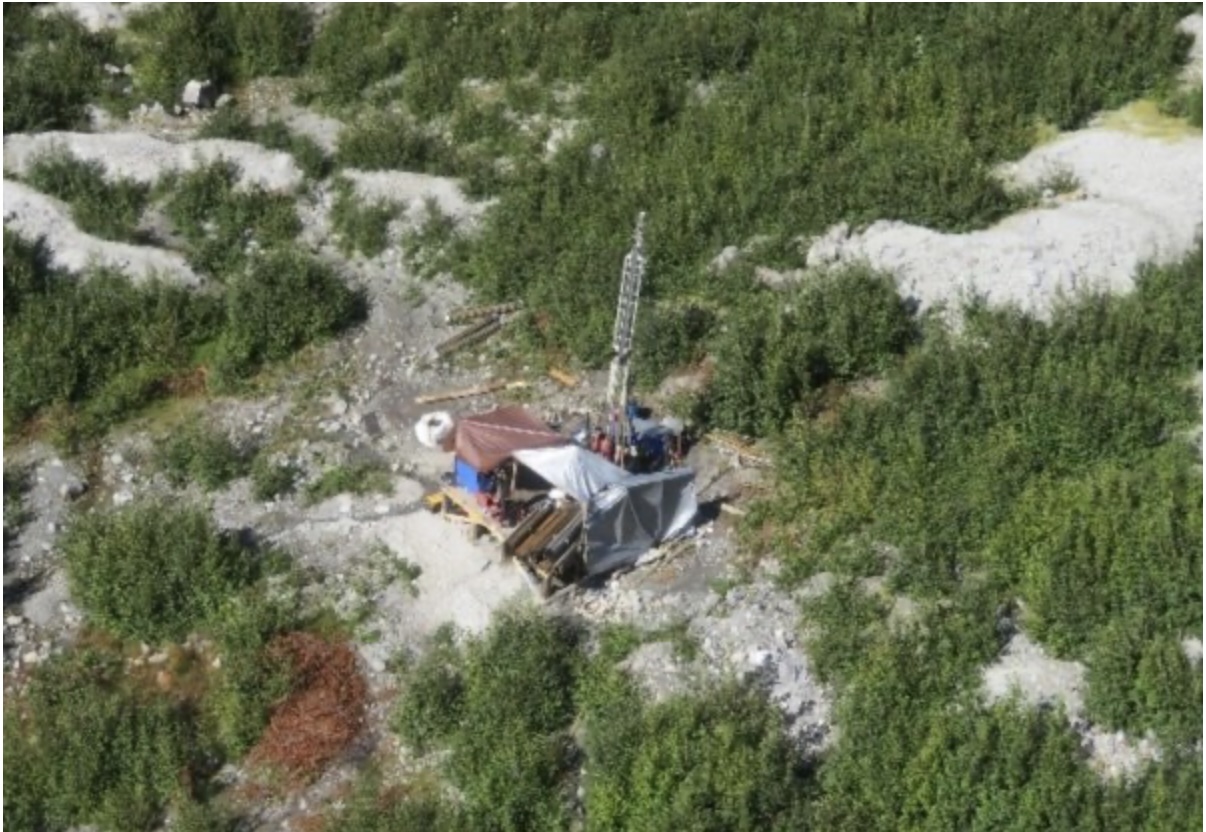
The New Amalga gold project north of Juneau has received approval for an access road connecting Glacier Highway with the exploration project near Herbert Glacier.
The Alaska Department of Natural Resources issued a favorable regional manager’s decision Aug. 18 for a private, nonexclusive easement requested by GPG Alaska Resources Inc., the Alaska subsidiary of Canadian junior mining company Grande Portage Resources Ltd.
The decision covers a 60-foot-wide easement corridor extending approximately 1.3 miles across state land, within which the company could construct a 15-foot-wide unpaved road. It also authorizes two one-acre staging areas for equipment, drilling supplies and helicopter operations.
The road authorization will proceed in two phases.
- Phase 1 allows the company to immediately move toward developing a 0.17-mile road segment near Glacier Highway and the first staging area. Before construction begins, the company must meet several conditions, including providing a $469,748 performance guarantee, obtaining insurance and required state and municipal permits, and submitting an updated development plan that keeps the road outside a 300-foot fish-habitat buffer along the Eagle and Herbert rivers.
- Phase 2 would cover the remaining 1.13 miles of state road and the second staging area. That portion cannot be developed until the company receives U.S. Forest Service approval for a plan of operations allowing mineral extraction and production on the adjacent federal land.
The entire road needed to reach the project would be approximately 3.4 miles long. More than one-third would cross state land, while the remainder would be located on federal land and require a separate environmental review and authorization from the Forest Service.
The DNR decision does not authorize construction or operation of a mine. It establishes legal access across state land and creates a route that could eventually become part of the mine-access road if the project wins its remaining permits.
The state intends to issue a five-year entry authorization allowing construction and completion of a state-approved survey. Once the conditions are satisfied, the final easement would run for 25 years.
Grande Portage President and CEO Ian Klassen called the decision an important step for the project.
“The road development and equipment staging areas will not only enhance the efficiency of our exploration efforts but will also reduce the impact of helicopter noise on residential areas of the Mendenhall Valley,” Klassen said in a statement.
The first staging area would move helicopter-supported drilling operations closer to the property, reducing the distance required to sling equipment and supplies by an estimated 60% compared with the company’s previous staging location in the Mendenhall Valley, according to Grande Portage.
DNR received 196 public comments during its review, mostly in opposition, with concerns raised about effects on wetlands, wildlife, recreation, water quality and the Eagle and Herbert River watersheds.
DNR concluded that the easement is consistent with the Juneau State Land Plan, which identifies the area as having high mineral potential and specifically allows state land to support access for mineral exploration and development on adjoining Forest Service property.
The agency said environmental-liability requirements will be incorporated into the easement and that the company must comply with applicable water, floodplain, cultural-resource and transportation requirements. The road would also be required to use culverts, drainage controls and other measures intended to preserve existing water-flow patterns.
The New Amalga property is an exploration-stage, partially drill-tested gold and silver deposit approximately 25 kilometers, or 15.5 miles, north of Juneau and south of Coeur Alaska’s operating Kensington gold mine. Grande Portage holds a 100% interest in the property, which includes 91 unpatented lode claims and at least six identified quartz-vein structures.
The company’s mineral resource estimate reports an indicated resource of approximately 1.44 million ounces of gold at an average grade of 9.47 grams per tonne, along with an inferred resource of about 515,700 ounces at 8.85 grams per tonne. The estimate also includes approximately 891,600 indicated ounces and 390,600 inferred ounces of silver.
The deposit remains open along strike and at depth. Drilling has produced several high-grade intersections, including 15.27 meters grading 37.07 grams of gold per tonne in the Deep Trench vein and 3.05 meters grading 72.3 grams of gold per tonne in the Main vein.
Grande Portage envisions a selective underground mine without an on-site ore-processing plant or tailings-disposal facility. The company is studying a plan under which sorted ore would be transported to an off-site third-party processor.
The project received another significant boost in July when the Federal Permitting Improvement Steering Council accepted it into the FAST-41 program. That designation does not guarantee federal approval, but it establishes coordinated agency review, a public permitting timetable and greater accountability among the agencies involved. The Forest Service will serve as the lead federal agency. The federal project description includes the access road and a proposed 30-acre surface site containing equipment shops, electrical generation, water-treatment and ore-sorting facilities.
The decision is not quite final, as it may be appealed to the DNR commissioner within 20 calendar days of its issuance.


4 thoughts on “State approves first leg of access road for New Amalga gold project north of Juneau”
My Milestone estimate
Environmental/permitting work intensifies 2026–2027
Formal EIS/permitting process 2027–2029
Major permits / Record of Decision ~2029
Final feasibility + full financing 2028–2030
Construction decision ~2029–2030
Major construction 2030–2032
First production 2032 ± 1 year
The NIMBYs here in Juneau will fight tooth and nail to keep this project from ever getting that far.
SEACC has been pre-gathering negative comments for some time now to flood the process.
Will all the soon-to-be-filed lawfare ultimately stop the project? Maybe not, but look at what happened with Kensington: it took a Supreme Court ruling to get the permits.
The ruling was for Coeur d’Alene Mines Corp.’s tailings disposal permits of which GPG will have no tailings deposal in their very pro-environmental mining process.
The communists will never surrender. They will wage lawfare to stack delays upon delays to defeat the applicant by financial attrition. They want to restore Alaska to its virgin condition so we must import needed resources from the 2nd and 3rd worlds.