


By THE ALASKA STORY
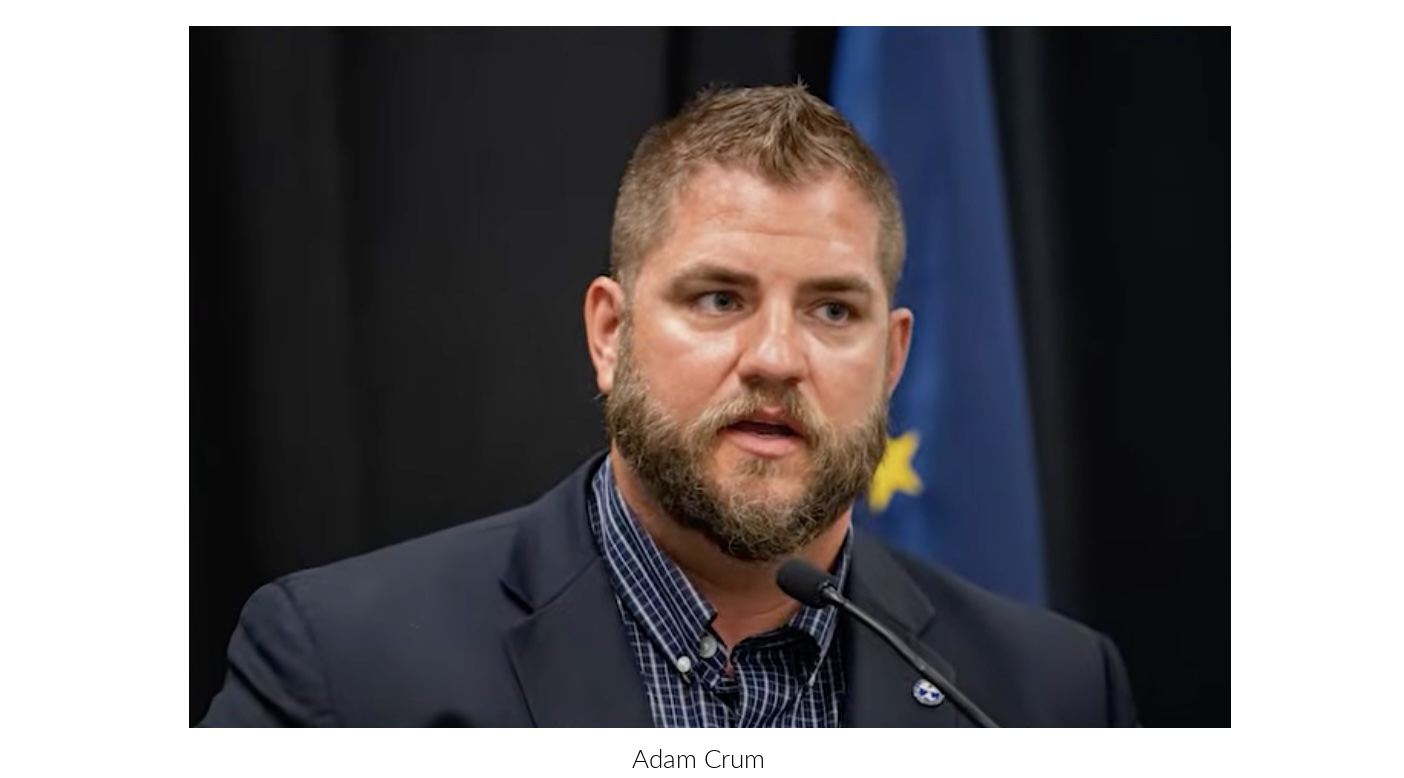
Aug. 7, 2026 – Adam Crum emerged as the clear favorite in both audience votes Thursday night during a two-stage gubernatorial forum that drew more than 175 people to Soldotna.
Not all of the leading candidates for governor attended. Tom Begich, Jonathan Kreiss-Tomkins, Bernadette Wilson and Click Bishop declined invitations to participate. Wilson was prescheduled to be at an event for House Speaker Mike Johnson and Congressman Nick Begich in Anchorage. Treg Taylor had RSVP’d but in the end did not attend the Soldotna forum.
Nine candidates participated in the opening round: Crum, Dave Bronson, Shelley Hughes, Matt Heilala, Bill Walker, Edna DeVries, Lesil McGuire, Meda DeWitt and Michael Gilbert.
The Soldotna and Kenai Chambers of Commerce hosted the event at the Soldotna Regional Sports Complex, where the packed room heard more than two hours of discussion about education, fisheries, state spending, energy, taxes, outmigration and other issues likely to shape Alaska’s race for governor.
The unusual format gave audience members a direct role in deciding which candidates would remain on stage. The audience was going to vote people off the island after the first round.
During the first portion, each candidate was given 90 seconds to answer two questions. The first asked candidates to name one measurable accomplishment they would want Alaskans to identify four years from now as something that changed the state’s future.
The second asked whether they supported the $700 increase in the Base Student Allocation approved by lawmakers in 2025.
After the opening answers, eligible audience members voted in the first of two straw polls.
Of the 133 ballots cast, Crum led the field with 47 votes, or slightly more than 35%. He also finished first in a pair of gubernatorial straw polls held on the Peninsula in April.
Heilala placed second in the opening vote with 22, followed by Bronson with 21, Hughes with 18 and DeWitt with eight. Those five advanced to the second round of questions.
Four candidates were, in effect, voted off the island. DeVries received seven votes, Walker six, and McGuire four. Gilbert did not receive a singe vote.
The second round lasted slightly more than an hour. Candidates had 60 seconds to answer each question, with another 30 seconds allowed if moderators asked a follow-up.
The finalists faced several policy questions covering some of Alaska’s most difficult and persistent problems.
Candidates were asked how their administrations would respond to declining king salmon returns and whether they agreed with Alaska Department of Fish and Game assessment that bycatch alone cannot explain the scale of the decline.
They were also pressed on what they would cut during a budget shortfall, which spending they would protect, what terms they would accept from developers involved in the proposed Alaska LNG project, how they would address Alaska’s continuing net outmigration and high cost of living, and whether they would veto a broad-based tax increase that could discourage private investment.
The candidates also had to confront the realities of Alaska’s top-four election system. Moderators asked what circumstances might cause them to withdraw if they advanced to the general election but trailed another candidate who appealed to a similar group of voters.
Crum remained firmly in first place, receiving 46 of the 126 second-round votes, essentially unchanged from his opening total.
Hughes came in second, Bronson remained in third place, while DeWitt finished fourth and Heilala finished fifth.
Moderators directed individualized questions to each finalist. Bronson was challenged over his contentious relationship with the Anchorage Assembly during his term as mayor. Heilala was questioned about his criticism of Alaska’s political establishment. Hughes was asked how her legislative experience would translate to managing the executive branch. DeWitt was asked what she learned from leading the effort to recall Dunleavy.
Crum’s question focused on his experience managing state finances: What decision would he make as governor that would upset people but nevertheless needed to be made?
Crum said he had already made such a decision.
He pointed to investment changes involving the Constitutional Budget Reserve, saying the state was not earning a sufficient return and needed to accept greater investment risk to improve its performance.
“We are the richest poor state imaginable, with the most cash in the bank and the worst cash flow,” Crum said, confronting the controversy over that investment decision directly.

9 thoughts on “Crum sweeps straw poll at packed Soldotna governor debate”
A lot of these candidates should have dropped their run for Governor and been Lt. Governor candidates with better options at the top of the ticket. As large as the field is, it makes it difficult to decide who I should vote for to make the top four.
That’s the strategy of the Big government Republicans and Big government Democrats. Flood the gubernatorial race with as many Governor hopefuls so that Alaskans split the votes and to keep as many Republicans off the general ballot.
I personally think it’s an attempt to try putting a hurdle in the way of Bernedette/Shower. When AKDemocrats and AKRepublicans had no one except Matt Clamon, she and him were the first two to announce while former state senator Nick Begich announcing after Wilson. After Wilson entered the whole government dependent crowd threw their heads back exclaiming oh hell no! And threw as many Republicans and Democrats into the race.
I hope she prevails and if we Alaskans who hate lies, deceit, and tantrums from the political left and right, Wilson would the only Republican who makes the top four! Then the AkGOP would have no choice but to support Wilson/Shower if they don’t want to lose the Governor’s office in 2027.
It would display again God has a sense of humor if Wilson/Shower came forth as the Only Republican. Just because of the Republicans being that way and they’d have to support a candidate they strongly attempted to get squeezed out by RCV.
Her messaging and branding is resonating with more Alaskans than the other Republicans.
Her campaign team is showing they are the A students of political campaigning.
I did not see the event and don’t know if I agree with all of Adam Crum’s answers. I do know this: He is smart, well-educated, informed, hard-working, conservative and honest. We are staring at a new generation of leadership. He has my vote.
I don’t know much about him. I am going to look into his candidacy.
Not a very good event to tell whom Soldotna-Kenai Republicans would actually favor. Because out of all the others Crum would come forth as the most conservative and Republican as well as he is a guy and he is not a Babyboomer. Yes. Even baby boomers today’s want to see the baby boomers retire from political offices and let GenXers but more so Millennials and GenZers stepping up to fulfill legislative and governor offices.
Have you guys seen the new JKT mailer. There is a new one where his campaign team created a flyer of all mini photographs of headshots of commmunity leaders with JKT. They are ALL millennials who are movers and shakers influencing Alaska’s leadership direction by each of their own contributions.
The takeaway from their little and immature straw game is even in Soldotna-Kenai they are gravitating to a Republican who is younger.
Never forget he was King COVID for Alaska and crowned Anne Zinke. I know I’ll never forget so he’ll never get my vote.
Interesting that nearly all the voters who voted for the dropped 1st round candidates voted for Shelley, or… Or I don’t know. 15 votes are unaccounted for from the first round. For the second round, Crum lost one. Bronson gained 3. Shelley gained 13 after they heard her speak. Just so you know the totals: 2nd round with 5 candidates: Crum 46, Hughes 31, Bronson 24 and I don’t know Dewitt or Heilala. These are from the ADN article about the event. Crum is from Kenai, so not surprising that his hometown crowd supported him. Based on new votes and swayed voters in a non-hometown location, I would say that Hughes is the main standout in this event. Heilala remains a non-factor. Dewitt is not a serious contender. All those voted off the stage: Bill Walker, Edna DeVries, Lesil McGuire, and Michael Gilbert are wasted votes. For those who are watching this election closely, it will come down to Bronson, Click Bishop and Hughes for the 4th spot. Choose wisely!
Biased source as I am the Policy and Strategy Lead (1000+ hours in) for Hughes/Gettys, but at least I don’t get paid for it!
Maybe Crum can explain?
.
“Tech firm sponsoring Adam Crum summit awarded $4M+ more than we reported…
.
On (May 12, 2026), we reported that Saige Consulting sponsored a 2024 summit for GOP state treasurers that was hosted by former Revenue Commissioner Adam Crum, during a time when the firm was under consideration for a state contract issued by Crum’s department.
.
We stated that the initial Department of Revenue (DOR) contract was worth $7.5 million, when in fact, that contract expanded to $11.9 million, according to Saige Managing Partner Charles Hu, who supplied us with the numbers himself.”
.
(https://thealaskacurrent.com/2026/05/14/correction-tech-firm-sponsoring-adam-crum-summit-awarded-4m-more-than-we-reported/)