


By SUZANNE DOWNING
Aug. 6, 2026 – Alaska’s primary election ends Aug. 18, leaving candidates just 12 days to persuade voters, turn out supporters and—in some cases—tear down their opponents.
Early voting continues through Aug. 17, the day before polls open statewide for the final day of voting. Between now and then, Alaskans can expect the attacks and strange political maneuvers to come fast and furious from every corner of the political spectrum.
One of the more dishonest attacks now circulating targets Bernadette Wilson, one of the leading Republican candidates for governor.
A digitally altered image shows Wilson wearing a hat that reads, “I ❤️ Murkowski,” creating the false impression that Wilson is a supporter of Republican Sen. Lisa Murkowski.
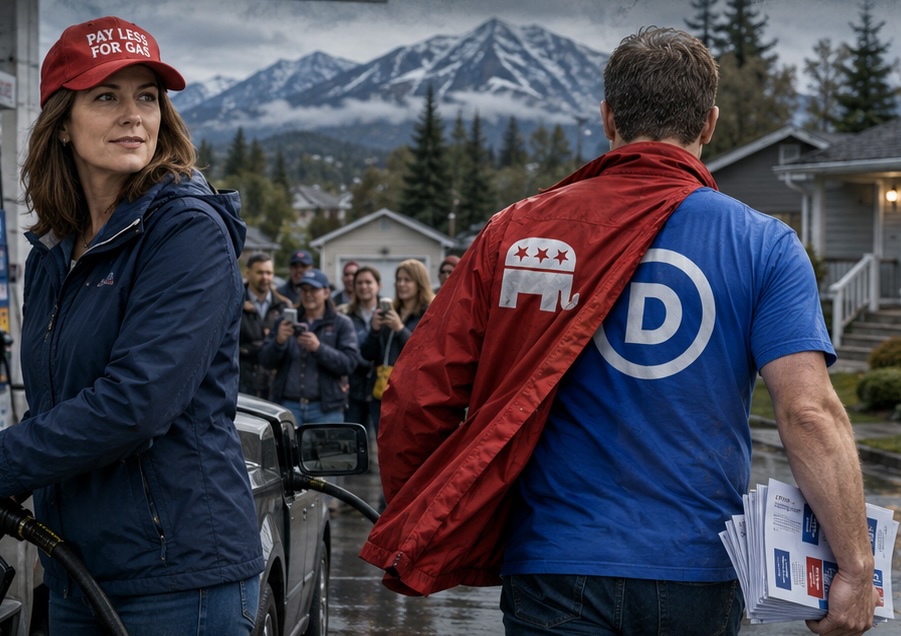
The actual hat said, “Pay Less for Gas.”
Wilson was wearing it while serving as Alaska state director for Americans for Prosperity and hosting a free gasoline event in Anchorage intended to highlight the high cost of energy.
The altered image turns Wilson’s political history on its head.
Wilson was a paid staff member of Republican Joe Miller’s 2010 campaign to defeat Murkowski. Miller defeated Murkowski in the Republican primary that year, although Murkowski went on to win the general election through a hastily launched write-in campaign.
The fake hat appears to be part of a broader effort to use artificial intelligence or digital manipulation to manufacture political positions that candidates have never held. More such material is likely during the final days of the primary, particularly from Republican rivals trying to stop Wilson’s momentum.
Some of Wilson’s Republican competitors and their supporters appear to have few moral boundaries when it comes to misleading voters. Artificial intelligence now makes it possible to create a convincing fake photograph in minutes, and many voters scrolling quickly through Facebook or other social media platforms may never realize that what they are seeing has been fabricated.
But fake images are not the only curious tactic appearing in the closing days of the campaign.
Legislative candidates across Alaska are knocking on doors, introducing themselves and urging supporters to vote. In Eagle River’s heavily Republican House District 23, however, the people showing up on doorsteps are raising questions about exactly which political team candidate Ruby Jones represents.
Jones changed her voter registration to Republican before launching her campaign to unseat conservative Republican Rep. Jamie Allard. On Wednesday, hard-left Anchorage Democratic Rep. Zack Fields was door-knocking in Eagle River on Jones’ behalf.
Fields is no casual Democrat. He is a former Alaska Democratic Party staff member and a Democratic legislator representing House District 17, which includes Downtown Anchorage, Fairview and South Addition. Yet there he was campaigning in conservative Eagle River for a candidate now presenting herself to voters as a Republican.
That naturally raises a question: Is Ruby Jones a genuine Republican candidate, or a false-flag Republican intended to remove Allard and give the Democrat-led House coalition another dependable vote?
Jones’ party switch and her support from one of the Legislature’s most partisan Democrats are facts voters may wish to weigh for themselves. At a minimum, Fields’ involvement provides a clearer picture of where Jones’ political alliances may lie than the party designation appearing beside her name.
Alaska’s jungle primary system already blurs traditional party lines. Candidates may adopt a party label shortly before filing, while voters see everyone listed together on a single ballot. Under that system, political alliances are not always what they appear to be.
Now add artificial intelligence, digitally manufactured campaign images and Democrats campaigning for newly registered Republicans in conservative districts, and the final days of the 2026 primary could become unusually deceptive.
Voters should look twice before believing explosive images or claims on social media. They should also look beyond the party label printed on the ballot and ask who is financing, promoting and door-knocking for each candidate.
Between AI-generated attacks and apparent false-flag political operations, Alaska’s election season is about to get much weirder, and the deceptions may be difficult for the average voter to detect before the final ballot is cast Aug. 18.
Editor’s note: Yes, the illustration at the top was created by an artificial intelligence program. Very observant of you!

9 thoughts on “With 12 days to go, AI attacks and ‘false flag’ Republicans make Alaska’s primary increasingly strange”
This immoral time is just the day of age we live. I doubting everyday that people will become better even after disaster.
2nd Timothy 3:2-5 “ People will be lovers of themselves, lovers of money, boastful, proud, abusive, disobedient to their parents, ungrateful, unholy, without love, unforgiving, slanderous, without self-control, brutal, not lovers of the good, treacherous, rash, conceited, lovers of pleasure rather than lovers of God having a form of godliness but denying its power. Have nothing to do with such people.” Which the children being disobedient to their parents (or elders or those older than them) is a huge indicator we are at the final leg of this world. In history books never have I read generations being more disobedient than how baby boomers, GenXers, Millennials, GenZ, GenAlpha, GenBeta treated their parents.
We just endure the suffering to the end however much time today’s generations have, even though it angers oneself seeing people not changing for the better like they are a narcissist and don’t know how to change. If one knows better then don’t let others bitterness poison you.
As for Ai generated images
We shouldn’t be surprised. After all we been using technology long before AI’s invention to Airbrush a woman’s body into the ideal perfection to women and young girls destruction believing a lie and setting out to make her own body fit the fake photograph.
Watch the Four ‘B’s in the governor’s race:
Bernie, Bronson, Bishop, Begich.
That’s my prediction.
Name recognition will carry the day more than any other factor. The other B, as in Bill (Walker), cannot shake the twin evils he engaged during his brief ride as governor. Unilaterally gutting the statutory PFD. Enabling a known pedophile, Byron Mallot.
I don’t know about your list, Paul. Treg Taylor is gaining a lot of momentum. I believe he will be in the final four.
SD
Is it known who altered Wilson’s picture?
The rest is SOP for democrats – democrats running as independents, putting up same name candidates (looking at you decoy Dan), to this sort of party name change.
Or at least who published or used the image? Without naming names, you cast suspicion on all the other Republican candidates.
My Bet would be on the Hughes Campaign!
I’m in agreement with Ken!
Another shocking story about the abuse heaped on Bernadette that I never heard about until printed here in the Bernadette for governor headquarters.