


By SUZANNE DOWNING
Aug. 2, 2026 – Federal and state officials say nearly $425 million will be invested in Alaska’s aviation infrastructure over the next three years. But US Sen. Dan Sullivan warned that money alone will not make flying safer unless equipment is installed, maintained and repaired on an Alaska timetable.
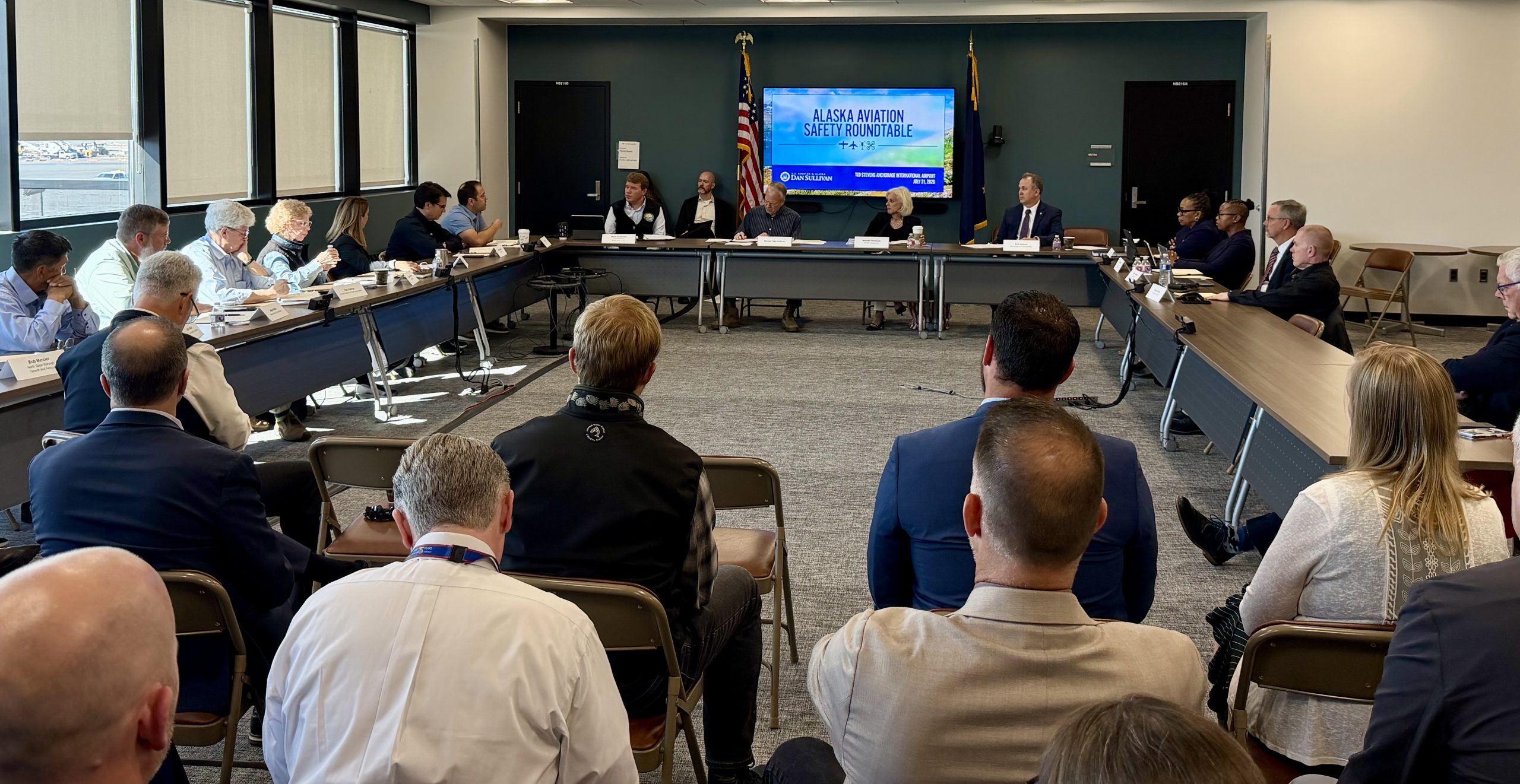
Sullivan convened an Alaska Aviation Safety Roundtable on Friday at Ted Stevens Anchorage International Airport, bringing together approximately 50 representatives from air carriers, aviation associations, government agencies and public safety organizations.
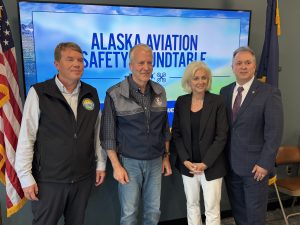
Joining Sullivan at the table were Alaska Department of Transportation and Public Facilities Commissioner Ryan Anderson, Federal Aviation Administration Regional Director Erik Amend and National Transportation Safety Board Chair Jennifer Homendy.
The discussion centered on the realities of flying in a state where aviation is not merely a convenience. For many rural Alaska communities without road or ferry access, airplanes provide the principal connection to medical care, groceries, mail, government services and the rest of the state.
Those flights frequently operate across immense distances, mountainous terrain and rapidly changing weather, often with limited communications and weather-reporting infrastructure. When a weather sensor, runway light or navigation system fails in rural Alaska, the outage can affect an entire region—and repairs can take months or, in some cases, longer.
The safety record reflects those challenges. A landmark 2020 NTSB report found that Alaska’s overall aviation accident rate from 2008 through 2017 was 2.35 times higher than the rate in the rest of the country. Alaska’s fatal accident rate was 1.34 times higher. The report concluded that federal aviation programs were often fragmented and recommended a more comprehensive approach tailored to Alaska’s operating environment. Read the NTSB report.
Sullivan, a member of the Senate Commerce, Science and Transportation Committee, has worked to translate those recommendations into federal law and funding.
The FAA Reauthorization Act of 2024 established a federal goal of reducing fatal aviation accidents in Alaska by 90% by 2033. It also placed the FAA Alaska Aviation Safety Initiative into permanent law with a $25 million annual mandate.
Sullivan also secured $120 million for weather infrastructure through recently enacted federal tax legislation. Over the next three years, the FAA plans to commit nearly $425 million to upgrading Alaska’s aviation system, including runway lighting, air traffic systems, navigation and communications equipment, automated weather stations and weather cameras.
The modernization plan calls for deploying 174 new weather stations and cameras around the state, an especially important investment in a place where pilots may have few reliable sources of real-time information between their departure point and destination.
But much of the roundtable focused on the gap between allocating federal money and putting working equipment on the ground.
Participants described weather sensors and other aviation systems in rural communities remaining out of service for months while pilots and carriers wait for federal repairs. Among the proposals discussed were establishing a spare-parts depot in Alaska, allowing DOT&PF personnel to perform some maintenance under contract with the FAA and creating a hotline through which pilots and carriers could promptly report equipment outages.
Sullivan emphasized that reliable local maintenance capability is just as important as purchasing new equipment.
“We need reliable, local capability in rural Alaska,” Sullivan said. “Maintaining safe and responsive flight services for our pilots and communities is non-negotiable.”
The temporary closure of seven rural Flight Service Stations also drew concern. Operations were shifted to hub stations while an investigation was underway, resulting in reports of longer wait times for pilots seeking weather briefings and other flight information.
Homendy, meanwhile, pointed to NTSB recommendations that remain unfulfilled, including improvements in upset-recovery training, crash-resistant cockpit recording systems and flight-data monitoring. The agency has repeatedly warned that identifying safety problems is not enough if government and industry fail to implement the recommended solutions.
For Alaska’s rural communities, the stakes are immediate. A broken weather station or an unanswered call to a Flight Service Station can determine whether a pilot launches, turns back or attempts to land with incomplete information.
Photo: U.S. Sen. Dan Sullivan leads an Alaska Aviation Safety Roundtable at Ted Stevens Anchorage International Airport with state and federal transportation officials and representatives of Alaska’s aviation industry.
One thought on “Sen. Dan Sullivan presses FAA for faster action on Alaska aviation safety”
FAA funding is important, but there are many more timely matters our only republican senator should be addressing today. The “SAVE ACT” is a #1 must do now battle. I have not seen Sullivan’s name on the list of patriot senators. El murky is a lost in space hater and she embraces election fraud.
Where can I find your efforts senator Sullivan to ensure this American majority backed Act will be enacted before the upcoming election?