

By THE ALASKA STORY
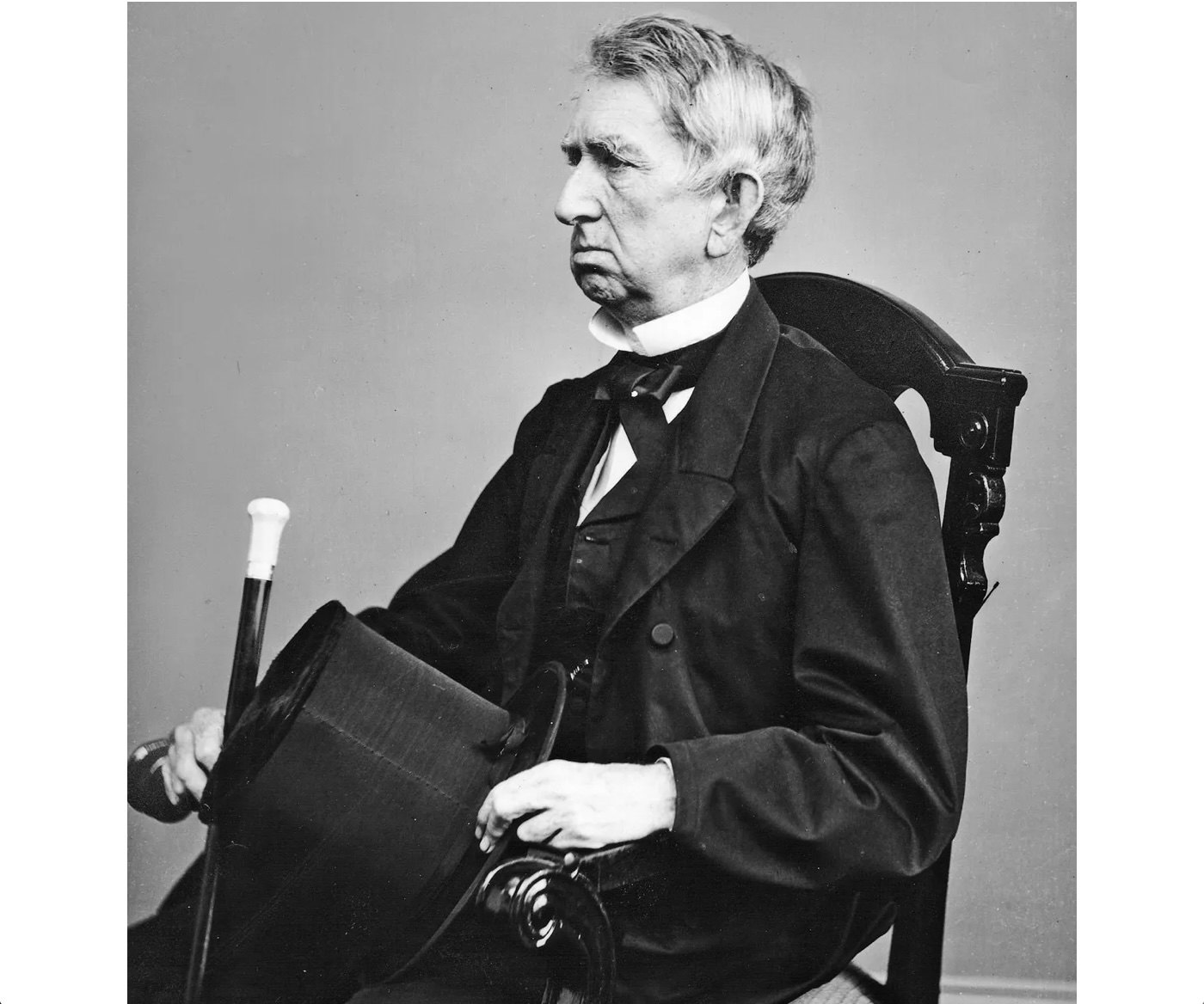
July 31, 2026 – On this day in 1869, former Secretary of State William H. Seward arrived in Sitka to inspect the vast northern territory he had helped bring under the American flag.
Seward served as secretary of state under Presidents Abraham Lincoln and Andrew Johnson and was the principal American negotiator of the Alaska Purchase. The United States and Russia signed the treaty on March 30, 1867, transferring Alaska to the United States for $7.2 million — roughly two cents an acre.
The formal transfer had taken place in Sitka on Oct. 18, 1867.
Critics derided the acquisition as “Seward’s Folly” and “Seward’s Icebox,” dismissing Alaska as an expensive and remote wilderness. Seward remained convinced that the territory would prove strategically and economically important. He proved brilliantly correct.
After leaving office in March 1869, he set out to see the acquisition for himself. Traveling west across the newly completed transcontinental railroad, Seward reached San Francisco and then headed north aboard the steamer Active. He was accompanied by his son, Frederick.
Following stops in Victoria, British Columbia, and the Puget Sound region, Seward’s party arrived in Sitka on July 31, 1869.
American military authorities, including Gen. Jefferson C. Davis, hosted the former secretary of state during his visit. On Aug. 12, Seward delivered a public address in Sitka in which he predicted a prosperous future for Alaska and envisioned its eventual development into one or more states.
His Alaska travels were confined primarily to Southeast. Seward journeyed north through Lynn Canal to the Chilkat Tlingit village of Klukwan, near present-day Haines, where he met the influential Chilkat leader whose name appears in historical accounts in several forms, including Kohklux and Koh’klux.
The visit coincided with the presence of a US Coast Survey party that had traveled north to observe a total solar eclipse. Seward was welcomed by Chilkat leaders and became involved in discussions that helped resolve a dispute with Sitka Tlingit through the payment of blankets. He also hosted Chilkat leaders aboard the Active and was reportedly addressed as the “Great Tyee.”
Historical accounts indicate that Seward later sent Kohklux a large yellow chinchilla blanket bearing a personal inscription or special American emblems. The chief reportedly treasured it as a ceremonial robe and later had Seward’s name tattooed on his arm.
Some later retellings reverse the exchange and claim the blanket was presented to Seward. The stronger historical account indicates that Seward sent the blanket to Kohklux after their meeting.
Although William Seward never visited Seward, which did not exist at the time, on this day in 1869 he arrived in the territory that would later preserve his name with a town, several streets, a highway, glaciers, mountains, creeks, and an entire peninsula named after him. On this day he began a personal inspection of the purchase he had made sight unseen, but that he believed future generations of Americans would come to value.


2 thoughts on “On this day in 1869: William Seward arrives in Alaska to see the territory he helped acquire”
Knowing the present poor condition of the Indigenous people living in the Far East of Russia, Alaska Natives should be very thankful and grateful to God that the wealth transfer of Alaska to America took place. Us descendants of Alaska native blood today would be in a far worse condition if we were Russians. Though Alaska Natives didn’t understand the purchases then, God was protecting us Native descendants from worser condition of an endless cycle of poverty that never ends because of being Native in Russia.
I never knew he traveled to Alaska.