


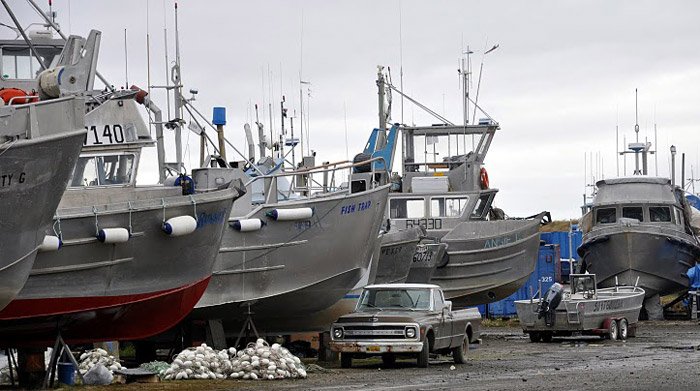
The world’s largest wild salmon fishery is expected to see a sharp downturn next year, according to a new preseason forecast released Nov. 14 by the University of Washington’s Alaska Salmon Program.
Biologists project a total run of 41.5 million sockeye to Bristol Bay in 2026 — a figure 32% below the recent 10-year average and 18% below the 20-year average.
If the estimate holds, it would be among the weaker returns of the past decade, following a stretch of record-breaking years.
The forecast includes projections across the dominant age classes for all nine major river systems — Kvichak, Egegik, Ugashik, Naknek, Alagnak, Wood, Nushagak, Igushik, and Togiak — and anticipates a run composed of 46% 2-ocean fish and 54% 3-ocean fish. From the overall return, researchers estimate an inshore harvest of 29.1 million sockeye, translating to about 168 million pounds. That projection accounts for anticipated escapement goals across the region and an estimated 440,000 fish harvested in the South Peninsula June fishery. Average weights used in the calculation were 4.9 pounds for 2-ocean salmon and 6.6 pounds for 3-ocean salmon, consistent with long-term patterns in Bristol Bay where fish tend to be larger when total run sizes are smaller.
The preseason estimate relies on decades of Alaska Department of Fish and Game data, along with run reconstructions back to 1963. For 2026, the UW-FRI team used a combination of sibling-based models, dynamic linear models, ensemble approaches, and machine-learning techniques to predict stock-specific returns. Dynamic linear models, which adjust to shifting environmental conditions and have shown strong retrospective accuracy, were used for 42% of the stock-age forecasts, while machine learning produced 32% of the projections, particularly where cross-river and environmental indicators help refine predictions.
This final November forecast revises downward the university’s early “preliminary” forecast released in August, which predicted 45.8 million sockeye, about 10% higher than the updated estimate. Most of the reduction comes from refinements in the expected strength of the 2-ocean component of next year’s run.
Across the district, the Naknek-Kvichak system is forecast to see a total return of 10.85 million fish, with a projected harvest of 5.84 million. Egegik is expected to produce 9.03 million fish and a harvest of 7.54 million. Ugashik is forecast at 4.66 million fish, with 3.43 million available for harvest. The Nushagak district, including the Wood and Igushik rivers, is projected to deliver 16.38 million fish and an inshore harvest of 11.86 million, while Togiak is forecast at 590,000 fish with a harvest of 390,000.
The outlook marks a big drop after an extraordinary period for Bristol Bay. The region saw an all-time-record return of 83.3 million sockeye in 2022, followed by 71.2 million in 2021.
Last season’s 2025 run totaled 57.1 million. Against that backdrop, the 41.5 million-fish forecast signals a shift away from the remarkable highs of recent years, though it remains within the historical range for the fishery.
Forecasts typically carry a margin of error of around 15%, and Bristol Bay has a long track record of delivering surprises. The report appears to align with the Alaska Department of Fish and Game’s projections, which can be found here.



One thought on “UW forecast predicts steep drop in 2026 Bristol Bay sockeye run”
State of Alaska and the Federal government needs to put a ban on Trawlers fishing year around while reducing by catch count allowance
They wasting too much other supply when Alaskan Natives are going hungry without an inadequate daily diet of fish
The problem is Federal Government and State of Alaska have no courage to face off the Trawlers