


“History doesn’t repeat itself but it often rhymes.” – Mark Twain
By SUZANNE DOWNING
On Jan. 8, 1900, President William McKinley made a consequential decision about how the federal government would exert authority in a place Washington viewed as increasingly lawless.
With Alaska engulfed by the chaos of the Gold Rush, McKinley ordered the creation of a formal military department for the territory under the War Department, reshaping federal oversight without actually suspending civilian rule. It’s 125 years to the day since Alaska briefly came under military authority.
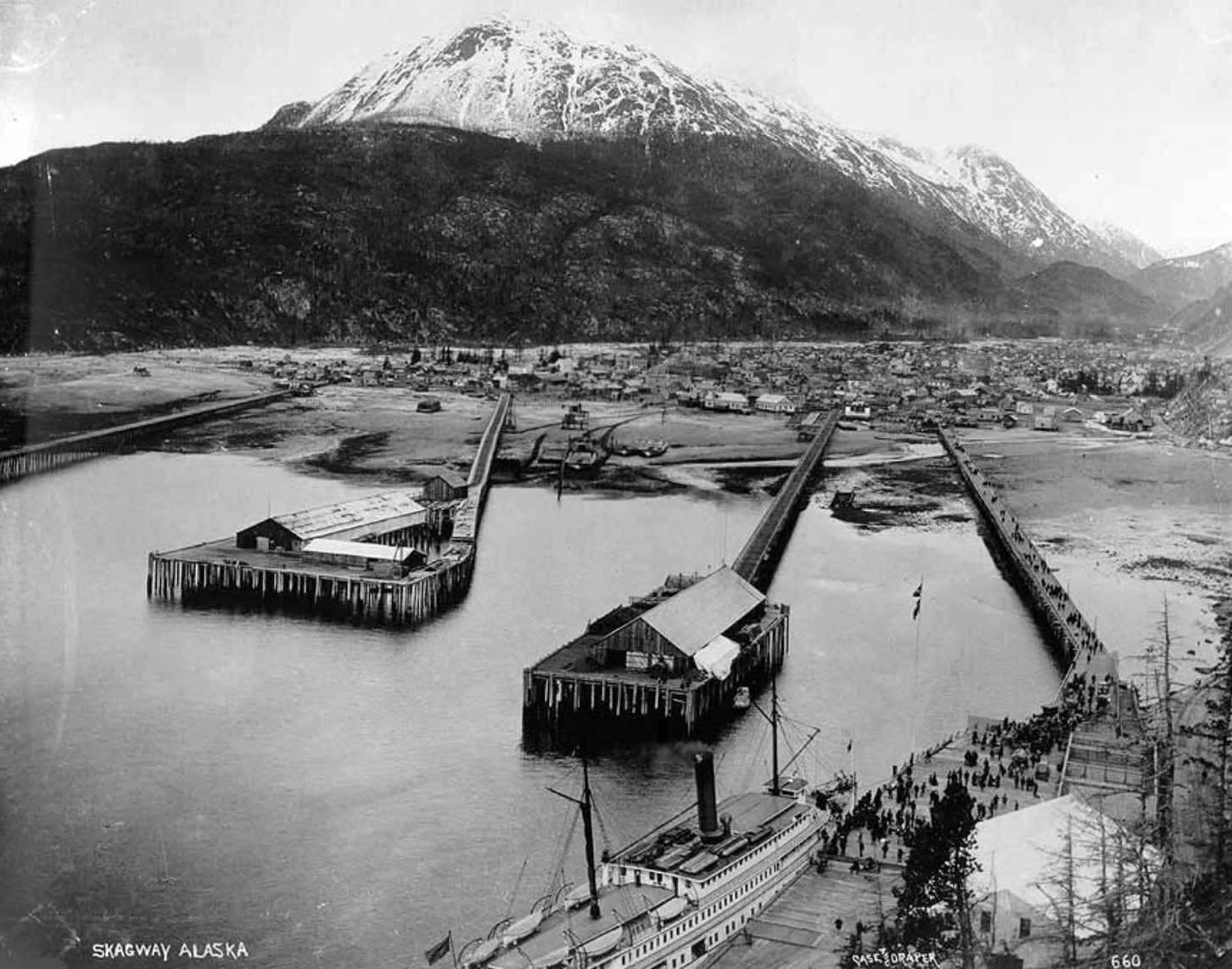
At the turn of the 20th century, Alaska was a vast and sparsely populated frontier overwhelmed by sudden population surges, weak or nonexistent civil institutions, and widespread criminal activity. Tens of thousands of prospectors flooded boomtowns like Skagway and Nome, bringing wealth and opportunity, but also fraud, violence, claim jumping, and organized crime.
Courts were scarce, law enforcement was inconsistent, and in many remote regions, federal troops were the only functioning arm of government capable of enforcing US law.
McKinley’s order did not impose martial law, but rather clarified command and coordination for troops already operating in the territory, placing Alaska firmly within the War Department’s structure and appointing Col. George M. Randall of the Eighth Infantry to lead the effort. The goal was to stabilize disorder, support federal officials, and ensure that US sovereignty and economic interests were protected during a period of intense upheaval.
More than a century later, the same governing question of how far federal power should extend when local systems are overwhelmed has reemerged under President Donald Trump, particularly during his second term beginning in 2025.
Trump and his administration inherited uncontrolled mass migration at the southern border, cartel and gang activity, human trafficking, and cities where even the local governments, such as in Minneapolis, openly resist federal law enforcement.
In January 2025, Trump declared a national emergency at the US–Mexico border, expanding federal authority to deploy resources, personnel, and military support to what he described as zones of breakdown in law and order.
As federal immigration enforcement intensified, protests erupted in several major cities. In response to violent unrest and threats to federal facilities, Trump authorized the deployment of National Guard units, and in some cases active-duty military force, to restore order and protect federal operations. These deployments, including thousands of Guard members in Los Angeles, were criticized by opponents as military occupations. But they were temporary stabilization measures in areas where local authorities were either overwhelmed or unwilling to act. Just like in Alaska in 1900.
The same governing logic has appeared in Trump’s foreign policy. In Venezuela, the administration has justified military pressure, sanctions enforcement, and naval operations by describing the regime as illegitimate, lawless, and intertwined with criminal networks that threaten US security and regional stability. As with Alaska in 1900, the argument centers on disorder spilling beyond borders and the federal government’s responsibility to intervene before chaos undermines broader national interests.
The parallels are not exact. Yet the underlying pattern is familiar. Both presidents relied on executive authority to deploy federal power, including military assets, into areas they believed civilian governance could not adequately control. Neither suspended civil government. Neither formally imposed martial law. Both acted on the premise that federal responsibility does not end where disorder begins.
In Alaska, McKinley’s decision helped bridge the gap between frontier chaos and durable civil institutions. Within months, Congress enacted a civil code, and by 1912 Alaska became an organized US territory with a Legislature of its own. The military presence gradually receded as civilian governance strengthened.
In that sense, Alaska’s experience in 1900 offers not just a historical footnote, but a reminder that debates over federal authority, military involvement, and civil order are not new. They are as old as America’s expansion.
6 thoughts on “That time President McKinley put Alaska under War Department to restore order, and how it compares to Trump actions in 2026”
Excellent history lesson on Alaska and the feds circa 1900.
Then the weak attempt to compare apples to the orange of Venezuela. The latter is a straight up empire move of “We want your stuff” and here is our fig leaf of explanation. The pararells are not even close to exact. Politically it’s a horror show move to a coalition built on no more war or foreign adventures. We needed America first and are getting neo con double Christmas. It is disgusting and serious and accuate pollsters like Rasmussen and Big Data prove out that from Iran in June to now our coalition is fracturing. And for what? Broken sh*thole country doorprizes? MIGA? America First means America First.
Oh no no no no. Venezuela raid is exactly what I voted for. Stop the drugs from flowing into my country “by the boatload” and take back the oil that they stole. THAT is America First, but of course you don’t want to hear that. Ah and guess what, Murkowski doesn’t either! Hmmm, imagine that!
Stop the drugs from flowing into my country
> Why not Mexico and Canada then as they have a much greater impact and both refuse to let our operators work in their country. Pretzel logic.
> take back the oil that they stole.
So you love the empire move? Another word for it would be stealing. Watch out for the unintended consequences.
Or is all of this screed the fox news talking points you are repeating. Even though you may be on the right, you and I are not the same.
Do you want Trumo to invade Mexico and Canada? You know that we share borders with them and have strong economic ties with them right? Actions have been taken here and in Mexico and Canada to stop and/or reduce the flow of illegal aliens and drugs from our neighboring countries, perhaps you’ve somehow missed the news?
As far as the talk about an empire, please explain that leftwing talking point because, limited decisive military action that advances clear U.S. interests without an occupation force is in no way shape or form a way to build an empire.
By your words over some time I have come to realize you are a neocon or a neocon apologist and MIGA.
Though we are both on the right, we are not the same.
It’s unfortunate that some do not understand that these limited actions are done in order to advance our national interests and national security. The illegitimate narco-terrorist Maduro had had welcomed China, Russia, Cuba, and Iran into Venezuela and allowed them to have important roles in his military and industrial base. He further trained with Hezbollah and let loose a wave of terrorist trained illegal immigrants into our country. Instead of going off on some ill thoughtout antisemtic rant, when there is no reasonable link between Israel and Maduro. Maybe stop and think about how by securing our borders and a source of terrorist trained illegal immigrants and drug traffickers is in fact America First and done so in a way that is as anti-interventionalist as possible while doing so. Or just keep blaming Israel for something that has absolutely nothing to do with them because that’s just what antisemites do.