


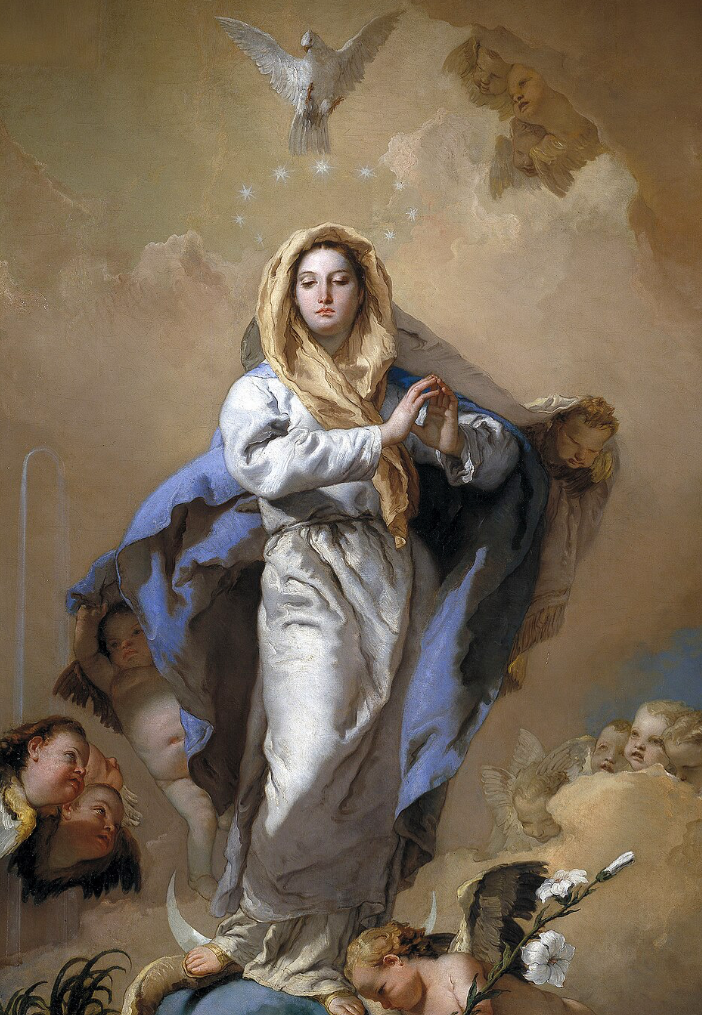
President Donald Trump on Monday released one of the most detailed and overtly theological White House statements ever issued on a Catholic holy day, marking the Feast of the Immaculate Conception with a lengthy reflection on Mary, her role in Christian teaching, and her imprint on American history.
While presidents have long included the feast in diplomatic calendars, no modern president, not even the two Catholics who have held the office, has offered a statement of this depth. Trump himself is not Catholic.
In the message, posted to the official White House page, the president described Dec. 8 as “a Holy Day honoring the faith, humility, and love of Mary,” and explained Catholic teaching that Mary was conceived without original sin as the mother of Jesus. He cited Scripture recounting the angel Gabriel’s appearance in Nazareth and Mary’s acceptance of God’s will: “Behold, I am the handmaid of the Lord. May it be done to me according to your word.”
The statement traced Mary’s influence into early American history. Trump noted that in 1792, Bishop John Carroll, the first Catholic bishop in the United States and cousin of Founding Father Charles Carroll, consecrated the young nation to Mary. He pointed to the post-War of 1812 tradition in New Orleans, where Catholics credited Mary with interceding in General Andrew Jackson’s improbable victory over the British. Each Jan. 8, the Big Easy still celebrates a Mass of Thanksgiving in recognition of that devotion.
Trump cited American Catholic figures such as Elizabeth Ann Seton, Frances Xavier Cabrini, and Archbishop Fulton Sheen, and noted how Mary’s legacy has shaped civic life, from the Basilica of the National Shrine of the Immaculate Conception in Washington, DC, to dozens of American colleges and universities bearing her name.
He also connected the feast to the upcoming Dec. 12 celebrations of Our Lady of Guadalupe, whose 1531 apparition remains central to Catholic devotion in Mexico and the United States.
The president broadened the message to global conflict, recalling that during World War I, Pope Benedict XV commissioned a statue of Mary, Queen of Peace, to encourage prayer for an end to the war. “Just a few months later, World War I ended,” Trump wrote, saying Americans again look to Mary “as we pray for an end to war and for a new and lasting era of peace, prosperity, and harmony in Europe and throughout the world.”
He closed the historic statement by publishing the full text of the Hail Mary, the traditional prayer recited by Catholics for centuries, calling it a source of “aid, comfort, and support” for American believers”
“Hail, Mary, full of grace, the Lord is with thee. Blessed art thou among women and blessed is the fruit of thy womb, Jesus. Holy Mary, Mother of God, pray for us sinners, now and at the hour of our death. Amen”
What makes the message striking is not that a president acknowledged the day, which is routine, but the theological depth and devotional tone that stand in sharp contrast to the only two Catholic presidents.
John F. Kennedy, in 1962 and 1963, added the Feast of the Immaculate Conception to the list of local holidays observed by federal employees stationed in countries where it is a public holiday. His orders simply listed the feast by name, without commentary.
Joe Biden, the second Catholic president, did the same in his annual executive orders updating embassy and consulate holiday schedules. His 2023 order reads like others before it: “Feast of the Immaculate Conception – December 8,” with no elaboration.
Trump’s statement reads more like a catechetical essay and historical narrative, a full, public reflection from the most powerful political figure on the planet on Mary’s role in Christian teaching and American heritage.
By all available records, it is the most extensive presidential statement ever issued on the Feast of the Immaculate Conception, and it comes from a president outside the Catholic faith. Read it in its entirety here.

11 thoughts on “Presidents have acknowledged the Feast of the Immaculate Conception before – but never like this”
It’s my understanding that sexual intercourse can create human life, something generally thought of as a positive outcome. Why then do Christians call it “original sin” and “immaculate conception” (implying anything else is dirty)?
Original sin was Adam and Eve defying God, not having sex. Immaculate conception is Mary becoming with child while still a virgin. Two completely different things.
Thanks for that. I didn’t know. How did Mary become pregnant?
How did the holy spirit impregnate Mary? If you know, please answer with biologically provable facts.
You would noy believe or understand anyway so why bother?
Google it. Faith is described as the assurance of things hoped for and the evidence of things not seen, meaning it involves believing in what cannot be physically observed or proven. This concept emphasizes trust in the unseen and the conviction that what is hoped for will come to pass. Thanks AI.
Very common misunderstanding, but you are half right. Original sin is the effect of Adam and Eve disobeying God in the Garden of Eden. However, the Immaculate Conception is the doctrine that Mary was conceived without Original Sin so she could be a pure vessel to receive Our Lord and Savior Jesus Christ, who was “conceived by the power of the Holy Spirit”
This is the way to Make America Great Again!
Thanks for sharing this, and for your insights, Suzanne!
Will admission to national parks be free on this holy day?
Elizabeth, the Immaculate Conception is NOT Mary conceiving Jesus through the Holy Spirit. Don’t feel bad, many Catholics have never had it properly explained. No, the IC is MARY being conceived without original sin, when her parents Anna & Joachim conceived her. Why? Because God will not allow Himself to be in such proximity to sin. The relationship between unborn child and mother is so intimate in that respect. The mistaken idea that you expressed is an opportunity for Christians to engage in debate. Many, but not all, Protestant denominations do not believe that Baptism is necessary to erase Original Sin, but see it as a mere formality and witness. Very excellent exchanges and debates can be found online. It is an opportunity for a Charlie Kirk-style of exchange between Christians, so we can understand our differences, what still unites us, and allow us to think for ourselves.
Original Sin: the first sin committed on earth (distinct from the angels’ non serviam, “I will not serve”) by Adam and Eve. We inherit Original Sin from Adam and Eve. Baptism washes away Original Sin.
The Immaculate Conception: was any person ever free from Original Sin? Yes, the Blessed Virgin Mary was conceived without Original Sin. Catholics celebrate the Feast of the Immaculate Conception on December 8th each year.
The Incarnation: refers to the moment when Mary conceived Christ in her womb by the power of the Holy Spirit. It is celebrated on March 25th, nine months before the date of Christmas. The Incarnation (literally, “in-carne,” “in the flesh”) marks the moment when the Son of God became man.
The one point the White House got wrong in the Dec 8th proclamation is the fact that God became man at the Incarnation, not the moment He was born. He was conceived by the Holy Spirit and became man at the same moment, and we recall that moment in time on the Feast of the Annunciation, March 25th. Why another funny word? Because the Angel Gabriel announced to Mary that she was to be the Mother of God, and she reversed the angels’ non serviam with her fiat -her “yes.” The God-Man was then born 9 months later in a stable at Bethlehem.
Totally awesome stuff. God is good, Mary is His Mother -and ours too!
Deo gratias!
(Thanks be to God!)