




For most Americans alive today, Pearl Harbor is something they learned about in a classroom, a documentary, or a visit to a memorial. Only those now in their late 80s or older can actually recall hearing it as breaking news on the radio: Japan has attacked Pearl Harbor.
That’s exactly how my own mother learned about it that Sunday in 1941 in Oregon. She was a teenager, feeling sick and not at church with the rest of her family. Lying in bed in an empty house and listening to the AM radio, she could hear the tension of the announcer’s voice as the news crackled over the airwaves — and it has stuck with her for her entire life.
It was the sentence that signaled the end of one world and the beginning of another. But that day, Americans could not know what was ahead.
The last time the United States had been attacked on its own soil before Dec. 7, 1941 was during the War of 1812, an event so distant that few today can tell you much about it at all.
By contrast, Pearl Harbor is still etched into the national memory, although it, too, is slipping away as the decades roll by. While it’s still taught about in schools, it is usually as part of the broader World War II curriculum.
Even in 1941, many Americans didn’t even know where Pearl Harbor was. Hawaii, still a US territory, was a distant place in the middle of the Pacific, more exotic postcard than military target. Families gathered around their radios that Sunday morning with confusion: Where exactly was this harbor? How could the Japanese strike something so distant from our continent, and did it even matter? Did any Americans live there?
It mattered to the more than 2,400 men who lost their lives that day and the families they left behind.
President Franklin Delano Roosevelt spoke to the shock and the gravity of the moment the next day when he addressed a joint session of Congress: “Yesterday, December 7, 1941 — a date which will live in infamy — the United States of America was suddenly and deliberately attacked by naval and air forces of the Empire of Japan.”
The brazen attack sent a tremor through the world, including through the mind of Adolf Hitler. For him, the news out of Pearl Harbor was a gift. He believed the United States would now be consumed in the Pacific, freeing Germany to focus on Russia, which was an increasingly problematic fight. He mistakenly concluded that the Axis powers were destined to prevail. Convinced America was weakened and distracted, he declared war on the United States on Dec. 11, just four days after Pearl Harbor.
From that moment, the global conflict that had been raging for years and that we had avoided became our war. America was all in.
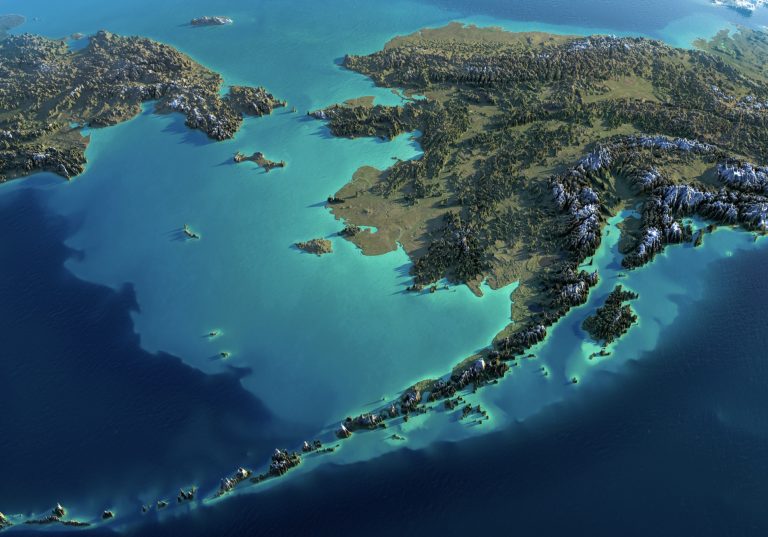
Alaska, also still a territory, also still sparsely populated, and also still unknown to most Americans, found itself thrust into a pivotal role. Within months, Japanese forces invaded Attu and Kiska in the Aleutian Islands, which became the first enemy occupation of US soil since the War of 1812.
Suddenly, the war was not just in Europe or in the Pacific; it was at America’s northwestern door.
Those who fought in the Aleutians faced some of the worst conditions of any theater of the war: freezing fog, blinding winds, rugged terrain, isolation, and an enemy determined to hold territory.
The Alaska Campaign was overshadowed at the time by war raging across Europe, but history has since revealed its strategic importance. It also marked the beginning of Alaska’s transformation into the nation’s northern stronghold.
What followed changed this place forever. Defense infrastructure expanded. Bases were built. The territory gained new attention and new purpose. And after the war, Alaska’s strategic value only grew. Today, our state remains one of the most essential locations for national defense, as a crossroads of the Arctic and Indo-Pacific, a platform for missile defense, power projection, and critical natural resource development.
What began as a vulnerability became an advantage.
Pearl Harbor Remembrance Day is about honoring the lives lost and the generation that rose to defend this country. But it is also about understanding the chain reaction set in motion that morning in 1941 and how a single attack reshaped the destiny of nations, toppled dictators, rewrote borders, and elevated Alaska’s importance in ways no one then could have imagined.
Dec. 7 is a reminder of the moment Americans stood up, pulled together, and changed the trajectory of the free world.
As the sun rises over memorial in Oahu, and as flags are lowered on this day, we still remember what was lost, and we honor what was defended.
The freedoms we enjoy today were secured by those who stepped forward in the nation’s darkest hour.
I’d like to thank my high school history teachers at Juneau-Douglas High School — Mr. Brad Snodgrass and Mr. Ron Metzgar — for trying their best to relay the importance of events like these in America’s history. Thanks to all history teachers today who still try to impart to students how one event can unravel a nation.
In this case, that unraveling happened to Japan and Germany. But it could have easily gone the other way, if not for the patriotism and valor of the Greatest Generation.


3 thoughts on “Pearl Harbor and the ‘Day of Infamy’ that also changed Alaska forever”
When the Democrat and Republican Party had common enemies but still being separated by differing political governance ideologies
Something has happened since Pearl Harbor where the parties can’t agree who is an enemy to America while the enemies of America are on our soil and outside tearing this country apart, dividing it even wider, exploiting/stealing its resources and intellectual ideas and properties for their own personal gain.
When I visited the USS Arizona Memorial I was on the first boat of the day and headed directly to the shrine room with the names of all who died aboard. I spent a minute or two there by myself before anyone else had made their way through the rest of the memorial. That time alone facing those names is still one of the most profound and intense moments in my life.
I read a good book on the Aleutianscampaign ” the thousand mile war” it has a,lot of info on how Anchorage grewout of the war effort. There’s a lot here still from that