



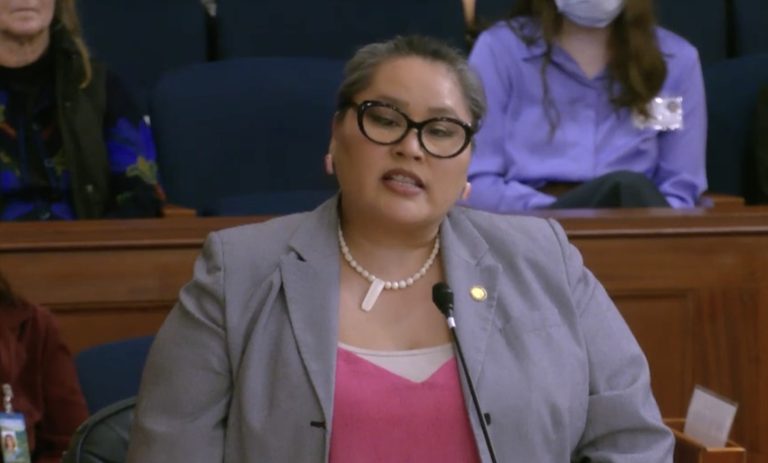
Anchorage Mayor Suzanne LaFrance used her State of the City address on Monday to make a full-throated pitch for a new 3% sales tax, telling the Anchorage Chamber of Commerce that the city must “modernize” its revenue structure.
Her remarks came at the Chamber’s weekly “Make It Monday” forum at the Dena’ina Center, where the audience is largely the city’s well-funded nonprofit sector, one of the chief supporters of larger government footprints and new taxation mechanisms. Small businesses make up a smaller and smaller percentage of the group’s membership.
LaFrance painted a rosy picture of her first year and a half in office, saying her administration has strengthened the municipal workforce, improved snow plowing, and steered Anchorage onto a better path.
She attributed Anchorage’s growing vagrancy crisis not to policy decisions at City Hall but to the lingering effects of the Covid-19 pandemic of 2020–2021.
Her solutions lean heavily on new construction, new taxes, and new incentives for developers. LaFrance reiterated her “10,000 homes in 10 years” initiative, which depends on substantial tax breaks for apartment complexes. These are tax breaks that would shift more of the property-tax load onto homeowners.
She also announced she intends to move forward with her plan for a “micro-unit community” on the land at Tudor and Elmore Roads. That’s the same site former Mayor Dave Bronson had designated for a large-scale homelessness navigation center and emergency shelter, which LaFrance vigorously opposed while serving on the Assembly.
The micro-unit concept consists of tiny standalone structures, roughly the size of a king-sized bed and a closet. Versions of this model have been widely adopted in California under Gov. Gavin Newsom, who set aside hundreds of millions of dollars for a statewide rollout. Early results from California and other states have been mixed at best.
A Los Angeles evaluation showed fewer than 25% of residents transitioned to permanent housing, while more than half returned to homelessness due to untreated addiction or mental-health issues.
Oakland’s program met just 28% of its targeted 50% progression rate. Safety and maintenance problems have also plagued sites elsewhere: flooding, broken heaters, and severe limits on basic amenities such as showers.
One LA location had just two functioning hot showers for roughly 80 residents. Because between 30-40% of California’s homeless population struggles with substance-use issues, violations are frequent; Tulsa’s Eden Village sent five of its 25 residents to rehab in 2025 alone. That’s 20%.
Communities around North America have pushed back on tiny-home encampments, citing safety concerns, crime, and a lack of visible improvement. Neighborhood resistance has pushed many projects into industrial zones, funding gaps have caused major delays, and some municipalities, like Penticton, British Columbia, have rejected proposals outright over concerns they would not reduce vagrancy.
LaFrance told the Chamber she will also bring hundreds of low-income housing units to Eagle River. What she did not mention is that many in Eagle River are already exploring detachment from Anchorage’s municipal structure, a sign of continued dissatisfaction with the city’s direction. Eaglexit is actively trying to bring the matter to a public vote.
The mayor is now halfway through her term, and although she has announced multiple housing concepts, most remain in the planning stage. The Bronson administration’s navigation-center model, which would have provided centralized services, workforce engagement, and warm beds, never got the necessary Assembly approvals to move forward. The building materials purchased for that project are now being repurposed at the Port of Alaska.
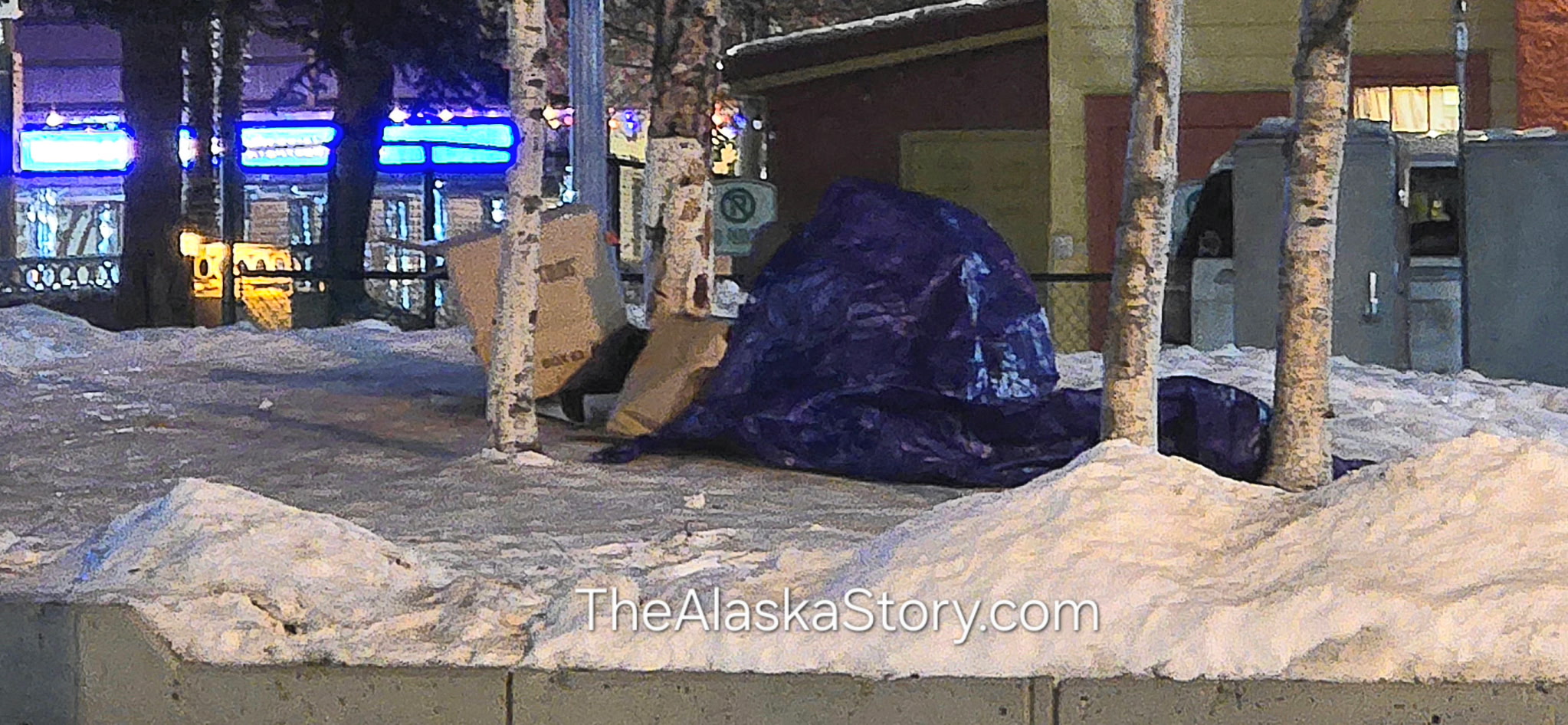
Meanwhile, downtown Anchorage continues to grapple with some of the worst doorway-sleeping conditions in years, with people bedding down at night on frozen concrete just steps from businesses preparing for holiday shoppers.
The mayor’s speech outlined a new path for Anchorage, but the crisis remains visible on downtown streets, where residents and shopkeepers see the consequences every morning, people cold, vulnerable, and without shelter, while the city debates yet another multi-year housing plan.

8 thoughts on “Mayor LaFrance uses State of the City to sell her sales tax … as downtown street people take over”
Ummm…”micro unit communities” are popping up all over the place, without tax dollar price tags. Maybe LaFrance didn’t get the memo, or maybe she doesn’t drive around town:
How many times have you had to hit the breaks for a person running across Dowling and Old Seward carrying pallets towards the woods on the N side of Dowling?
How about the wooded area on the NW corner of Dowling and Lake Otis?
Or the woods behind Reading Write Alaska and next to the Fred Meyer on Abbott?
Has she not seen the portable micro units that come and go along NS between Northern Lights and 15th? How about along the Coastal Trail? The hill on the backside of Pioneer Park?
And…who is going to purchase 10,000 homes in 10 years while LaFrance’s admin and Assembly are busy driving the middle class out of Anchorage?
I honestly wonder if it’s going to take the current micro-unit community builders making their way up to the Hillside neighborhoods before Anchorage will wake up and take back our city. The vagrant creep is real, folks.
The vagrant creepsare seated on the Assembly
Could the process be self cancelling? If micro-unit community builders and residents infest Hillside neighborhoods, but don’t pay property taxes because one’s non-profit and the other’s never-profit, what makes up for unpaid property taxes?
.
How much sales tax has to be forced on people through Anchorage’s crooked election system to make up for missing property taxes?
.
What if this starts an 80’s style exodus and not enough productive residents remain to make up for lost property taxes?
.
City credit rating’s already shaky, Eaglexit’s about to happen, public-school finances are gloomy because students are bailing out, house-for-sale signs sprout like winter weeds, now they’re going to bust the bank by spawning colonies of micro-unit community builders and residents who’ll occupy high-value property, but won’t pay property taxes?
.
LaFarce’s sales tax’ll make up for property taxes lost during the “10,000 homes in 10 years” initiative which depends on substantial tax breaks for apartments (read “inner-city projects” style)?
.
NotAnymore, maybe we’re not seeing the big picture? Remember the Great Alaska LeDoux Vote Experiment? Do the math …10,000 homes times a few dozen voters registered per “address”? Is this not guaranteed job security for a political dynasty who oughtta be in jail instead of in office? These guys are in like Flint and they know we the people can’t do a damned thing about it, since current events indicate rather strongly that our election and grand-jury systems are both FUBAR’d.
.
No? Recall the pathetic plea from Division of Elections, they need John Q’s help to get their voter rolls right, because apparently left-leaning ERIC (look ’em up), to whom they farmed out voter-roll maintenance, is too incompetent, crooked, or both, to get Alaska’s voter rolls right?
.
Yeah, 10,000 homes times a couple dozen indigents per home equals how much in SNAP benefits sent to somebody, somewhere? Somali fraud’s got nothing on us, right?
.
10,000 homes times a couple dozen unemployment applications per home …might be talking serious money here.
.
Ten thousand homes in LaFarce’s “Welcoming City” times God knows how many illegal aliens per marvelous tiny home the likes of which they’d never live to see in the Old Country …they’re home free, unless you got ICE on speed dial, but you know what we’re saying, no?
.
10,000 homes times how many hard-core dopers per home …guessing DEA needs to be on somebody’s speed dial, no?
.
No? Who’s checking? When our Democrat governor/legislature/judiciary teams win the trifecta, who’s checking then?
.
Bottom line, NotAnymore, this could be a good thing, an epic fail from the ashes of which God-fearing Americans could rebuild a decent community.
The mayor said how much better snowplowing is??? “howmuchwillit snow.com shows we have had 14 inches of snow down 50% from normal. This is credit? When Mayor Bronson got crucified, there was record snow at the beginning of the snow season.
I grew up in the Bay Area and Seattle. When I was in high school in Seattle, sales tax was 4%, now over 10%. Do not ever give lawmakers another avenue of taxation. Don’t fall for the property tax relief. Short term and then taxes go right back up.
I have been following Seattle/Washington State since I left. There is not one year that new taxes both at the city and state level have been enacted. If property taxes are too high here, then the Mayor and Assembly will have a hard time raising them. They are finding other ways to tax certain items. Don’t listen to the sirens.
If the Municipality expenses are greater than the tax receipts, there are two choices:
1. Increase Taxes
Or
2. Decrease Expenses
I propose a Win Win situation.
The Muni should cut Chugiak/Eagle River loose. No longer would the expensive Northern Neighbors be draining the Muni Treasury; Chugiak/ Eagle River would obtain the local right of self determination.
Easy Peasy.
Everyone would be happy.
Joe, how exactly are the “northern neighbors” draining the treasury?
Please be specific!
If CH/ER is such a drain then why is the assembly fighting tooth and nail to keep us? Could it be that we too pay a considerable amount of property taxes into that general fund???
Well. Mayor Lafrance and her crew think they are doing a good job.
Anyone thinking differently, they know what they can do Go and Join their community council. Study hard anchorage municipal and work their way up.
We have a Fair God.
He gives rain to the righteous and unrighteous.
Those who work hard and sows will reap a harvest. While 2000’s Anchorage Republicans were doing whatever, Anchorage Democrats (before these current Democrats) were tilling the ground, planting the seeds, and preparing the harvest they are reaping total domination of Anchorage.
What does that mean we ride out what has been planted and grown, get to work in our fields of work, and pray in knowledge that God us fair and faithful, he’ll reward us for our work like the Democrats today are enjoying their total domination. Because in 2000 they didn’t have total domination.
A foolish Mayor and Assembly will continue doing foolish things! Anchorage and Alaska generally will continue to decline while leftists run the show.
On a grade scale of A to F, A being the highest score and F being failure, (had to be explained for possible leftist readers) I give our Mayor an F minus, our assembly an F, our Governor a C minus, our senior Senator Lisa an F minus, Senator Dan a C and our Congressman Nick a B….
We deserve better from nearly all of our officials!