


By REP. KEVIN MCCABE
The Jones Act was built for a world where America led global shipbuilding. That world is gone. Reforming it with aviation-style cabotage and Canadian flexibility would grow jobs, lower costs, and rebuild the fleet.
The Jones Act was designed to protect America’s maritime strength, but it has instead become an anchor dragging it down. Aviation and maritime commerce both operate under cabotage rules that forbid foreign carriers from transporting passengers or cargo between two U.S. points. Yet one industry thrives while the other barely floats. The difference is not in ownership, registry, or crewing; all of those requirements are nearly identical. The difference lies in one short clause of the Merchant Marine Act of 1920: the vessel must be built in the United States, a rule that has no counterpart in the robust U.S. airline industry.
American airlines operate hundreds of Airbus aircraft built in Europe and Asia, competing head-to-head with Boeing models from Washington State. The result is healthy competition, affordable fares, and the most profitable air fleet on Earth. Capital goes to the best product, not the most protected one. Maritime commerce, forced to buy ships only from domestic yards, pays three or four times the global price for the same tonnage.
The outcome is predictable: fewer than a hundred large Jones Act vessels remain, down from more than a thousand in the 1950s. The U.S.-built mandate is not a matter of national security; it is a hidden tax on every coastal community and a slow death for American shipbuilding.
Compare the United States to Canada. Both nations restrict domestic trade to their own carriers. Both require domestic ownership, crews, and flags. But Canada’s Coasting Trade Act does not require Canadian-built ships. Instead, it allows foreign-built vessels to operate under a simple licensing process when no Canadian vessel is available. The United States could do the same, or it could remove the U.S.-built requirement entirely, aligning our rules with aviation. Add Canada’s licensing flexibility and the system would immediately balance security, sovereignty, and economic reality. Keep the requirement and the maritime sector remains trapped in inefficiency.
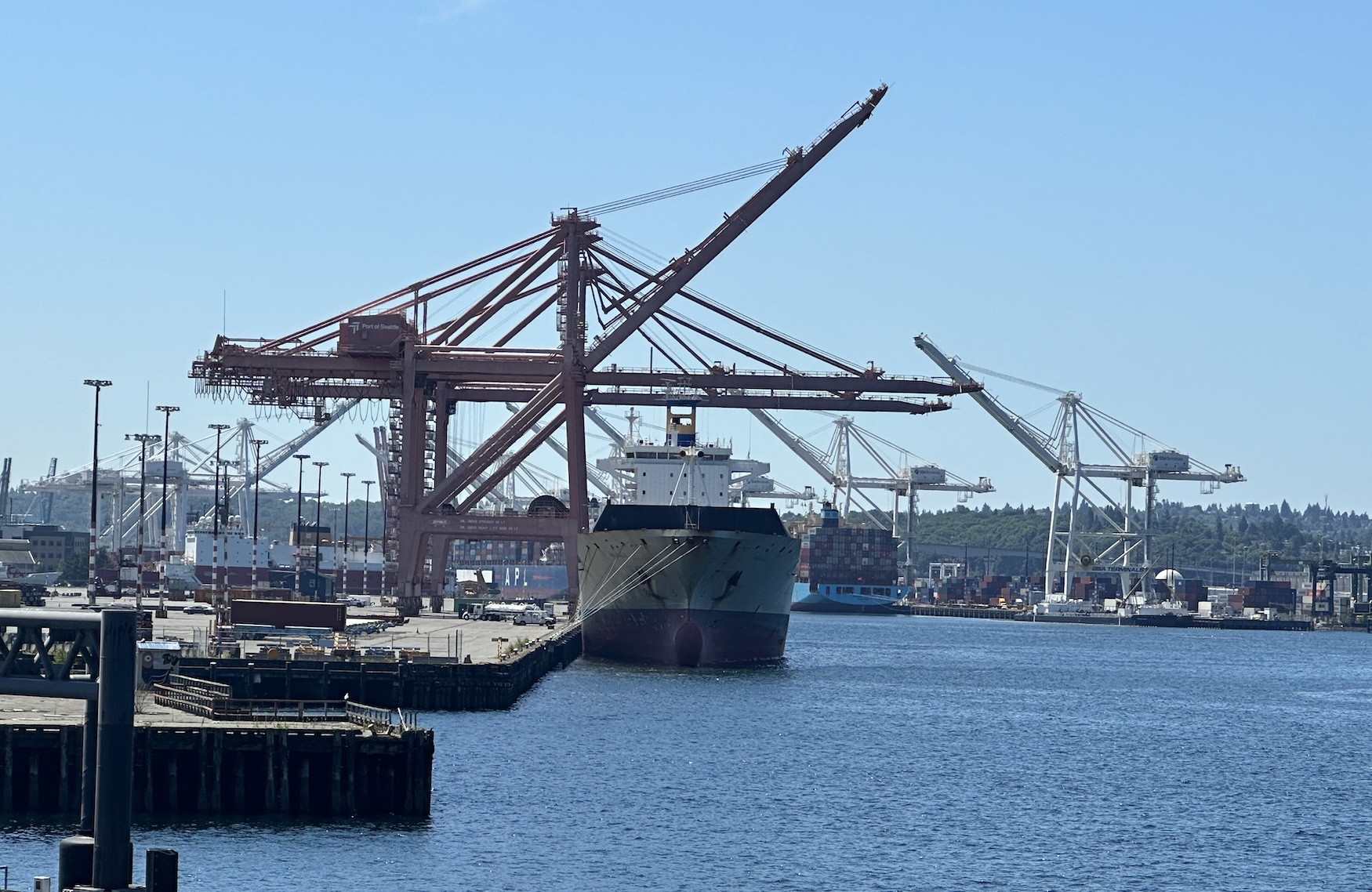
The cost of insisting on “Made in America” at sea is staggering. A modern containership costs around $55 million in South Korea or $60 million in China. The same ship costs more than $250 million when built in an American yard under Jones Act rules. That $190 million difference per hull is not a national security premium.
It is a direct transfer from consumers in Alaska, Hawaii, and Puerto Rico to a handful of shipyards that have long since abandoned global competition and innovation. At world prices, an American operator could build five ships for the cost of one. That would mean more routes, lower freight rates, and better service to smaller ports that today are ignored. Instead, the fleet ages, maintenance costs climb, and scarcity defines the system.
For a century, the Jones Act has been sold as a pillar of national security and American industry. In reality, it has become a century-old anchor that drives up costs, stifles competition, and punishes coastal states like Alaska and Hawaii. The solution isn’t to scrap the law but to modernize it—to keep the flag, the crew, and the security, while letting the market decide where the hull is built.
Opponents of reform warn that repealing the build requirement would destroy American shipbuilding jobs. That argument is hollow. Commercial shipyards already depend on Navy contracts, not Jones Act work. From 2010 to 2023, the major Jones Act yards built fewer than twenty large commercial ships. Last year they built a single one. The same yards stay afloat by building destroyers and support ships for the Department of Defense.
The commercial side is an afterthought. Good union mariner jobs depend on the number of ships in service, not the nationality of the steel. A fleet of 500 modern vessels crewed by 75 percent American mariners would triple the number of good-paying maritime jobs compared to today. The real choice is between a growing maritime workforce and a shrinking relic of the past.
National security is often used as the final defense of the Jones Act, but even that argument collapses under scrutiny. The Department of Defense does not rely on Jones Act ships for wartime sealift. It relies on the Maritime Security Program, which fields sixty U.S.-flagged, U.S.-crewed, and U.S.-owned vessels built mostly in Korea or Japan. Each receives a small annual stipend and remains available for military use at any time.
Those ships are newer, faster, and more capable than the entire Jones Act fleet combined. If foreign-built ships under American control are trusted to supply our troops overseas, they are surely good enough to deliver groceries to Alaska or fuel to Hawaii.
Congress could fix the problem with a single, simple amendment. The vessel would still need to be majority U.S.-owned, U.S.-flagged, and crewed by at least 75 percent American citizens, but its place of construction would no longer matter. Add a licensing system like Canada’s, where the Federal Maritime Commission could issue temporary licenses if no U.S.-flagged ship is available—such as for LNG tankers—and the system becomes both competitive and secure.
Foreign-built vessels would still pass Coast Guard inspections, meet U.S. labor standards, and pay prevailing wages. Existing ships could retain their status for fifteen years to allow a smooth transition. Military contracts and Maritime Security Program ships would remain reserved for domestic yards, preserving defense capacity without distorting the commercial market.
The results would be immediate. Within a decade, the domestic fleet could grow from a hundred to more than five hundred large vessels. Freight costs could drop by nearly half on routes to Alaska, Hawaii, and Puerto Rico. Tens of thousands of new mariner jobs would emerge, and shipyards could focus on repair, conversion, and offshore infrastructure work while the Navy provides steady, predictable defense contracts. America’s sealift strength would double, backed by a fleet of licensed commercial ships ready for surge operations.
The Jones Act was written in a time when America built one-third of the world’s ships. That time is long gone. Today we lead in design, finance, logistics, and technology, but not in commercial shipbuilding. Forcing consumers to pay triple for domestic steel is not patriotism. It is economic protectionism that hurts the very American workers it claims to defend and punishes every family who depends on affordable goods shipped to their communities. Aviation shows how to protect routes, flags, and crews without crippling the system. Canada shows how to keep cabotage flexible and efficient.
If we remove the U.S.-built requirement and add a licensing backstop for scarce routes, the Jones Act can finally fulfill its purpose. It can once again support a proud, competitive, and truly American merchant marine, one that serves every state and territory with the efficiency, affordability, and reliability our economy deserves.
Rep. Kevin McCabe lives in Big Lake.


2 thoughts on “Kevin McCabe: Jones Act, the maritime dinosaur, at 105”
Now, if Senator Sullivan would read this, maybe he’ll understand why I’ve been railing at him for several years. Damn politicians seem far more interested in lining their pockets and the pockets of those they associate with. It would certainly help get Alaska out from under the jack boots of the Washingtonian senators and congressional hacks. But I am simply tilting at this windmill for another day….
Agreed: the Jones Act inflates our shipping costs. China ships to and between the rest of the world. There is no competing with their commercial hegemony for the foreseeable future. If they are allowed into our markets it will be very challenging to hold them back, and then we are at their mercy. Forces of greed could subvert any attempt to “right size” changes in the Jones Act. Tell us how the shipping industry and organized labor are unified behind only changing the built-in-America provision, and not more.