



By SUZANNE DOWNING
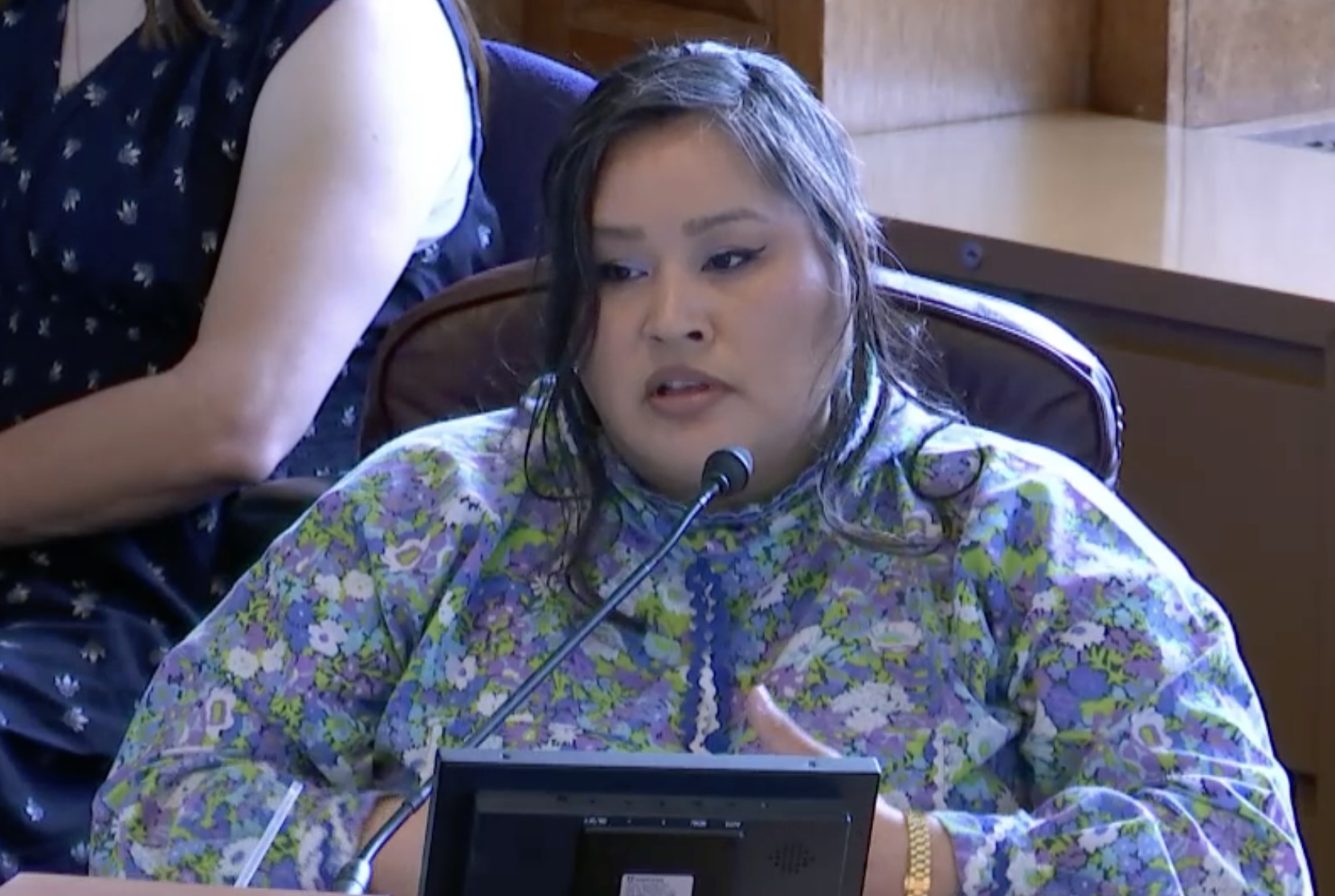
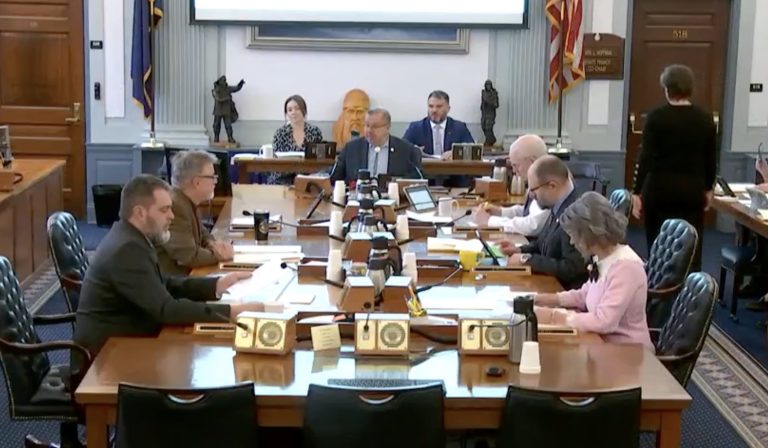
Feb. 5, 2026 – A House Finance Committee meeting on House Bill 284, a sweeping proposal tied to sales taxes and oil and gas revenue, took an unexpected detour Thursday when a lawmaker opened her remarks with a land acknowledgement in the middle of detailed fiscal questioning.
Committee members were hearing from representatives of the governor’s office about various moving parts of the administration’s plan, which touches everything from statewide taxation to long-term budget stability.
But when Rep. Nellie Jimmie, D-Bethel, began her turn to speak, she paused the technical discussion to thank the Tlingit people “for allowing us to do state business on their land.”
The comment was part of a growing trend in progressive political spaces, where land acknowledgements have become a routine preface to public meetings, hearings, and government proceedings. She also misstated that people in rural areas pay taxes and urban residents don’t.
Nellie Jimmie land acknowledgement
Land acknowledgements are intended to recognize the Indigenous peoples connected to the region, but some argue that the practice has become less about history and more about ideology , a kind of political mantra repeated regardless of context.
In this case, the acknowledgement struck some Alaskans as oddly placed: inserted into a meeting focused on sales tax structure, oil production revenue, and the state’s fiscal future.
Juneau, the seat of Alaska government, sits within the general traditional region of the Tlingit people, who have long used the Gastineau Channel region for fishing, seasonal camps, travel, and resource gathering.
But the modern downtown Juneau has been shaped by mining development and tailings and is not a place known historically for permanent Indigenous settlement in the way other nearby areas were, such as Auke Bay.
To some Alaskans, the increasing use of land acknowledgements reflects a broader political shift on the Left: an emphasis on reframing government and civic life through the lens of colonialism, land ownership, and historical grievance over stolen land, when the early inhabitants, in fact, had no legal construct for land ownership.
Rather than serving as meaningful recognition, the acknowledgements often imply a moral claim that today’s Americans, and even Alaska’s elected government, are merely operating at the permission of others.
That framing, they argue, goes well beyond historical respect and enters the realm of modern political messaging.
For many watching, the brief land acknowledgement highlighted how cultural and ideological statements are increasingly woven into even the most technical corners of government, ometimes awkwardly so.
For some legislators, even a tax hearing is now a stage for racial identity as much as fiscal policy.

15 thoughts on “From taxes to ‘occupied land’ politics, a Juneau hearing takes detour”
If they are paying taxes, it’s a local tax. The ignorance level with every new batch of legislators that don’t know what they don’t know is frightening. Seldovia has a 9.5% local tax. Seasonal and crazy high. I buy all I can elsewhere. Stupid local governments think they can tax themselves into prosperity. For government workers, it lines their pockets. Seldovia can’t figure out why businesses keep failing, and new ones do not invest.
How much soda and sweets did she eat in the village?
She exampled why village kids have the worse eating habits of Alaska kids across the state.
Even ANTHC and SCF are campaigning to their Indian beneficiaries about changing their diets and lowering their sugar intake for healthier Alaskans. There are two year-5 year Alaska Natives coming out of the village with already a full set of silver teeth front and back because of soda and juice before their baby teeth came through, during when they came through, and after fillings and extractions. Now they have silver teeth.
Couldn’t she had chosen a better example of something she ate while she is a sitting legislator representing a group that struggles with sugar? Like going to the store to buy an apple and bottle of water having to pay a tax on it. It been a better more forward thinking example.
Sounds like a planned diversion from the business they didn’t want to make public. Like the ” technical problems ” that keep happening in Anchorage
Over and over we hear the “land acknowledgment, stolen land narrative.
If I am in possession of stolen property, prove it.
If it is know that I am in possession of stolen property and I am then expected to pay a tax on that stolen property, then whoever is demanding that tax is complicit in the crime.
Cultural Identity, not racial identity. That’s your problem, you don’t even understand what this is about.
What tax is she talking about? There is no sale tax in the state and news flash adding transportation cost onto the price of a product is NOT A TAX!!!
As for this irritating land idiocy, one should ask Rep. Jimmie what power she thinks the tribe has to “allow” anything, considering they have no jurisdictional say. Isn’t she the same person, who sold her caucus affiliation to the highest bidder?
Mark Twain famously stated: “It is better to keep your mouth closed and let people think you are a fool than to open it and remove all doubt”
Downing and Landfield deserve real credit for covering the rhetoric coming from some state officials as of late. When people start using language about the Alaska purchase that overlaps with existing foreign narratives, that creates environments that require attention. That’s just prudent.
Maybe Nellie’s onto something..
.
Why not pause the performance to thank Alaskan taxpayers “for allowing us corrupt, debauched bast… folks to do whatever we want with taxpayers’ money”?
.
Why not acknowledge the moral claim that today’s taxpayers are merely living with the permission of others, in this case, Others who rule from the Holy Party City of Juneau?
.
Of course it’s modern political messaging, formalizing historic transition from representing to ruling, say it often enough, people should buy in, clamor for their right to reward government officials who brought Alaska to the brink of financial disaster
.
…with even more money.
.
Moral claim, you say? Okay, why not apologize sincerely, give the whole nasty mess back to the Tlingit, surely they can’t do any worse with it, might even build a casino or two worth visiting, no?
I’d like to take a moment to acknowledge the Russian victory over the Tlingit in September 1804, and pay tribute to the courage and bravery shown by Commander Alexandr Baranov, Lieutenant Commander Yuri Feodorovich, and their men, who secured the territory that would eventually become the great state of Alaska. May God rest their souls.
I don’t think any good land acknowledgment is complete until the very first human is thanked for setting foot upon this land. In the example that the good Representative Jimmie brought forth, she should have also acknowledged the Russians who came before the Americans, and she also should have thanked the Haida and Tsimshian people who are known to have also inhabited the area. Of course before the Tlingit, Haida, and Tsimshian people inhabited the area science has told us that another group or groups if people inhabited the area. So I suppose the good Representative Jimmie, if she were interested in historical fact and thanking those who owned this land previously, should have started with thanking the Russians who should have had a representative on hand to thank the Tlingit, and then she should have had a representative of the Tlingit, Haida, and Tsimshian peoples declare a land acknowledgment for the people who came before them…you know in fairness to those who came before and had their land stolen by way of war, enslavement, rape, and pillaging. Because if we are going to waste time discussing something that has no place in the middle of a House Finance Committee meeting, we might as well carry it out to it’s logical conclusion.
Steve-O, You have said what many of us think but are reluctant to speak. Thank you.
I thought ANSCA settled all that.
Rep. Jimmie and everyone claiming indigenous land rights should prepare to complain to the progressive/socialists who are taking over our Alaska and who think that “equity” means everyone (who toe the ideological line) is entitled to share equally in what everyone (but the leadership) has. Forget the past – think of the future. Your land is my land…..
If this article had any real value it would cover the Alaska Native Claims Settlement Act. Which has everything to do with the topic. Instead, the article is defensive about the current reality. Like it or not, this land was stolen and later, the Tlingit sued Uncle Sam for that, and won, a settlement which has yet to be paid fully.
” Instead, the article is defensive about the current reality”
Darrell please explain this statement. What current “reality” are you referring to?
I always wonder if the Russians would ever have considered a settlement of any sort. Somehow I have great doubts, knowing something of their history. Maybe a fact to keep in mind in your “reality”