


The US Small Business Administration has widened its investigation into the 8(a) Business Development Program after suspending a tribal-owned contractor accused of running a multimillion-dollar “pass-through” scheme.
The move follows a blistering investigation by journalist James O’Keefe, who documented evidence of fraud, bribery, and systemic abuse within one of the federal government’s most lucrative small business programs that gives advantages to Native American-run businesses.
The 8(a) program, designed to help socially and economically disadvantaged entrepreneurs compete for federal contracts, is under unprecedented scrutiny. The Department of Justice uncovered a $550 million bribery network earlier this year. The scheme involved government contracting officials and 8(a) firms allegedly colluding to steer no-bid contracts in exchange for kickbacks.
That revelation prompted SBA Administrator Kelly Loeffler to order a full-scale audit of 8(a) awards spanning the last 15 years. The audit targets high-value, limited-competition contracts, with findings to be referred to the SBA Inspector General and the DOJ for enforcement. Many of these contracts have been awarded to Alaska Native corporation entities.
Just weeks later, the SBA formally launched an internal fraud investigation and stripped the US Agency for International Development of its independent authority to issue 8(a) contracts, citing “rampant fraud” tied to the bribery scandal.
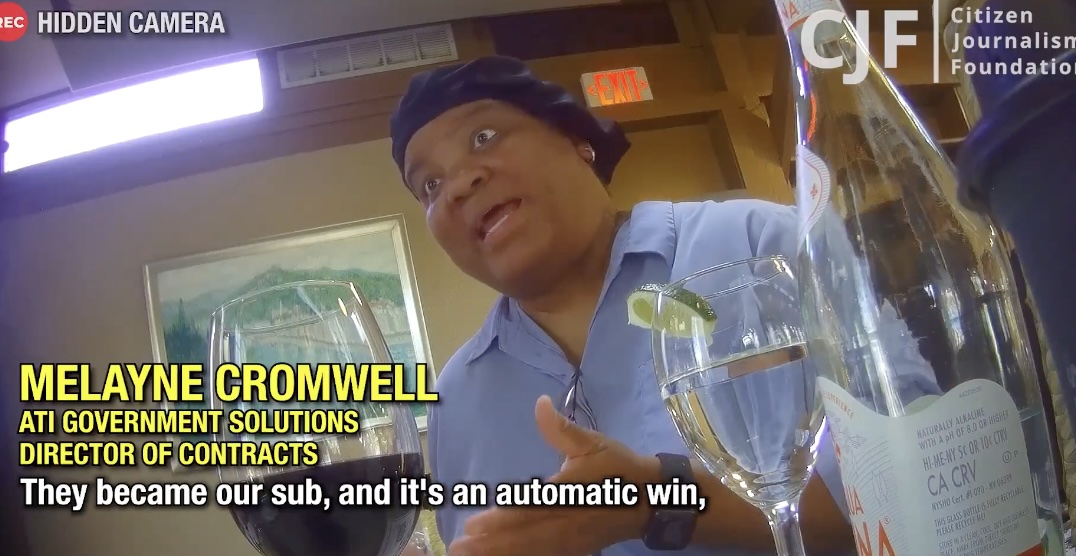
The issue reignited this month when O’Keefe Media Group released undercover footage showing executives from ATI Government Solutions, a tribal 8(a) firm, discussing how they used their “super 8(a)” status to secure no-bid federal contracts worth more than $100 million — including work with the IRS — while outsourcing as much as 80% of the labor to outside firms.
In the footage, ATI officials appeared to acknowledge exploiting the company’s ownership by the Susanville Indian Rancheria to win contracts reserved for disadvantaged firms. The scheme, investigators say, may violate federal acquisition rules requiring prime contractors to perform at least half the work themselves.
Within 24 hours of the exposé’s release, the SBA suspended ATI and its related entities from receiving new contracts, and three company executives were also suspended. The agency has since launched a formal debarment probe that could result in multimillion-dollar penalties and a permanent ban from federal contracting.
The investigation builds on a May 2025 Supreme Court decision, Kousisis v. United States, which held that misrepresenting eligibility in federal contracting programs constitutes wire fraud — a ruling now shaping enforcement efforts.
SBA’s ongoing audit has expanded since the ATI revelations, with particular focus on verifying ownership, affiliations, and subcontracting practices across the 8(a) portfolio. Officials warn that any misrepresentation may be treated as a total loss to the government under federal regulations.
The controversy has drawn bipartisan attention in Congress, where lawmakers are calling for transparency and program reform. Some have urged a Defense Department Inspector General review, given the heavy use of 8(a) contracts within the Pentagon.
Meanwhile, the broader political debate over “equity-based contracting” has intensified. The SBA quietly adjusted several 2025 small business goals, lowering certain disadvantaged business targets for agencies including the Department of Defense and the Veterans Affairs Department. Legislative proposals circulating on Capitol Hill would further tighten eligibility and oversight requirements.
Despite the turmoil, 8(a) awards reached a record $183 billion in fiscal year 2024 under President Joe Biden, a scale that critics say magnifies both the benefits and the risks of abuse.


5 thoughts on “Feds open investigation into waste, fraud, and abuse of 8(a) contracts for tribal groups”
This practice of 8a designated companies has been abused for years. I know of companies that have made their wives a 51% owner just so they can say they are a woman owned business.
It should be scrapped. Or……heavily reformed. And we know how that usually goes.
This has been a problem for decades, one I’ve seen first hand. My DW worked for two AKN corporations and I have spent years working with ANS and SW villages. SW is better, but parent corps: corrupt from the ground up.
Lisa (ie: Daddy’s Little Princess) is about to have a complete “MELTDOWN” over this!
Please come to AK and have a field day.
I’m shocked. Shocked to find that corruption is going on here.
I guess a whole bunch of extra money somehow attracts an occasional person that hopes to steal it. Never happened in the US before.