


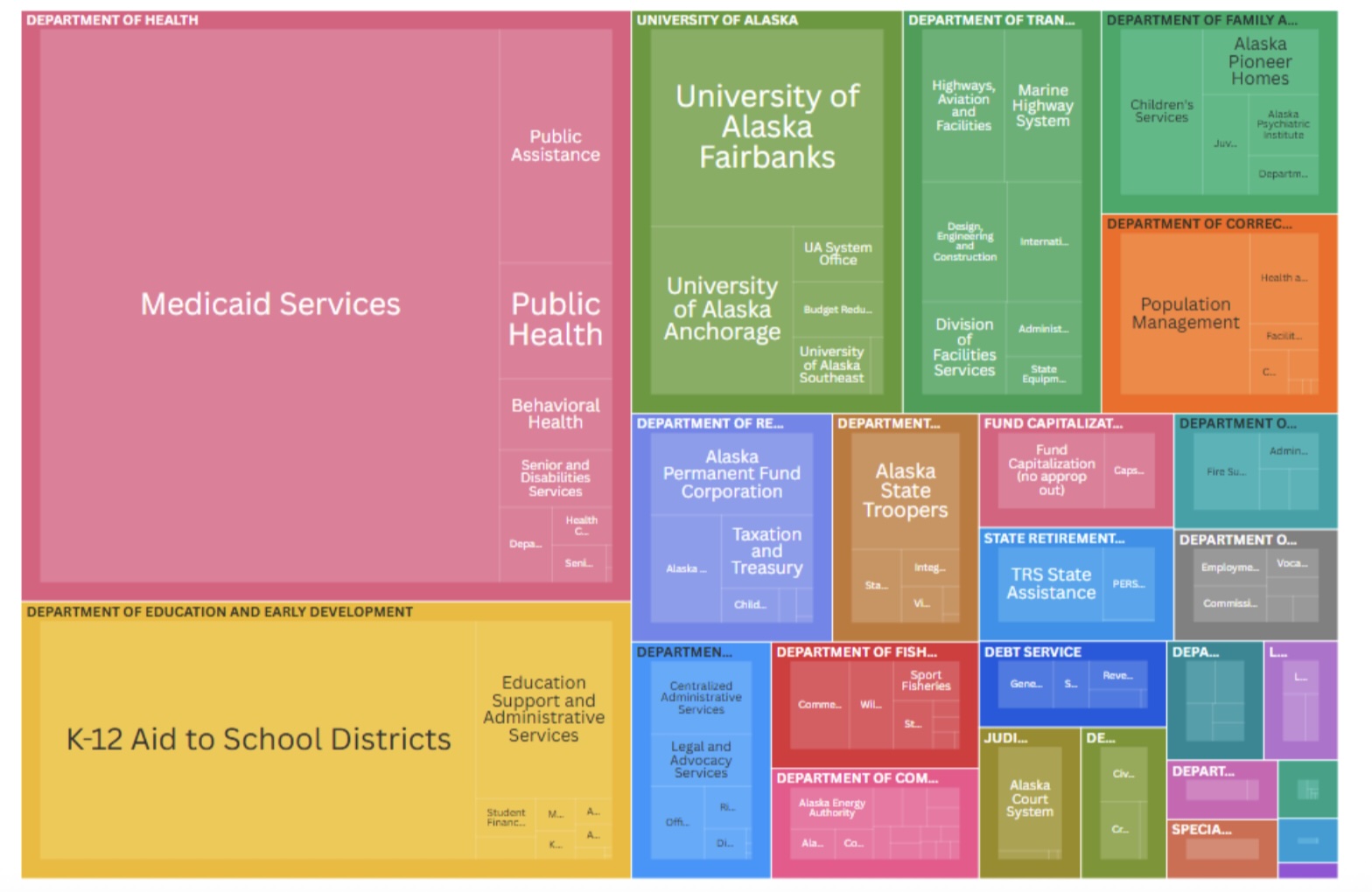
Gov. Mike Dunleavy released his proposed budget on Thursday, offering a no-surprises spending plan that mirrors last year’s approach and leans heavily on a strong Permanent Fund to offset weaker oil revenue.
Dunleavy’s proposed 2027 budget outlines close to $12.1 billion in spending across major state agencies, including healthcare and education, and once again incorporates a full statutory Permanent Fund Dividend, unlike what the Legislature has done in prior years. This year’s proposed payout would be $3,650 per eligible Alaskan and would set a new record, surpassing the $3,284 distributed in 2022 and far exceeding last year’s $1,000 check received by more than 600,000 residents.
But as always, the amount is far from final after a 2017 Alaska Supreme Court ruling affirmed that the PFD is simply another appropriation and that lawmakers may use it to balance the budget, and it remains subject to the governor’s veto, as it has since it was slashed by Gov. Bill Walker. Since 2017, the annual dividend has become a perennial political battleground that dominates nearly every conversation in the Legislature.
According to the Department of Revenue’s fall forecast, oil income will again come in lower, continuing a multi-year trend of diminished petroleum support for state operations.
But the Permanent Fund principal has grown to a record $87.3 billion, and because the state uses a percent-of-market-value draw to fund government, that larger balance means a bigger transfer into the general fund. The result is a maintenance-level budget that holds spending growth to roughly 1 percent — notable given the automatic increases in public-employee contracts and last year’s Legislature-approved boost for K–12 education.
As in every prior year, Dunleavy built a full Permanent Fund dividend into the budget. And as in every prior year, the numbers don’t quite pencil out. The Legislature is almost certain to trim the amount. Even with a statutory dividend included, the spending plan shows a deficit of about $1.5 billion, which would require cuts from a Legislature that seems determined to only spend more.
The governor is expected to unveil a broader fiscal plan in early January, outlining his preferred path toward long-term stability. Any such plan would likely rely on a full dividend and some form of new revenue to balance the books.
But with both the House and Senate run by Democrat-led coalitions, and with Dunleavy in his final year, it is far from clear whether lawmakers will be willing to assist him in crafting a legacy-defining fiscal fix. Democrats will want higher oil taxes,
One notable departure from past years was how the budget was presented. Although the rollout was due by Dec. 15, Dunleavy released it early, on Dec. 11 — and he did so without appearing before reporters. After seven years of often combative press conferences in which questions were framed to put him on the defensive, the governor opted instead to bypass traditional media entirely. He delivered his budget message by video, speaking directly to Alaskans and avoiding what he has come to view as the predictable filter of a hostile press corps.
With no reelection campaign ahead and little patience left for the usual theatrics, Dunleavy’s final budget reflects a governor finishing out his term with familiar priorities, familiar battles, and a fiscal landscape that remains as unsettled as ever.
Although in 2026, he will file a preliminary budget for the Legislature that convenes in 2027, the incoming governor will likely have amendments to that budget, just as Dunleavy had amendments to the budget he inherited from former Gov. Bill Walker, who he unseated in 2018.



2 thoughts on “Dunleavy’s final budget: No surprises, a statutory PFD, and a 10-year fiscal plan still in the works”
Dunleavy has been a good governor, we would be served well if he were to replace Murkowski.
Hmmmmmm. Not sure Donald J. Trump (or anyone else, for that matter), would give M.J. Dunleavy’s final State of Alaska an A plus, plus, plus, plus, plus rating. That, BTW, is how President Trump characterized the American economy.