



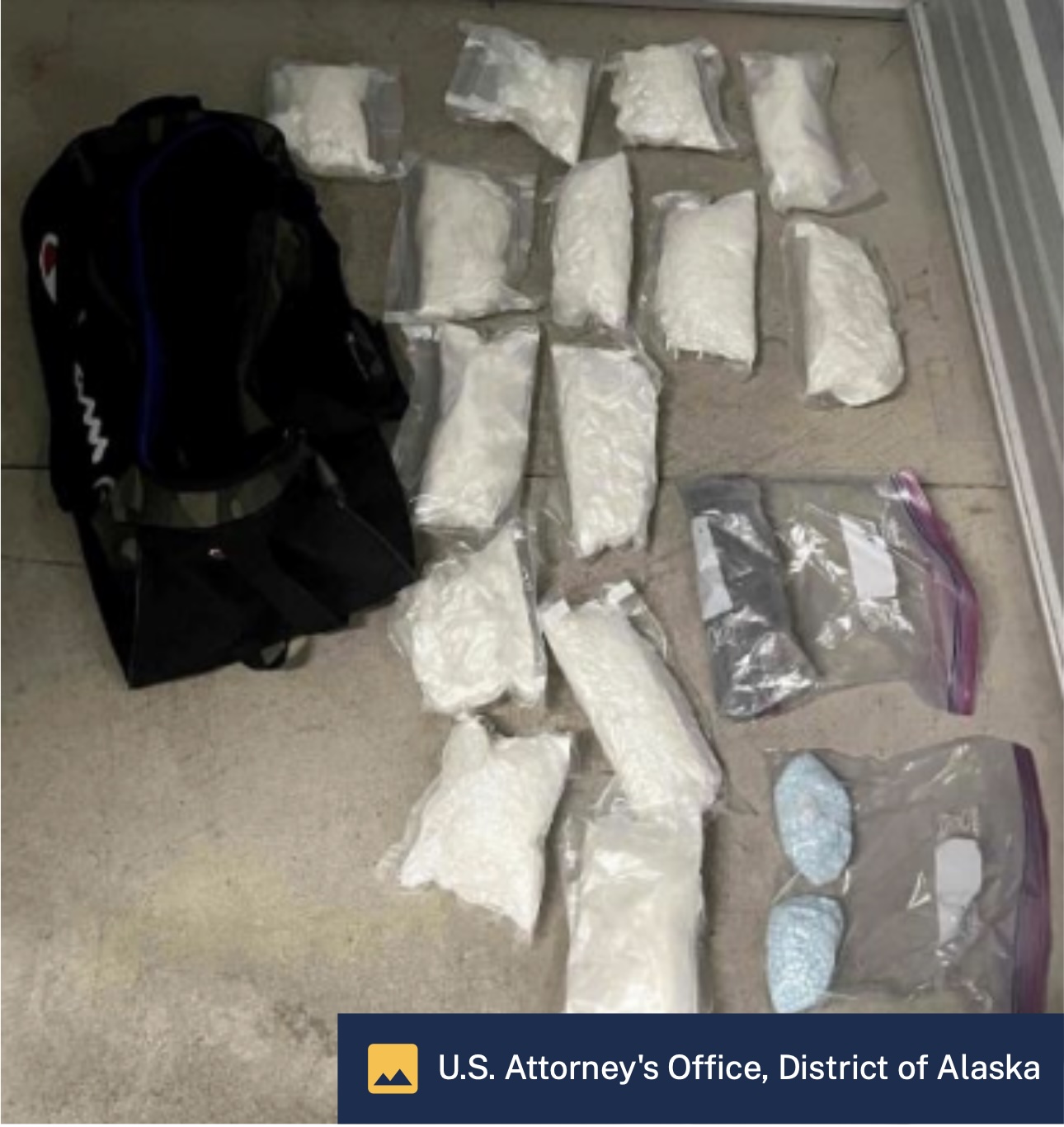
An Anchorage man with a vast criminal history will spend at least some of the next 15 years in federal prison after admitting to trafficking large quantities of fentanyl, heroin, methamphetamine and other illicit drugs, while armed, across the city.
Prosecutors said Thurman Reed, 67, repeatedly sold dangerous narcotics throughout early 2024. Court records show that in February of ’24, Reed sold about six grams of a fentanyl analogue and six grams of heroin. In March, he sold more than 27 grams of a methamphetamine mixture, followed a week later by a sale of over 49 grams of heroin. By May, his drug trafficking had escalated, with a sale of more than 311 grams of methamphetamine.
When FBI agents and Anchorage police searched Reed’s residence later that month, they found a backpack containing a firearm, distribution quantities of drugs and a digital scale. Investigators said Reed already had seven prior felony convictions at the time.
On Aug. 14, Reed pleaded guilty to possession of a controlled substance with intent to distribute and possession of a firearm in furtherance of a drug trafficking crime.
Federal and local investigators later recovered a far larger drug stockpile tied to Reed. During searches of his home and a storage unit, the FBI and Anchorage Police Department seized more than 10 kilograms of pure methamphetamine, 245 grams of fentanyl, 485 grams of heroin and 15 grams of cocaine.
Officials said the quantities involved and the scale of Reed’s narcotics operation put the public in great danger. They credited the FBI Anchorage Field Office, the Anchorage Police Department and the Anchorage High-Intensity Drug Trafficking Area Unit with dismantling the operation and bringing the case to prosecution.
But Reed has been at this for a long time. His rap sheet goes back to the last century.
Reed’s criminal history in Alaska spans more than three decades, and court records show that he once tried, unsuccessfully, to rescind a guilty plea in a federal drug and firearms case in the early 1990s.
In that case, Anchorage hotel staff had alerted police to suspected drug dealing out of Reed’s room at the Barratt Inn. A hotel manager entered the room with officers standing in the doorway, and while the officers did not ask him to search the room, they listened as he opened drawers and a latched briefcase belonging to Reed, finding what appeared to be drug-related items.
Reed sought to suppress the evidence, arguing the warrantless entry violated the Fourth Amendment. On appeal, the Ninth Circuit agreed the district court had erred in suggesting police could allow private citizens to conduct illegal searches while officers stood guard. The appellate panel said that reasoning conflicted with long-standing precedent and risked allowing police to sidestep the Constitution by delegating unlawful searches to civilians.
Even so, the court held that Reed’s conviction stood. After removing the tainted material from the search-warrant affidavit, judges found there was still ample independent evidence to support probable cause, including anonymous tips, Reed’s pattern of behavior at the hotel, and a drug-detecting dog’s alert on his vehicle. The valid portions of the warrant led to the discovery of firearms, cocaine and other contraband, and a subsequent arrest at the Anchor Arms Motel uncovered still more weapons and drugs.
Reed ultimately pleaded guilty in that case to multiple firearm and drug-distribution charges and was sentenced in 1992 to more than 12 years in federal prison. The Ninth Circuit affirmed both his conviction and his sentence, noting that his long record and the circumstances of his arrest supported the district court’s rulings.


3 thoughts on “Drug dealer with a past pleads guilty to trafficking large amounts of fentanyl, heroin, meth in Anchorage”
Maybe Trump will pardon him.
Why are foreigners commenting on our domestic politics?
why do you think I am a foreigner?