



By SUZANNE DOWNING
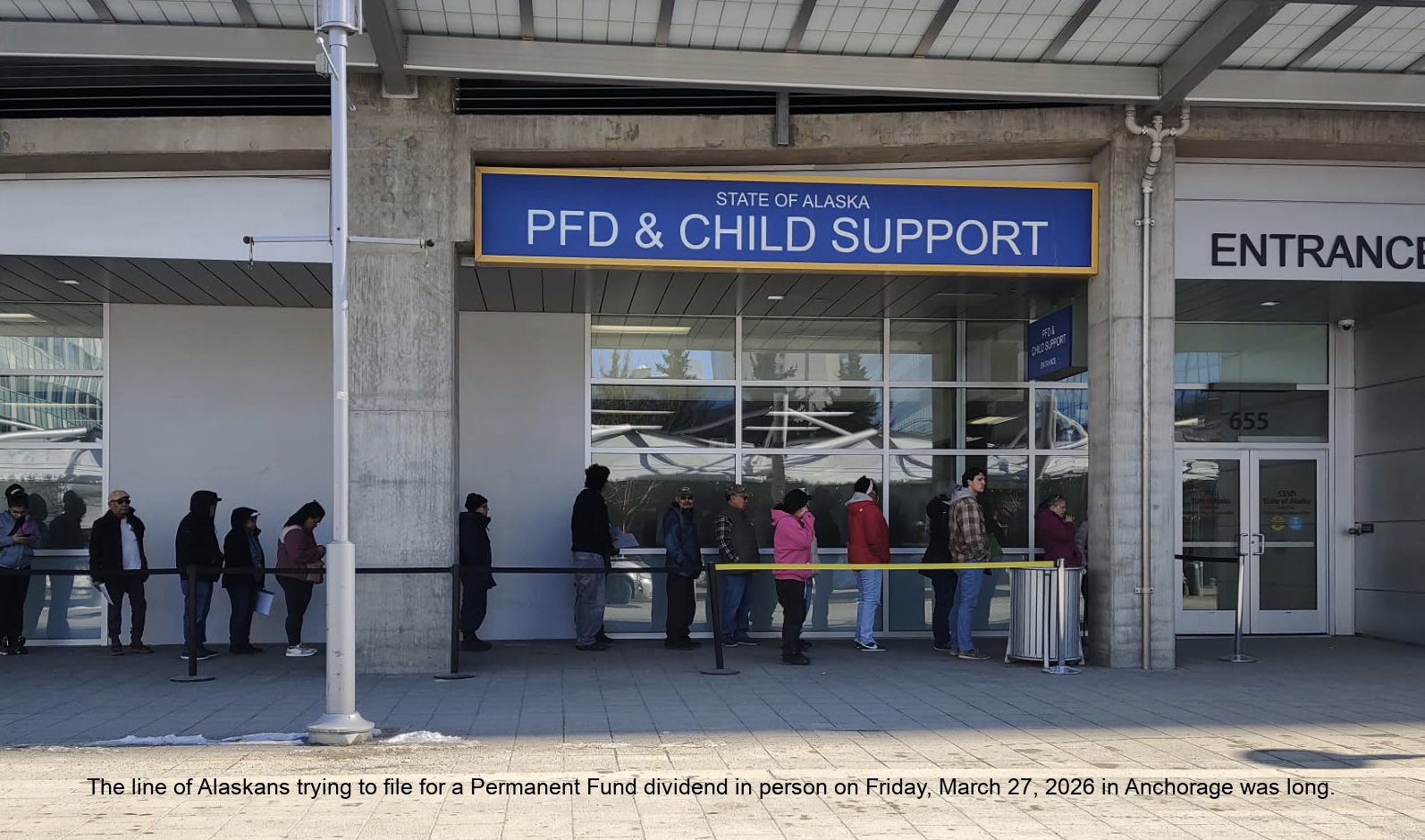
March 28, 2026 – There may be no appropriation yet for the Alaska Permanent Fund dividend this year, but for those eligible to receive one, a deadline is coming up fast. Alaskans who have not yet applied for the 2026 Permanent Fund dividend have only three days left to do so. The application period runs from Jan. 1 through March 31 each year, and late filings are generally denied without exception.
The Permanent Fund dividend is Alaskans’ share of oil royalties. The uniquely Alaska program was established by statute in 1980, signed into law by Gov. Jay Hammond, and is in recognition that Alaskans don’t have the ability to own subsurface rights to the land they own, so they should get a share of the oil wealth the state gets. Although the amount is supposed to be followed by a statutory formula each year, since Gov. Bill Walker vetoed half of the dividend in 2016, it’s been a crap shoot ever since. Alaskans now get what’s left over and what is politically safe for members of the Legislature.
The deadline comes as the Alaska Legislature has not yet set aside funding for this year’s dividend. Lawmakers are still working through the state budget, and while no money has been appropriated yet, the dividend amount and funding mechanism are typically finalized before the end of the legislative session. The amount has never been “zero” since the program was established.
For the current filing season, online applications must be submitted by 11:59 pm Alaska time on March 31. Paper applications must be postmarked by that same date, and in-person applications must be delivered to Permanent Fund Dividend offices in Anchorage, Fairbanks, or Juneau during business hours on March 31.
Missing the deadline means forfeiting eligibility for the 2026 dividend, even if an applicant otherwise qualifies. Supplemental documents can often be submitted later, but the initial application must be filed on time.
More than 552,700 applications have already been submitted this season, according to the PFD website.
Last year, 738,737 people applied for a dividend, and 618,863 dividends were paid; the amount last year was $1,000, the same amount that it was in 1982. The total amount to the treasury last year was $619.6 million.
Even without a finalized amount this year, eligible residents must still apply by March 31 to receive a payment, if one is approved.
Applicants must meet residency requirements and other eligibility standards, including intent to remain in Alaska and compliance with certain criminal disqualification rules. Filing on time does not guarantee approval; applications are verified after submission.
The application is available online through the state’s Permanent Fund Dividend website and can be completed by anyone who believes they meet eligibility requirements.
However, the PFD application does more than determine dividend eligibility. Since 2017, the process has also been tied to Alaska’s automatic voter registration system, which was created after voters approved Ballot Measure 1 in 2016.
During the PFD application process, applicants are asked questions related to voter registration. If an applicant does not opt out, their information is transmitted to the Alaska Division of Elections for potential registration or updates.
That data can include name, residence address, and date of birth. The Division of Elections then verifies eligibility, such as U.S. citizenship, age requirements, residency, and disqualification status. If the applicant is eligible and not already registered, the state begins the process of registering them to vote.
New registrants created through the PFD process are listed as “undeclared” voters unless they later choose a party affiliation.
The system also updates existing voter registrations. If an applicant lists a new residence address on the PFD application, that address may replace the one currently on file with the Division of Elections.
After the March 31 deadline, the Division of Elections sends notices to individuals who are not currently registered or whose address information differs from their existing voter record. Recipients have 30 days to opt out before the registration or update is finalized.
Those who do nothing are automatically registered or updated.
The process does not affect eligibility for the dividend itself. Applicants may opt out of voter registration and still receive their PFD if otherwise qualified, although opting out is difficult for many people.
The system is meant to increase voter participation by simplifying registration. However, some applicants may not realize their voter registration has been created or updated unless they read the notices carefully.
If a non-citizen receives a voter registration card in error, the Division of Elections ways they should contact the agency immediately to cancel the registration. This is somewhat the honor system.
Alaskans who applied for the 2026 PFD and whose information triggers a voter registration update may receive notices in the weeks following the March 31 deadline.



5 thoughts on “Deadline approaching: Alaskans have until March 31 to apply for Permanent Fund dividend”
The insatiable avarice of the teacher’s union, Native legislators and assorted NGOs will eventually kill the Permanent Fund dividend. We are almost there.
I wonder what the late Jay Hammond would say. While advocating for the PFD, he also did a great job of enabling the forces that will soon destroy it.
Fort Knox couldnt protect a nestegg the size of the fund from greedy politicians passing hands full of cash under the bar tables in Juneau who spend like drunken sailers. Dont be too critical of Hammond for enabling the theft. He at least tried.
THE HAMMOND DOCTRINE:ALASKA’S ORIGINAL CONTRACT WITH ITS PEOPLE
There was a time in Alaska when leadership spoke plainly—when the purpose of government was not to manage the people, but to serve them. That time was defined by Governor Jay Hammond, the architect of the Alaska Permanent Fund and the Permanent Fund Dividend. His vision was not merely economic policy. It was a constitutional doctrine.
And today, that doctrine has been forgotten.
Governor Hammond understood something that many in power now seem to ignore: Alaska’s natural resources do not belong to the government. They belong to the people. This is not political theory—it is constitutional mandate.
Article VIII of the Alaska Constitution requires that our resources be managed “for the maximum benefit of its people.” Hammond took that seriously. He did not interpret “maximum benefit” as government expansion, bureaucratic programs, or selective subsidies.
He understood it as something far more fundamental: Direct, equitable ownership by the people themselves.
He stated clearly that the Permanent Fund was meant to be a “People’s Portfolio,” and that every Alaskan should have a direct stake in it—not filtered through government priorities, but placed in their own hands. The dividend was not a handout. It was a structural safeguard. A check on power. Hammond warned what would happen without that safeguard:
“Without dividend recipients fending off invasion, the fund would long ago have been spent.”
That was not speculation. That was a warning.
He understood that governments, left unchecked, would spend resource wealth to satisfy short-term demands, political interests, and institutional growth—often at the expense of the very people the Constitution was written to protect.
He also made clear that the greatest threat was not scarcity, but mismanagement:
Politicians would “spend every windfall… only to find themselves in a world-of-hurt when oil wealth declined.”
What Hammond created was not just a fund—but a system of accountability:
The **Permanent Fund** to preserve wealth
The **Dividend** to distribute it equitably
The **People** as the final line of defense
This structure ensured that no government could quietly appropriate Alaska’s wealth without consequence. It created what Hammond called a “militant ring of dividend recipients”—citizens with both the incentive and the authority to protect what is rightfully theirs.
Today, that structure is under strain.
When dividends are reduced, diluted, or treated as expendable, the protective mechanism Hammond designed begins to fail. When decisions about resource wealth are made without transparency or accountability, the balance shifts—from the people to the system.
When public officials operate without enforceable safeguards—without true accountability—the risk is no longer theoretical.
It becomes systemic.The Hammond Doctrine reminds us of three simple truths:
First, Alaska’s resource wealth belongs to the people—not the government.
Second, the Permanent Fund exists to preserve that wealth for generations—not to serve as a political tool.
Third, the Dividend is not optional—it is the most direct and equitable expression of constitutional duty.
Hammond himself acknowledged that the battle to uphold these principles would never end. He warned that the constitutional mandate had been “largely ignored” even in his time.
That warning has not expired.
If anything, it has become more urgent.
Alaska now stands at a crossroads. We can continue down a path where resource wealth is increasingly controlled, directed, and diluted through systems that distance it from the people—or we can return to first principles.
Return to the Constitution.
Return to accountability.
Return to the understanding that the wealth of this land is not the property of institutions, but the birthright of its citizens.
The question is not whether the Hammond Doctrine still applies.
The question is whether we have the courage to enforce it.
**North to Alaska — First in Liberty, Last to Surrender.**
By Liberty Ed Martin Jr
“Where the Spirit of the Lord is, there is liberty.” — 2 Corinthians 3:17
Don’t blame only the D’s on this. All the R’s are trying to cut the budget either. If it wasn’t for the veto of the governor, our state would and still can become Los Alaska.
If there is one
If they didn’t not issue a dividend or its puny, it’ll make a very interesting Nov 2026 election it’ll be ANYONE’s race