




By DAVID BOYLE
In a previous article I wrote about how the Anchorage School District 3rd graders were losing ground in reading based on the AKSTAR summative assessment results. And the trend line is negative.
David Boyle: Anchorage School District goes wrong direction in reading proficiency
On the other hand, the other Big 5 (Kenai, Fairbanks, Juneau, and the MatSu) districts’ 3rd graders show positive results, and their trend lines are going in the right direction.
Unfortunately, board members asked very few questions regarding what is going on, why our 3rd graders are not improving, and whether we have implemented the Alaska Reads Act faithfully. The board failed to ask the “why” questions and failed to hold the administration accountable for the poor results.
The Teaching & Learning staff tended to use excuses. The T&L director said, “It’s important to keep this one test and its results in that category and not use as necessarily an overall look for how all of our students are doing and what we’re doing”. Translation: forget the results and trust us.
The staff said that it predicted that the AKSTAR results would have been about 9 points higher based on the fall and winter MAP test results. There was no reason given regarding the total disconnect between the two different test results and the board did not ask that question. Could it be that the teachers giving the MAP test were too lenient in their evaluation of the students? The MAP test should have forecast higher AKSTAR results in the spring.
Unbelievably, the T&L staff said, “We in our district have spent many years and a lot of time making sure that our teachers are very good at teaching phonics…and that’s showing because our kids our doing really well”. That seems to be a total disconnect to the presented data—AKSTAR results.
It makes one wonder how the staff can relate that statement to the results it presented when less than 30% of the 3rd grade students in 2025 were proficient in reading.
On cue, board member Lessens asked, “Do you see value in the revision of the Alaska Reads Act” to enhance the quality of instruction? The solution–it was pretty much agreed that the district needed more money to teach kids how to read.
Board member Holleman even questioned the cut-off scores for proficiency and non-proficiency. He implied that the cut-off scores were too high and should be lowered. Remember when the High School Exit Exam passing score was lowered to the 8th grade level so more students could pass and thus graduate? This is some of the same type of “strategic” thinking.
It makes one wonder if the high school graduates will be able to read their diplomas.
Andy Holleman then said, “I think it would be helpful if we could convey to the public that a student that’s not proficient (in reading) still has a fair amount of skill”. That is truly an amazing statement from a school board member. Why even have any metrics and why even teach reading? Why even have schools for that matter? What type of skills will they graduate with when they can’t read?
Then board member Pat Higgins, formerly from the Marshall Islands, blamed the low scores on teacher turnover and said, “We’re not competitive with the labor market.” It seems as if he supports the teachers’ union in demanding 15% salary increases. That should help 3rd grade students reach reading proficiency.
Board member Dave Donley drilled down and asked how the charter schools compared to the brick-and-mortar schools. He wanted to know if the charter students performed differently. The staff was very reluctant to answer his question. The T&E staff finally stated, “They (charter school students) did well but we typically don’t talk about individual schools”.
Anyone can go to the Department of Education & Early Development website and find the AKSTAR scores for every school.
Donley further pressed, “Did they do significantly better?” The staff answered, “No”. And that was that.
So, let’s look at those ASD schools that performed exceptionally well. Here are the 3rd grade reading proficiency rates:
| SCHOOL | 2023 | 2024 | 2025 |
| Eagle Academy Charter School | 79.2 | 81.0 | 76.0 |
| Aquarian Charter School | 77.6 | 64.2 | 65.5 |
| Birchwood ABC School | 31.3 | 30.0 | 53.9 |
| Northern Lights ABC School | 55.0 | 50.0 | 55.4 |
For comparison, here are the reading proficiency rates for all ASD 3rd grade students:
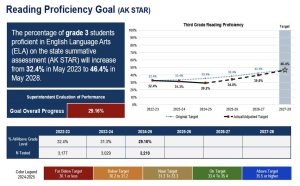
Note that the above charter and ABC schools nearly doubled the proficiency rates for all other ASD 3rdgrade students.
One must ask, “What are these four schools doing right and should we replicate those practices?”
Shouldn’t the ASD replicate the success of these four schools? Or are there other factors in play such as parental involvement, better teachers, more involved principals? And is the Alaska Reads Act being implemented with fidelity?
The board members should ask the district to investigate what the successful schools are doing correctly and replicate this success in all the elementary schools.
And this may be the worst part – more than 25% of ASD 3rd grade students are being promoted to 4th grade even though they cannot read at grade level.
Are many third-grade students being “socially promoted” instead of being literate?
It seems ASD has a new meaning for No Child Left Behind. Can’t read? No worries.
Our children deserve better.
We are tired of the excuses. ASD needs to take a good hard look at what it is NOT doing that the other four major school districts are doing.
The district needs to look at the successes and how to replicate them.
We keep giving the district more money and it keeps giving us the same results. It’s time for us to call the ASD out.
Go here to listen to the ASD School Board on 3rd grade reading proficiency.
David Boyle is a longtime Alaskan who writes on education topics for The Alaska Story.




6 thoughts on “David Boyle: Anchorage School District intentionally promotes students who cannot read”
I trust my Beagle guarding a,pot roast more than I’d trust the ASD. Especially the board
The failure of government schools and the grifting and corrupt teachers unions.
Eventually accountability swings back around onto the parents. They and soon their young adult children can’t blame the child’s poor education they received on Alaska Schools and teachers failures forever. God doesn’t listen to excuses and self pity.
Those few children who have parents reading to them before they could pick up a book, and parents who helped their child progress seamlessly through each child development stage; they are the examples of how all parents should be raising their child. At the end of the day’s end or that child’s 17th year your child is your own responsiblity.
It’s the parent’s job to had raised his sons and daughters to turn out responsible, accountable, productive adults for the family and community.
If the government schools want to help with a parent’s journey raising a responsible child then they can improve their schools, or if not, or if they want to continue giving a shotty education, then Alaska parents can quietly exit the school district and HOMESCHOOL.
I tell you one thing IF 75% of Alaska parents smarten up and homeschooled. Alaska Department of Education will change overnight!!!! You’ll see left to right radical education changes just to try to get those kids back enrolled at a neighborhood district to keep precious Union jobs.
For now they still have enough Alaskan kids just to keep the money flowing without needing to make changes in their structure. They don’t need to improve as long as they have the kids.
This is not news. The education bureaucracy in Alaska has been a disgrace for over 40-years. This is the proximate cause of the homeless symptom. Kids get lost in school; then derailed on drugs when they are unable to perform. They all get useless diplomas while most can’t even add up a column of numbers or write a proper sentence much less a paragraph. This is the demise of our culture. There is only one solution…. in one word: VOUCHERS!
More than disappointing reading achievements. Bet the know everything about gay/trans stuff though.:..