



By SUZANNE DOWNING
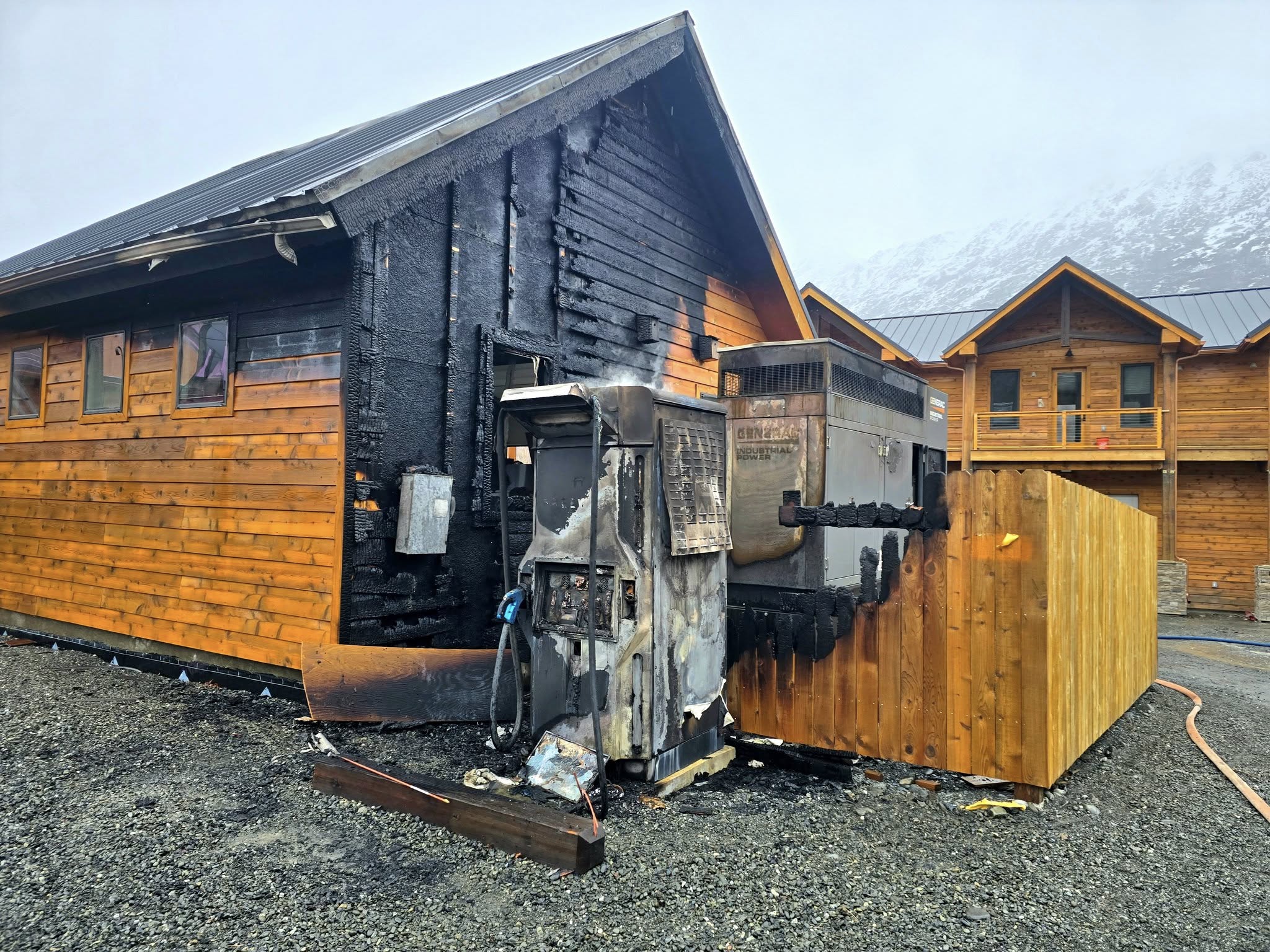
April 9, 2026 – A charred black wall, melted charging equipment, and a scorched wooden shed were the work of an electric vehicle charging station fire at Grizzly Ridge in Cooper Landing, a reminder that EV infrastructure is still new to Alaska, and perhaps a cautionary note about placing high-energy battery systems next to flammable structures.
If Alaska had 77 public EV charging locations before Wednesday, it might be fair to state that the number has dropped to 76.
The fire broke out around 8:15 am on April 8, involving a FreeWire rapid-discharge EV charger equipped with an integrated battery system, along with a generator on site. Flames spread to an attached shed before firefighters contained the blaze.
Cooper Landing Emergency Services, a largely volunteer department, served as the primary responder. Crews from Moose Pass and Seward provided mutual aid, while the Anchorage Fire Department dispatched a Hazmat-1 team at the request of the Alaska Department of Environmental Conservation. The Hazmat response focused on air and water quality monitoring due to the lithium-ion battery components involved in the charger.
By the afternoon, the fire had been fully extinguished. No injuries were reported.
In a statement posted to social media, Cooper Landing Emergency Services said crews responded to “an electric vehicle charging station fire with extension to a nearby structure,” noting that the Alaska State Fire Marshal was on scene and a hazmat team was requested “out of an abundance of caution to hopefully give our air quality a clean bill of health.” The department also said the DEC and EPA were assisting with resources.
The incident has been widely described as Alaska’s first known EV charging station fire. Lithium-ion battery systems, including those used in some rapid EV chargers, carry unique risks, including thermal runaway, where heat from one failing battery cell can cascade into others. These fires can be difficult to extinguish and sometimes require prolonged monitoring.
Cooper Landing Emergency Services covers hundreds of square miles of rural and mountainous terrain along more than 70 miles of highway corridors on the Kenai Peninsula. The nonprofit 501(c)(3) combination department operates with one part-time employee and roughly two dozen volunteers, responding to about 125 to 150 calls annually. The successful containment of Wednesday’s fire drew praise online for the volunteer team’s quick response in a remote area with specialized hazards.



3 thoughts on “Cooper Landing EV charging station fire leaves a mess, but no one injured”
Burn them all down. What a boondoggle “green energy” was. Many grifters got rich off of the taxpayers for no benefit.
I make a point of pointing and laughing every time I see some virtue-signaling leftist idiot sitting at a battery vehicle charging station.
This was a Freewire charger. To say they were unconventional would be an understatement. ‘Were’, not only because the charger is no longer with us, but because the company that made and supported it is no longer with us either. They went bankrupt in 2024, and when they did, they turned off this and all their other chargers. This charger hasn’t been in service for around two years, shortly after it was installed. The other reason it was unconventional is because it contained around 3,000 pounds of lithium batteries. No other roadside EV chargers contain batteries, they charge directly from the grid. There is only one other Freewire station in the state, at the Custom Seafoods on the Kenai Spur Highway in Soldotna. It too has been out of service for around two years.
As for the statistics… according to NFPA, there are over 4,000 gas station fires every year. Charging station fires? Uh… this one? NFPA doesn’t keep statistics on them. If you take out the arson fires set by democrats, and the fires caused by trying to charge damaged cars, I found one apparent arc flash at a Colorado hotel in 2025. As for the cars themselves… there are 1,500 fires per 100,000 gas powered vehicles per year. There are 25 fires per 100,000 EVs per year.