


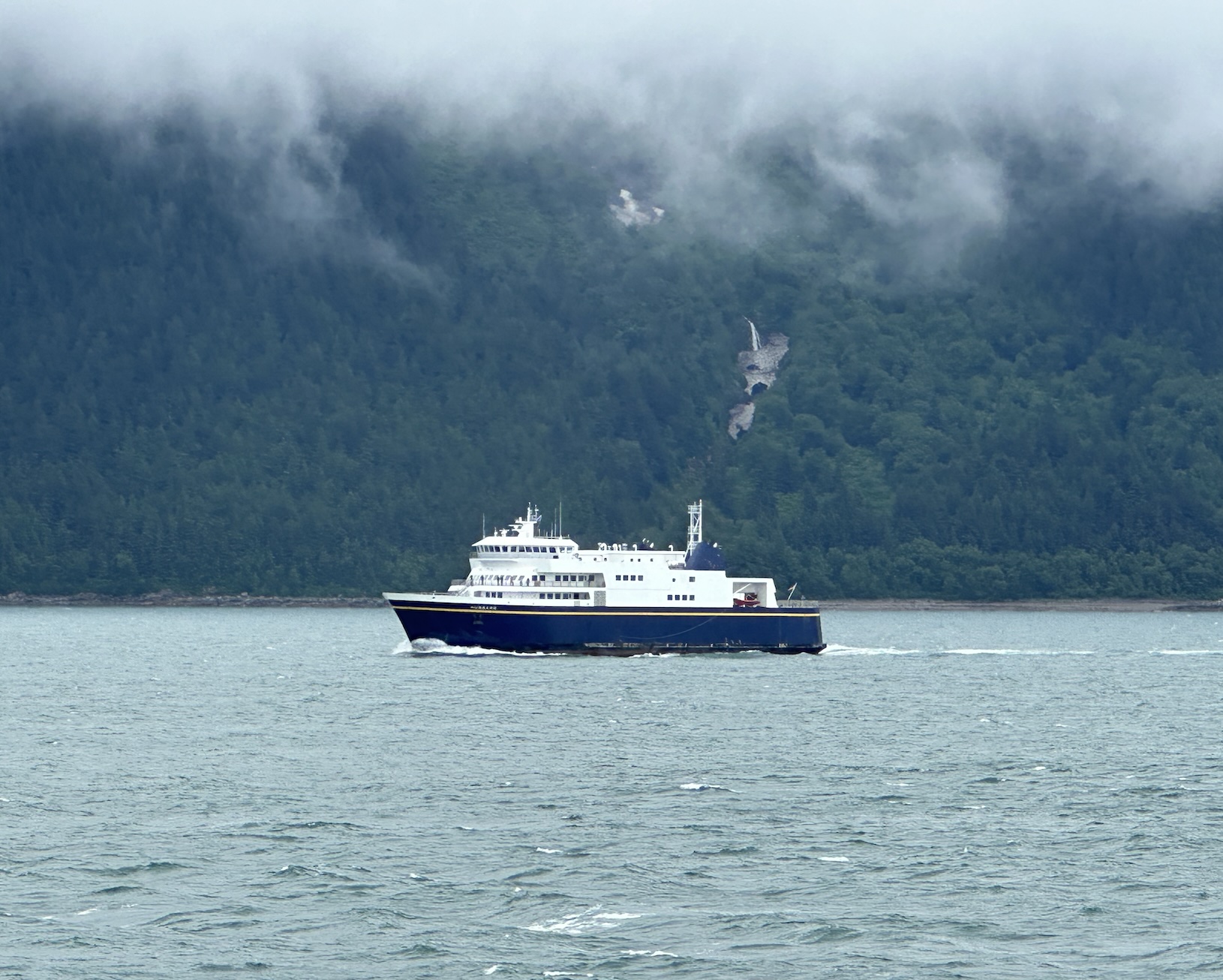
Public comments are now open on the proposed Cascade Point ferry terminal north of Juneau, but the clock is ticking.
The Alaska Department of Transportation and Public Facilities is taking input until Nov. 28, even as unions, environmental activists, and much of the mainstream media work to steer the narrative against one of the most cost-saving, efficiency-boosting reforms the ferry system has seen in decades.
But the case for Cascade Point is straightforward. Here are the points in favor of it:
Ferries aren’t meant to be long-run “cheapo Love Boats”
The Alaska Marine Highway System was never designed around overnight voyages staffed with full crews sleeping in bunks collecting overtime. The most successful ferry models — in Washington State, on the East Coast, and across the world — rely on shorter runs and longer roads. It’s a proven recipe: shorten marine miles, lengthen road miles, save money, improve reliability, and allow crew to work regular shifts and go home at night.
Cascade Point follows that same model. It’s the kind of modernization AMHS desperately needs if it is going to survive the next 20 years.
It saves enormous money and improves statewide connectivity
By moving the departure point from Auke Bay to Cascade Point, the ferry route to Haines and Skagway is two hours shorter round-trip. That means less fuel burn, fewer crew hours, and increased schedule reliability — all critical at a time when AMHS is struggling to recruit workers, keep vessels operational, and fulfill even basic seasonal service.
- The Cascade Point route shortens the Juneau–Haines crossing by 24 nautical miles,
cutting vessel run-time by more than three hours per day.
Saves approximately 117,000 gallons of marine diesel per year, reducing fuel costs by
about $550,000 annually and cutting 1,190 metric tons of CO₂ emissions - The “more road / shorter ferry” model is the most cost-effective AMHS modernization
strategy, reducing operating subsidies and extending system reach to more rural ports. - Fuel and labor efficiencies can be reallocated to improve frequency and reliability for
smaller Southeast and coastal Alaska communities.
A Cascade Point terminal would allow:
-
Juneau–Haines round-trip in reduced hours
-
Juneau–Skagway round-trip the next day
-
Regular, predictable schedules without needing overnight crews or berthing.
This is the kind of improved access the rest of Alaska needs, especially for people wanting to go to Juneau.
Operating costs drop. Fuel consumption drops. Crew fatigue drops. Reliability increases.
Anytime you are saving fuel, you are saving money — yet ironically the loudest opposition is coming from environmental groups and union representatives.
It supports real prosperity — not stagnation
If a community isn’t growing, it’s adrift. Cascade Point is a pro-prosperity project that enables mining, logistics, jobs, and private-sector investment.
Goldbelt, which owns the land, already hauls workers to the Kensington Mine and has said it will provide transportation from Juneau to the site – something that doesn’t exist at all at Auke Bay. The corporation is prepared to build:
-
The ferry terminal
-
A breakwater
-
A separate dock for Kensington mine crews
-
Potential commercial landing space
-
A staging area that could support future industrial and marine activity
This is not government expansion; this is a public-private partnership in real form.
And more development is coming. Grande Portage Resources, advancing the New Amalga gold project up the Herbert River, has signed an MOU with Goldbelt to move ore and supplies via Cascade Point. With more than $7.5 billion in proven gold in an accelerated permitting program, the economic significance is remarkable.
The mine will truck gold-bearing ore to Cascade Point and return inert rock to its pits, a tightly controlled and environmentally sound operation.
Thus, Cascade Point supports private investment.
It deploys scarce ferry dollars where ferries are actually required
Alaska’s ferry crews are aging, short-staffed, and stretched thin. Today’s workers don’t want to spend nights on board, away from families, sleeping in ship bunks. They want predictable shifts and to go home at night, and the Cascade Point model makes that possible.
Shorter runs mean fewer overnight requirements. That makes it easier to recruit workers in a competitive labor market. And it allows AMHS to reallocate staff and resources to places that will never have road access, such as Angoon, Cordova, or Kake.
Instead of burning millions on long, unnecessary marine miles, Alaska could stretch limited dollars to serve more communities more often.
Why the opposition? Look at the incentives.
Union leadership opposes Cascade Point because shorter runs mean fewer overnight shifts and less overtime. (Yet these same unions can’t recruit workers due to those very conditions.)
Environmental groups oppose it even though shorter routes burn dramatically less fuel.
And some members of the Alaska Marine Highway Operations Board, appointed from union designations and political factions, cling to the old model of “spend more and hope it fixes itself.” Many are the same critics attacking the economic report prepared by economist Ed King, hired by DOT, who produced a balanced analysis consistent with the AMHS 2045 Long-Range Plan.
The plan itself calls for:
-
Modernizing terminals
-
Standardizing assets
-
Reducing route lengths
-
Improving reliability
-
Enhancing community connections
Cascade Point checks every box.
This is not about being “rah-rah” for any side; it’s about math and common sense.
Right now, freight to Southeast is wildly inefficient. It can cost as much to ship hardware from Juneau to Skagway as it does from Anchorage to Skagway on Alaska Marine Lines. Shorter marine miles solve that too.
The Cascade Point project is the first uplands phase of a multi-stage terminal that includes:
-
A half-mile access road
-
A three-acre uplands pad
-
A retaining wall
-
A bridge over Cascade Creek
-
Culverts and drainage
-
Quarry activity to prepare armor rock for a future breakwater
Construction begins in Summer 2026, pending permits and public input.
Public comments close Nov. 28, and the Left is controlling the narrative
The people who use the ferry system, run businesses, ship goods, travel for medical care, and work in mining and tourism? Their voices are being drowned out by activists and their media friends who oppose any and all modernization.
If you support improving ferry reliability, reducing costs, and growing Southeast’s economy, now is the time to speak up.
Where to Send Comments
Email, fax, or mail comments by Friday, Nov. 28, 2025 to:
Greg Cvitash, Environmental Quality Manager
Michael L. Foster & Associates, Inc.
Email: gjc@mlfaalaska.com
Phone: (907) 696-6244

8 thoughts on “Cascade Point: The smart, shorter ferry route that can save the Alaska Marine Highway big bucks”
A Malaspina-class ferry has a dead weight of about 11.5-million pounds and carries about 80 vehicles. That means only about 3% of the total weight is the vehicles. Work-Energy-Force-Distance calculations show that 97% of the cost of moving the vessel is for its dead weight only. The arithmetic is quite obvious; we need to maximize the length of the road trip while minimizing that of the water trip. Any argument to the contrary, if scrutinized, will be revealed as serving the interests of a selfish faction.
I’m no skeptic but I have this to say: If it makes sense, it probably won’t happen.
The State of Alaska could save money if the Ferries were owned by a private company
Government makes a poor business owner
If Alaska wasn’t so locked up by the federal government and we won’t do government dependent. Juneau would have its road to the outside.
I bet many of those islands would be connected by a long distance bridge because other places have already built long distance bridges
This is the problem with Alaska. Though we are an Arctic state. The Arctic is opening up, Russia and China are advancing into it. Alaska should be a very well developed and advanced state. But we aren’t because of Government from its own locking us up but also our own government dependency
Weird that the author didn’t mention today’s estimated cost of the project. Pathetic that he suggests conservationists oppose it (despite alleged fuel savings) as if it’s the only concern. His employment title, Environmental Quality Manager is inaccurate. He’s a cheerleader, sort of like White House spin mistress Karoline Leavitt.
As a British Columbian where we have a similar coastal landscape and “ferry issues” and un-bridgeable fjords, I found your article about Alaskan highway vs ferry routes very interesting. In Norway there’s an extensive network of roads interconnecting with ferries but also long-distance hydrofoil routes (there’s no log debris in the waters there as clear-cutting ended centuries ago); attempts to use hydrofoils between Vancouver and Vancouver Island failed due to the debris problem; a new service – Hullo Ferries – is a high catamaran which avoids any ‘foils getting damaged by logs; in Norway, though, almost all ferries are electric or hybrid electric; as is their domestic air fleet.
There’s a question I have about how Alaska gets its oil to California. The leader of the Opposition rere in BC is claiming that Alaska uses its coastal waters for oil tankers from Valdez…. but surely you don’t use your Inside Passage for that – or do you? The waters off Prince Rupert and around Haida Gwaii are some of the most difficult on our coast so I can’t see Icy Strait and Clarence Strait being used for California-bound tankers.
From what I think is the case, Washington state’s then-governor Jay Inslee ended tanker traffic in the Strait of Juan de Fuca bound for Chery Point and Anacortes refineries a number of years ago; tankers head for California refineries I *think* would have to head offshore quite a ways to catch the Kuroshio Current before it splits off Oregon in order to ride if south to the Bay Area and beyond. Ou tanker ban is a big bone of contention for Albertans and BC’s Conservative Party who want it abolished to make Big Oil happy; But they never admit to the fact that processed petro products like gasoline and jet fuel are exempt from the ban; facts don’t matter when your head is stuck in the tar sands y’see. All our coastal and NW indigenous nations are dead-set against a new oil port on the North Coast; the same hedge fund behind Alaska LNG is the one advancing the Ksi Lisiims port near the mouth of the Nass.
How much are Alaskans aware of all this? And i’m sure you’ve heard that our federal government just announced funding for the Red Chris copper-gold mine inland from Wrangell – ?
there’s also been word that Alberta has a deal with Trump to build a rail line from Fort Nelson to Fairbanks; CN supposedly has exclusive rights for its terminus at Fort Nelson for such a line, but years ago the Dease Lake Extension, which was to end near Telegraph Creek on the Stikine, had not only the support of the the Nixon-Ford White House but also a readiness to pay for and build it.
I submit that a rai line closer to your Southeast is more amenable to Alaskans than a much more remote and longer one paralleling the Alaska Highway; the Fort Nelson line would not necessarily have passenger service but that was the biggest ‘sell’ for the Dease Lake Extension which could be connected by boat with Wrangell and Juneau, no?
I gotta go; my care aide’s here to put me to bed LOL but I look forward to any answers and comments.
Thank you Mike Cleven for all the points you bring up.
We really miss driving through BC – we drove through BC once or twice a year for over a decade.
We’d also love to see Haida Gwaii again, but imagine the beautiful BC ferries may be out of our price range now.
They were luxurious and pricey 15 years ago, but a lot of fun.
Without a ferry to Prince Rupert, it’s an almost impossible undertaking to get to BC from southern Southeast.
We’d happily settle for a ferry to Steward or Hyder!
The Alaska Marine Highway is our highway here in Southeast and we wish the funding and maintenance for it was treated like the federal highway it is.
Historically it was a big source of tourism revenue for the entire state – when it had all the amenities, stable schedules and enough boats.
For 20 years I’ve brought up the idea of Ferry Miles, like Alaska Airline miles. That’s what I’d have a credit card for – to accrue Ferry Miles.
The Alaska Marine Highway used to make revenue from carrying freight as well as passengers and vehicles.
Why can’t it do that again and give the barges a little competition?
We need the AMHS to have the capacity for long haul runs with full crews and MUCH better food. Last month we were told the ferry kitchens have to take what comes, all palletized directly from China.